

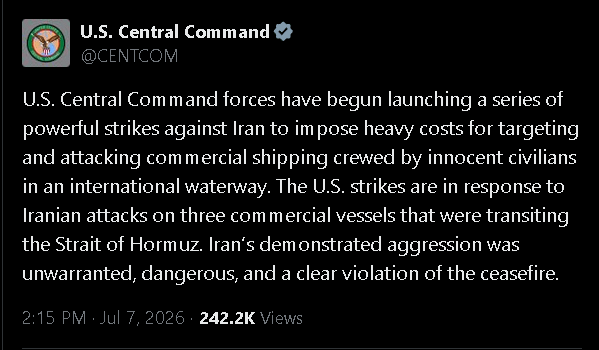
The United States Treasury Department revoked its waiver of sanctions on Iranian oil yesterday. CENTCOM reported strikes on “Iranian air defense systems, command and control networks, coastal radar sites, anti-ship missile capabilities, and more than 60 Islamic Revolutionary Guard Corps small boats in and near the strait to degrade Iran’s ability to continue attacking international commerce flowing through the international trade corridor.” Altogether, more than 80 targets were hit.
Iran was only just getting new interest in their oil when the IRGC renewed attacks on neutral shipping in the Strait of Hormuz. A Qatari LNG tanker was struck by a missile while using the ‘Omani route’. Traffic has nevertheless continued to transit the strait through Omani waters, often in pulses, with many ships turning off their AIS transponders during the transit.
As I have advised readers for weeks now, Iran lacks the military means to actually close down the strait. The IRGC do not have it in them to stop the US Navy and Air Force from doing whatever President Trump wants to do them. America can respond to provocations with disproportionate force. This dynamic is not changing.
The regime held a funeral for their supreme leader over the weekend. On Monday, Hamas dissolved their governing authority in Gaza, transferring their powers to something called the National Committee for the Administration of Gaza (NCAG), also known as the Technocrats Committee.
Hamas has not disarmed, nor should we confuse this with peacemaking. It is however a political capitulation in the war that Hamas began on 7 October 2023. Iran’s proxy is unable to govern the Gaza Strip and giving up on the project of administration altogether. Hamas is trading its political aims to better focus on being terrorists, which is what they do best.
For the IRGC, the diminution of one proxy is a calamity. Israel and Lebanon seem to have a tenuous agreement on disarming and demilitarizing Hezbollah, reducing a second IRGC proxy: catastrophe. Hamas would not have made this move without the blessings of the IRGC, however, so we can see this as a managed decline.
Understood as a rational actor, Iran’s leadership are steadily losing the ability to project power across the Middle East, making choices in the process, using the very public mourning event of Ayatollah Khamenei’s funeral procession as cover for a humiliating strategic retreat. The shooting last night is likewise a symptom of the regime’s inability to lose with grace.
To admit defeat is to admit that Allah is not on their side, which is impossible. From the outside, this can seem like a cultural strength that makes Iran impossible to defeat without a ground invasion on a historic scale. As evidenced by the political infighting over peacemaking authority in Iran, however, the impossibility of shaking hands with the Great Satan actually splits the regime into factionalism. Restricted resources under American blockade only increase internal tensions.
Time is not on the side of Iran’s resistance fantasy hardliners. They also cannot agree to a humiliating peace. They thought the MOU was their escape, but it turned out to be a trap. Americans have held hard lines, refusing to give over anything without performance from the Iranian side.
Put simply, the IRGC is not getting what they wanted, nor is the civilian triumvirate government getting what they promised their hardline opposition. Instead, the IRGC has lost power to close the strait, lost regional proxy power, lost leverage as negotiations continue.
They are losing, and they are mad about it.
When the protests flared up at the end of 2025, I suggested that the regime had reached a tipping point. Of ~90 million Iranians, perhaps 20 million are regime supporters. A water crisis, an inflation crisis, and a crisis of authority were all happening at once. The protests had a character that reminded me of 1979, and I said so.

After the first few days, I noted that the protests were centered in the bazaar, the ancient urban indoor malls of the country. This retail business community accounts for maybe 10 percent of the total national economy, but it has been on the winning side of every political upheaval in the history of Iran. At this point, I suggested the regime would be cooked unless it started slaughtering Iranians.
That is exactly what the regime did, of course. Sources vary, but tens of thousands of Iranians were reportedly killed in the gruesome violence that suppressed the street protests. In the meantime, I noted the emerging strategy of maritime dominance that had begun in Venezuela and would spread to Iran.

Donald Trump differs from recent past presidents in his unwillingness to endure frozen conflicts. Six days before the first Tomahawk strikes, it was obvious that he was on a warpath.

From the very first decapitation strikes to the deep penetrating bomb strikes on underground facilities, Iran’s air defense was immediately and entirely broken. They could not defend any point in the country throughout the kinetic phases of the conflict.

During Operation Epic Fury, the US and Israel had total air supremacy over Iran. This allowed the systematic destruction of key economic and military targets that had taken the regime many years, and many billions of dollars, to build. Damage to US real estate was limited to regional military bases that Trump was not keen to maintain forever, anyway.

As the supreme leadership went underground, rumors began to circulate about efforts to arm the Iranian Kurds. While the White House apparently nixed this idea, a series of attacks on the IRGC (and very convenient ‘accidents’) within Iran suggests that a low-key war has also been happening inside the country.

As OP Epic Fury began to affect payroll services for Iran’s regime, the Assembly of Experts dragged out a cardboard Mojtaba Khamenei and made it their supreme leader. Regime credibility hung by a thread. That situation has not improved.

By the middle of March, regime personnel were being targeted by individual strikes in the streets of the cities. Basij were observed hiding under overpasses. This ‘retail’ air campaign forced the regime to pursue a ceasefire. Operation Economic Fury began thereafter.

Mohammad-Bagher Ghalibaf, the speaker of the majlis, and his Foreign Minister, Abbas Araghchi, began negotiating with the Trump administration under this intense military pressure. Each side pursued an omnibus arrangement with opposing policy goals. This was to be a contest of wills in which time and pressure were against Iran.

Something definitely broke the will to fight of Trump’s negotiating partners in Iran. I suspect it was the Easter weekend battle to rescue an American pilot. A legion of ‘experts’ on frozen conflicts was very upset at Trump for unfreezing this one. Their credibility has suffered most in the wake of events since the ceasefire.

The United States still enjoys total military supremacy over the strait. Iran is talking tough today, writing verbal checks the IRGC is unable to cash. This keeps happening because it would be humiliating to admit their military capabilities have been greatly reduced.

The Europeans were of course buzzing mad the whole time. While the US Navy crushed Iran’s economy under a blockade, however, the naval weakness of European powers was on full display. American hegemony was not being diminished, it was being demonstrated.

As the blockade continued, the situation at the wellhead continued to deteriorate. Iran was running out of storage space for oil, and wellhead pressures were already being reduced, threatening decades-old wells with potentially permanent shutdown. Long-term economic damage to the regime was looming larger all the time.

Of course, there were still complaints about a lack of prior planning, as if the Pentagon can script a war in advance. All wars are extemporaneous. Good plans anticipate friction and leave room for adaptation to changed circumstances, for battle is chaos. A hyper-professional American force handed the chaos very well.

After Trump visited China in May, the writing was on the wall in Tehran. No help or intervention was coming from Beijing or Moscow. This is also when Trump began indicating the Iranian side had become serious about a settlement. Disbelief gave way to acceptance when it turned out he was right. During this period, Arab economic pressure on the regime proved decisive.

Then began a new phase in which Iran lashed out in frustration on a weekly basis while simultaneously negotiating the Memorandum of Understanding. This frenetic behavior derives from the factional nature of the regime in Iran. The IRGC does not want to admit defeat or surrender anything, but they lack the hard power to impose their will on anyone but random defenseless merchant ships.

By early June, when forecasts of permanent damage were supposed to be realized, the regime was clearly looking for a diplomatic alternative to the war it could not hope to win. Their potential leverage, including Hormuz, was declining all the time while the American blockade remained in effect.

The MoU did not end the controversy, of course. Its loose language fooled many people into expecting the Trump administration would capitulate, unfreeze assets, and restore capital flows without cooperation in return. The opposite has happened. Kinetic action has resumed without Iran getting any real benefits from the pause.

As I explained right after the MoU became public, any misunderstandings between the two sides would end up decided by hard power. The American side has the power to withhold assets until the Iranian side performs. The American side has the power to coerce the Iranian side with military force, whereas Tehran is struggling to make random Greek ship captains do what they want.

As I keep stressing, there are sure to be more episodes of violence. Iran will make announcements, strike civilian shipping, and put their ‘resistance’ on global display, if necessary through absurd propaganda devices, throughout their intermittent rounds of diplomacy. They do it this way because surrender is not an option, even when it is the only option.

Iran responded to the airstrikes with attacks on Bahrain and Kuwait. “For me? The ceasefire is over” Trump declared at the NATO Summit in Ankara last night. “I don’t want to deal with them anymore. They’re scum. They’re sick people. They’re led by sick people. And they’re vicious, violent people.”
“It’s just a waste of time dealing with them. They’re liars”, Trump said, comparing the regime in Tehran to cancer. “And you know what you do with cancer? You cut this cancer out early.” The Pentagon says the blockade will now be restored, and made even tighter than before, with daily airstrikes just to drive the point home that Iran will never win. Continued resistance is just a different way to lose.
The Pessimists Have Been Wrong About Iran

Iran is still in crisis. The economy remains devastated. Millions are unemployed. Oil prices have collapsed below pre-war levels, creating a market glut, and nobody is lining up to buy their oil. Because who wants to trade with a lunatic …