
Strait Flush: US Navy Holds All The Cards In Hormuz, Iran Loses All Maritime Leverage
The most dangerous operation coincided with the ceasefire to minimize risk
Vice President J.D. Vance left Pakistan without a deal. This was predictable, for he is the grinder, whereas Marco Rubio is the closer in the Trump administration. Vladimir Putin similarly uses Vladimir Medinsky, his minister of culture, for 21-hour diplomatic haggling sessions, then sends Sergey Lavrov to close a deal when the other side is serious about his terms. The act is not original.
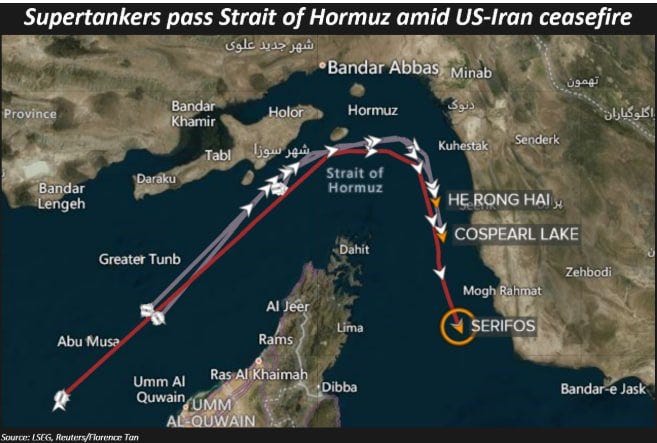
Like the classic ‘good cop/bad cop’ routine, this hostile negotiating tactic takes place in stages. Similarly, military campaigns unfold in stages. The two sequences can coincide. While the negotiations were happening, Adm. Bradley Cooper, head of CENTCOM, announced that the US Navy had cleared a navigation channel through the Strait of Hormuz. Two destroyers transited the strait and subsea drones (USVs) began looking for any remaining mines laid by Iranian forces.
While the regime has claimed they cannot find some of their own mines, this may in fact be yet another propaganda success by Tehran using western press to amplify their narratives. They wish the world would fear their mines. In fact, it is unclear that Iran has left any mines in the strait at all. I suspect this story is fake. True or false, it is a desperate bid for attention. Iran simply has less power to threaten commerce in the strait right now than American forces, which have total air and sea supremacy.
“Effective immediately, the United States Navy, the Finest in the World, will begin the process of BLOCKADING any and all Ships trying to enter, or leave, the Strait of Hormuz”, President Trump announced on Sunday. For once, he has spoken in the legalistic language of the international law experts. The word ‘blockade’ has a precise meaning they can now quibble over.
“The blockade will be enforced impartially against vessels of all nations entering or departing Iranian ports and coastal areas, including all Iranian ports on the Arabian Gulf and Gulf of Oman” reads an announcement from CENTCOM. Iran is sole subject of the blockade, as “forces will not impede freedom of navigation for vessels transiting the Strait of Hormuz to and from non-Iranian ports.”
Ceasefire negotiations began at the same moment the Iranian side was losing their single biggest point of leverage, so that the IRGC ended the negotiations weaker than they have ever been. When the talks ended without a deal — which was predictable, if we are honest — Trump imposed a blockade that Iran has no means to break. The US Navy now controls all movement through the strait and the IRGC is trying to pretend the strait is open to “harmless passage of civilian vessels”.
The shoe is on the other foot.
Iran has lost their single greatest source of strategic leverage. Iran will not be allowed to collect tolls on traffic, Trump says: “No one who pays an illegal toll will have safe passage on the high seas.” The Emiratis too say they will punish French and British vessels that have paid a toll to Iranians for passage, and thanks to this crisis, no one seriously believes any threats that Emmanuel Macron or Keir Starmer might make against the UAE. They have exposed themselves to the Arabs in this exchange. consequences shall ensue.
Mohammad-Bagher Ghalibaf was afraid to even take pictures with J.D. Vance in Pakistan for fear his own radicals will kill him. Ghalibaf enjoys the weakest bargaining position imaginable, right now, standing between the Great Satan and the deep blue IRGC. Yet it is this militant core of the regime, the Republican Guard, who must face reality, now, because their ‘shadow economy’ is at supreme risk under blockade. Ghalibaf returns to Tehran with increasing leverage over the IRGC, and that is a sea change in the internal power dynamics of Iran.
Securing the strait under fire, let alone enforcing a blockade under fire, would have carried tremendous risks for the US Navy. Instead of forcing their way through like Churchill in the Dardanelles, or conducting a close blockade in range of the shores, the Trump administration made their most dangerous move at the precise moment when the risk to sailors, ships, and mission success was as low as possible.
This phase was preceded by intense, higher-risk phases of action against Iran’s material means to close the strait. Trump and Pete Hegseth are not just beating their chests when they repeatedly announce that Iran has no navy or air force left. Hegseth is describing his actual accomplishments as Secretary of War, and Trump is leveraging the negotiation for a successful conclusion of that war.
Iran was never able to entirely close the strait, anyway. On Saturday alone, at least 16 vessels passed through, an uptick from the daily average of 10 during the 38-day campaign. Americans secured the strait, and the possibility of peace, through superior firepower. Now comes the part where they strangle the Republican Guard. I have told premium subscribers to expect this moment since January. I have also been saying that Iran is part of a larger plan.
Economic war at the end of effective kinetic action produces different effects than the opposite sequence. The IRGC built an entire underground antiship missile manufacturing facility near Dezful to threaten traffic in the strait in the event of war. The complex is now closed for business by GBU-57 Massive Ordnance Penetrator bombs dropped from B-2 bombers. Iranians might dig the tunnels out again, but the IRGC will have to pay someone money to do the digging, and that will be much harder without their ‘resistance economy’ paying the bills.
The net effect of this sequence is a far more expensive rebuilding process. Starving the economy of Iran through sanctions first made it more expensive to build in the first place, but did not stop it from being built. Now the IRGC must weigh their costs and priorities for an overstretched construction budget.
US and Israeli power systematically stripped the IRGC of the means to intervene in the strait. Both the IRIS Shahid Mahdavi and her sister “drone carrier,” Shahid Bagheri, are destroyed. All of the boats that IRGC might use to lay mines are destroyed. These were capital projects that would have to be rebuilt with resources the Republican Guard no longer has, through maritime trade that is now blocked.
Think of all the oil infrastructure that cannot be repaired without imports, now, and the true depth of risk for the IRGC becomes a little easier to imagine. Who needs to invade Kharg Island, or blow it up, when you can just stop any tankers that leave Kharg Island from ever reaching their destinations?
Over 90 percent of Iran’s seaborne trade transits the strait. By importing fuel precursors for missiles, electronics for drones, as well as half the black market consumer goods that reach Iran, the IRGC remained dependent on seaborne supply chains for military and economic sustainment. It was always a militarily weak force, unable to project power except through proxies, which is why IRGC built up its long-range strike capabilities to compensate.
Overland smuggling is certainly possible, indeed it already happens, but it is far more expensive than shipping containers at sea. This strategic vulnerability has always existed and been understood, just like the vulnerability of the strait to Iranian closure has always been an element of war planning for the Gulf. Miad Maleki, a self-described “sanctions nerd” at the Foundation for Defense of Democracies, writes that a “naval blockade imposes ~$435M/day in combined economic damage” on Iran.
The IRGC war plan assumed the Arab street would rise up and force the Gulf states to stop the Americans once missiles and drones began to explode. Instead, the IRGC has managed to make every single regional neighbor despise them, and the Arab street is quietly relieved that Iranian colonization of their politics, societies, and economies seems to be ending. Jihad has exhausted its political potency before our eyes.
Meanwhile, markets have shifted. The Saudis have restored the Red Sea pipeline to full capacity and the tanker trackers all report a stream of vessels inbound for the US Gulf coast. Call it cunning, if you must characterize it, but admit the administration thought their way through the problem. Everyone who said it couldn’t and wouldn’t be done is wrong. Everyone who said there was no plan, then said the plan would not work, then said the plan had already failed, is wrong. Everyone who took Trump literally instead of seriously is wrong.
The Strait of Hormuz is both opened and less relevant than it was before. Cui bono? Iran’s ‘closure’ of the strait was never real and never complete, more a crisis of convenience than a real emergency. It did not occur to altogether too many people with too high a platform that Donald Trump found the closure of Hormuz convenient, too. (“No one could have seen it coming”, he said, and then the usual suspects took him literally instead of seriously again.)
Who has felt the heat? Closure has been inconvenient to Paris, London, and Beijing, mariners, and refineries throughout the Asian littoral, South, Southeast, and Far East. Gasoline prices have spiked in the USA, a sacrifice Trump was willing to make months before the midterm, so that markets have time to correct.
Now watch the commentariat chew their sour grapes in astonishment. Goodbye, IRGC. Goodbye, regional proxies. Goodbye, revolutionary regime, and goodbye to all the Arab relationships that sustained the tensions of the Middle East. Demining the strait is in fact a terrific synecdoche of the current operational phase, a metaphor in which one part symbolizes the whole, like referring to ships as “sails” or “hulls”. The Trump administration is effectively demining the Middle East. If the end result is a more peaceful region, he is going to be insufferable about Nobel prizes.

This is economic war without sanctions, a policy option which Trump sees as part of the ‘frozen conflict’ problem that he is resolving through action. He is departing from more than a century of western security policy wisdom in which economic warfare through sanction regimes has been a substitute for military action. This formula leads to frozen conflict, in Trump’s view. Instead, he threatens to issue sanctions against countries that sell weapons to Iran.
The ‘gray zones’ are disappearing from the map. Venezuela went first. After Iran, Havana. After Havana, Russia and China will no longer have the means to tie down American power and policy in a strategic confrontation with the United States. A maritime energy blockade would then put absolute limits on Chinese aggression in the Taiwan Strait. Trump could very well find himself meeting new Russian leadership, after Havana, and then we can all laugh at everyone who told us that he was a Kremlin agent in a sinister plan to conquer Ukraine.
None of his enemies, foreign or domestic, can seem to predict Trump’s actions correctly. His words confuse and alarm them. They call him all sorts of things, some of which may even be true, but it does not stop Trump from succeeding after his war has been pronounced a failure eleven times.
Who could have foreseen America’s Gulf coast refineries nearly maxed out to meet the surge of market demand for Hormuz-free petroleum products? Maybe Trump, who has consistently promoted American energy exports at the expense of Russia and now Iran. His detractors will tell us this is a complete accident, that Donald Trump is just the luckiest man alive, so that things keep working out the way he wanted.
If that is true, then it makes no sense to bet against him, and yet they always do. Some enemy of Trump should try an experiment in which they refuse to underestimate him, and see what happens. Really — someone do this for science. Be the control group.
Vice President Vance has delivered the message: this is a leveraged buyout, not a haggling session at the bazaar over each individual carpet Trump wants. When Ghalibaf and his associates are serious about a deal, one that comes to terms with Iran’s military defeat, Rubio will come to meet them, and not in Pakistan.
Transformation of the regime will continue in the meanwhile. IRGC leadership and personnel, ‘shadow/resistance economy’ infrastructure, and Basij checkpoints have all been targeted before, and this campaign may return. Iraqi militias now deployed in service of the regime are also subject to destruction whenever the United States wants to target them. This tracking video of American military air traffic en route to the Middle East overnight suggests the hour of resumed hostilities is close at hand at the time I am publishing.
We should note that the ‘failed’ ceasefire also resets the 60-day window of constitutional authority for Trump and Hegseth to act without Congress. A fly on the wall might tell us that J.D. Vance explained all this to the speaker of the majlis, Mohammad-Bagher Ghalibaf, in Islamabad.
Hegseth’s Pentagon is the most lethal ever seen, and allied to the IDF. Their combined precision is capable of finding and killing the top three layers of IRGC command while leaving the civilian leadership, as well as the regular armed forces leadership, alone. The coalition treats the IRGC correctly as the actual cancer in the constitutional system of Iran. Its destruction always would have required some amount of destabilizing action.
Sometimes, a little instability is a good thing. It leads to overdue changes and accelerates the arbitrage of decline. Iran lasted just 38 days before the ceasefire. I do not think the IRGC can last another 60 days under fire. Chaos unfroze the frozen conflict, and many things were clarified.
We saw that the clerics are not really in charge of Iran. We saw that Iran, in truth a militarily weak state, could not keep the strait closed in word or in fact, even though the IRGC paramilitary has been allowed to run rampant in the country. Arabs got mad at Iran instead of exploding in rage at Israel and America. Energy markets adjusted to the crisis by rerouting infrastructure or purchasing American products. We were promised World War III, a draft, and a beach invasion. Instead, we have seen the entire strategy of Iran, as well as its defenders in the West, collapse.


Matt, I’m late to your discussion, if the clerics are/were not in charge of Iran, who is/was?