
Iran's Revolutionary Regime Is Finally Going To Find Out After 47 Years Of Fu*king Around
Why you should be very, very excited. I for one am very excited
Donald Trump has signaled repeatedly that he wants to do regime change peacefully in Iran. He positioned powerful forces (“a massive armada”) in the region, which took time while the regime suppressed the uprising with 38,000 murders. “We have a lot of very big, very powerful ships sailing to Iran right now, and it would be great if we didn’t have to use them”, Trump told reporters two weeks ago. Now it appears this patience is running out.
Regional allies are leery of war with Iran, which can do them significant retaliatory damage and would deplete interceptor missile stockpiles that may not been refilled since the 12-Day War. By last Friday, “over 120 U.S. military logistics flights [had] arrived [in] the region, including C-17s, C-5s, C-130s, KC-135s, and KC-46s” carrying air defense material and other equipment. The supply streams have not let up. Every available refueler was surged to the region by Wednesday while F-22s deployed to forward areas. At the time of this writing, over 220 fighter aircraft are reportedly in the Gulf. It is the biggest redistribution of American combat power since 2003 — and the culmination of a war that has been waged almost exclusively against the United States since 1979.
Trump clearly preferred coercion without a shooting war. He wanted “to exploit Iran’s weakened position to coerce strategic concessions — not only on the nuclear and missile programs, but also on Tehran’s regional proxy activity.” Tariff threats against countries doing business with Iran underline the macroeconomic bias in his national security policy. He has raised leverage in order to force a deal while Tehran is at their weakest. The approach comes with risks. Trump has made a threat, and he must follow through to maintain his own credibility. While it is impossible for the regime to call upon the hearts and minds of the masses right now, the elites are themselves fractured, and could unite against foreign aggression, making a negotiated outcome harder — or so goes the argument against action.
Trump asked Israel for help, and in the Spartan tradition of sending one man instead of an army, the Israelis sent their intelligence chief to Washington. Meanwhile, talks continued, though without any breakthrough. Iran made it clear they are very far from a deal this week. Benjamin Netanyahu visited the White House last Tuesday evening. Afterwards, Trump made it very clear Iran was the center of discussion. This week, the IDF struck Hezbollah command and control as well as rocket sites to pre-empt IRGC counterattacks on Israel from the north. The time for negotiations has clearly passed and the opening salvoes of the war have already been fired.
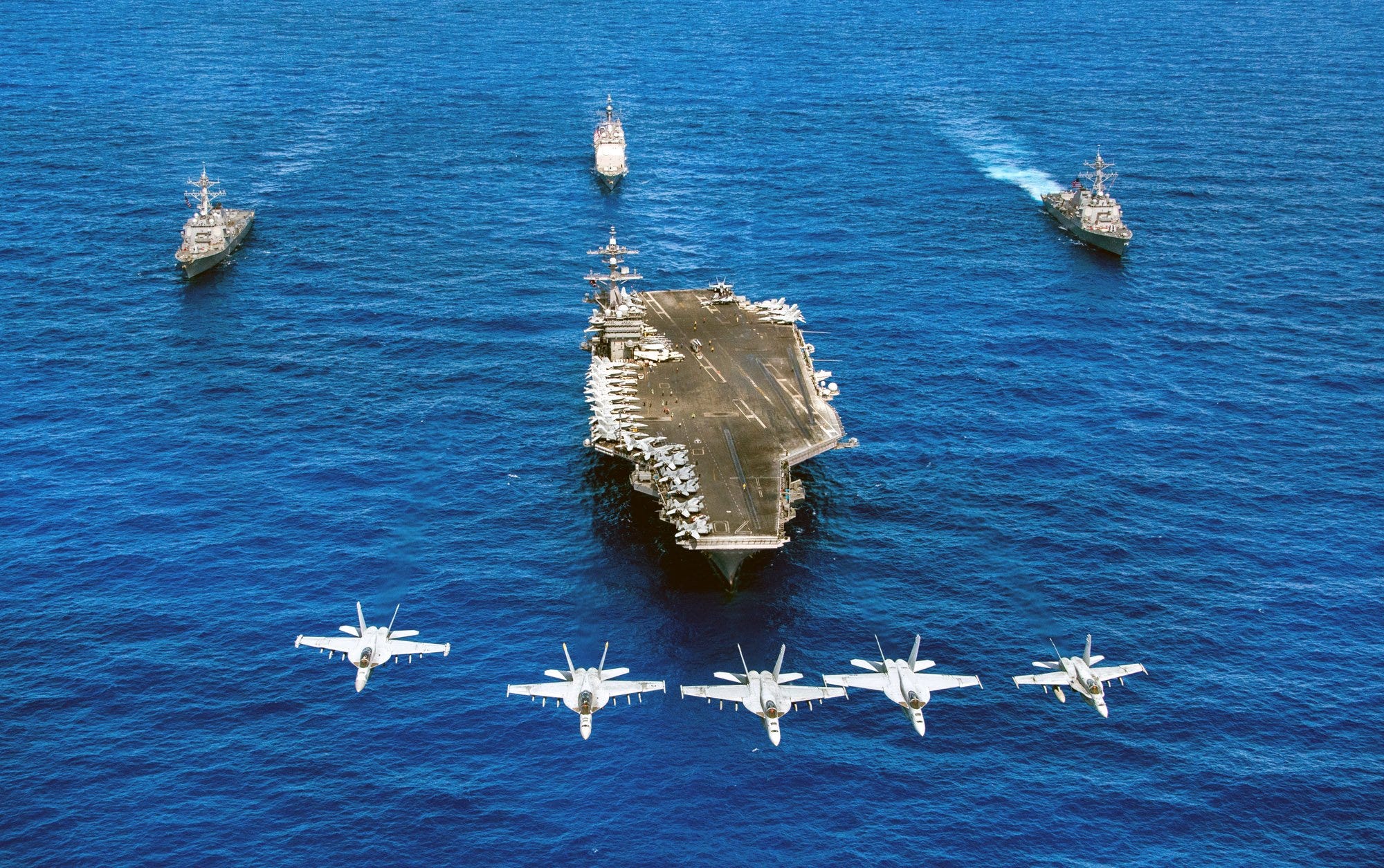
Regime change “could be the best thing” for Iran, Trump said, ordering a second aircraft carrier, the USS Gerald R. Ford, to the Middle East, doubling the strike power of the Abraham Lincoln battle group now in the Arabian Sea. The Gerald R. Ford was involved in the lightning operation to seize Nicolás Maduro in Venezuela. But Iran is not Venezuela, and some doubt a regime change is even possible with any number of airstrikes. Resistance to war from Democrats associated with the National Iranian American Council has increased in proportion to military preparations. Let us be blunt: Iran was always the happy foil to Israel in their project to destroy the Middle East with kindness, and the CCP does not want to lose access to Iranian oil, so their ideological diaspora opposes intervention.
It has become commonplace by now to observe that the same people who scream loudest about human rights in other times have emerged as open supporters of the regime which just killed nearly 30-40,000 Iranians, often in ways and circumstances as horrific as the atrocities of 7 October 2023. Whereas Trump and Iran both stalled the march to war for a while in order to prepare for battle, this process has also given Alexandria Ocasio-Cortez a chance to show us why she stumbles over questions about defending Taiwan. She fundamentally does not believe in the efficacy of force. In her mind, the Pentagon exists to create social equity. A person with those values will of course treat the IRGC and Basij as poor, defenseless innocents being bullied.
While some number of added troops are necessary in the region, no invasion of Iran appears to be on the horizon. Nor is that even necessary. Yesterday, students demonstrated again at the universities in Tehran and Mashhad, chanting “Death to Khamenei” and “Freedom” and vowing to “finish the job” when the United States strikes the regime. Occupation will be unnecessary because Iranians are a people who feel occupied by their regime, right now. After so much slaughter, there will be no ‘rally around the flag’ effect. The masses are quite prepared to bleed again if they think the regime is weak enough.
This is of course why US Special Forces have been smuggling Starlink equipment into Iran for weeks now. When I first identified one easy set of IRGC economic targets in January, the regime had still not committed its bloody crackdown, yet. Now the circumstances have changed, and a much more fulsome campaign will be required to dislodge the regime. Clashes have reportedly broken out this morning between students at the Khajeh Nasir Toosi university and security forces in Tehran. Organizers are undoubtedly signaling their willingness to take over the streets again, and risk another bloodbath, hoping to speed up American action. Irony of ironies, the culture of martyrdom is now inverted against the mullahs. A great deal of military work must now be done to support a new uprising.
One set of new target sets will suffice to illustrate. The IRGC has 11 regional military bases across the country. These act as major operational commands, coordinating security, defense, and internal stability efforts, and can be considered key national security bases. The most prominent of these will be Sarallah Headquarters, which covers Tehran. In addition, there are 31 provincial command headquarters, plus one specifically for Tehran. Around the country, there are over 3,000 local substations from which the IRGC and Basij militia control Iran’s cities.
Reader, we have just identified no less than 3,042 potential targets. You would need 25 missile cruisers of the USS Ticonderoga class to fire that many Tomahawk cruise missiles — but there are just seven of those sailing in the US Navy.
Planners will therefore stress the prioritization of high-value targets and spread the combat load. For example, Sec. Hegseth might recommend hitting every IRGC base around Tehran and Qom so that Iranians can seize control of the two most important cities, then ‘chase’ the regime from city to city, wherever security forces attempt to resist the crowd. Coordination with local insurgents via Starlink will improve the chances of success and reduce the number of flights and salvoes needed to do the job. The model here, ironically, is Libya, but I expect the outcome will be radically different.
Since the disaster of Desert One, the botched mission to rescue American hostages held at the US embassy in Tehran, the Pentagon has addressed the issues that caused the accident by changing the way it fights wars. Delta Force and other ‘tactical operators’ with special, silenced helicopters and ‘discombobulators’ are one example of this robust and systematic development of the US forces. Another is the AWACS aircraft that will coordinate joint operations between the branches, so that Air Force and Navy jets combine to produce greater effects than they could do achieve on their own. American armed forces are very, very good at this form of warfare.
Iran’s regular forces, known as the Artesh, are the opposite. They have hardly improved since the Revolution — and that is because they sat out the events of 1979, earning the distrust of the clerics, who then created the IRGC. One ‘known unknown’ is whether Artesh will sortie in force against Americans, primarily at sea, since the air forces are almost nonexistent at this point. A campaign against the regime will also require total air supremacy, necessitating SEAD (suppression of enemy air defense) missions to make the skies safe for loitering planes. Iranian missile launch sites and transporter-erector-launch vehicles will of course be priority targets, since they are the best weapons Iran has to strike at Israel, but these are IRGC targets. I will pay attention to this question after strike reports come in.
The intended audience of this display will be China. Powerful new ‘Angry Kitten’ jamming pods have been rushed onto the American F-16s that will perform the ‘Wild Weasel’ mission of dismantling Iranian air defense so that China can see them do it. The EA-47B Compass Call will fly above 55,000 feet jamming the Chinese and Russian-made radars that Iran uses for air defense so that China can see it work. The revolutionary regime is fragile and militarily weak, a perfect testbed for technologies that have been held in reserve, that the United States would have to put on display anyway if escalations began in the Strait of Taiwan. After the mission is complete, American diplomats can quietly warn Beijing: ‘We have more where that came from.’
Strategic deterrence of China has become one subtle, yet vitally important, aspect of Pentagon planning for the war against Iran. Yet the most telling aspect of all this is that the United States armed forces, which are the world’s very best at joint operations planning, had no such plans ready at the actual moment when the regime killed tens of thousands of Iranians. Iran has been at war with the United States since 1979 — not in the Westphalian, Queensbury Rules kind of way that involves formal declaration by a legislative body after rigorous debate and speeches, but the passive-aggressive ‘Death to America’ campaign of provocations and murder supposedly justified by the existence of the ‘Great Satan’. Yet the Americans were not ready.
The Iranians did it this way, and not by the formal, constitutionally-sound, liberal-democratic of war, precisely because they could never hope to win that kind of war. Iran is too dysfunctional for a sustained conventional conflict: too inefficient, too corrupt, too fatalistic in its fundamentalism. The bluff always depended on the West to cooperate in the illusion of Iranian military strength.
Now we have Miss AoC herself mewling about the evils of war and moaning that her opinion has not been consulted. While we cannot be sure just when the balloon will go up, for the president himself seems purposefully unsure, it is hardly unreasonable to imagine a new Iran on 20 March, the Nawruz holiday. Year 1395 of the Yazdegerdi era would then be a genuine fresh start for everyone in the Persian world. Persian nationalism has always been a volcanic force underneath the regime that the clerics sought to contain. When they lose containment, Miss Ocasio-Cortez will one of the people most surprised by the eruption, for the global left has never been right about Iran even once.
The failure of Operation Eagle Claw in 1980 created the 21st century American military. In time, that military became capable of utterly crushing the decrepit clerical regime whenever American politicians had the will to do so. It turns out that we did not have to submit to a ‘gray zone’, that we do not actually have to let the ayatollah have a nuclear program, that we actually can do things if we want to. Everybody is worried about the dangers that are regional and global and maritime and diplomatic. They worry whether aircraft carriers are vulnerable to drone swarms. They worry that whatever replaces the old regime will be worse. It is all cope.
I am genuinely excited. My generation has always known Iran as a bitter and malevolent enemy. They have been getting away with too much for too long. Turns out we can actually just face down a bully and break them to bits and go home if we want. We don’t have to stick around, dust him off, and build his nation for him afterwards. We can take low-risk, high-reward options with our incredible capacities and just ignore the people who whine that it’s so unfair of us to win. A world in which America’s enemies are terrified of American military power might be … good actually? Turns out that we can ignore the worries and just make our enemies worry.


