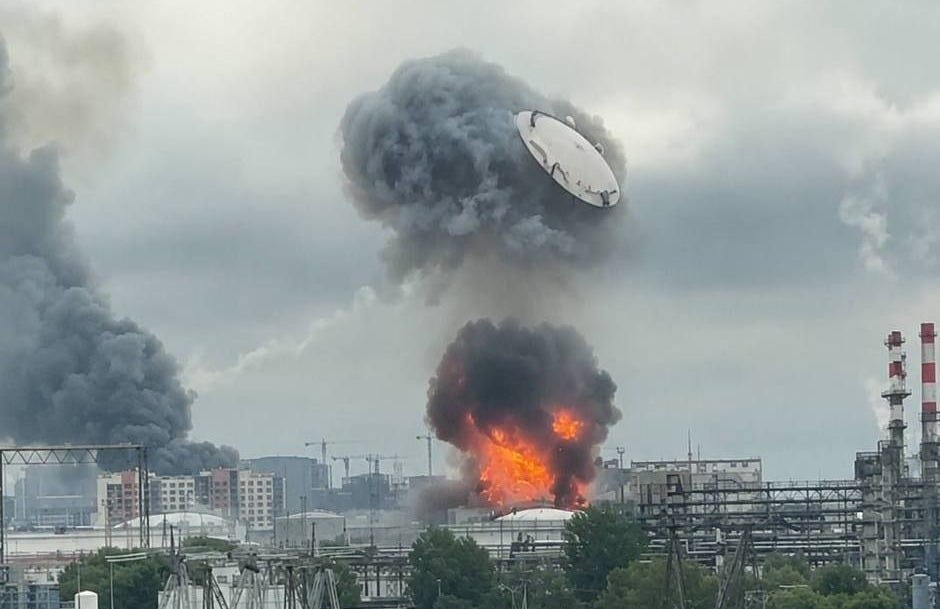
The lids on large petroleum tanks like this one are not fixed into place. They float on the surface of the oil, sealed to the wall of the tank, so that pressure changes do not damage the structure. This one was reportedly struck by a Russian surface-to-air missile that failed to intercept a Ukrainian drone that reached Moscow. Iconic now, the images of this explosion have become a visual shorthand for Ukraine’s long-range campaign against Russian economic and military targets and the ineptitude of Russian responses.
Monday’s strike on the Omsk Oil Refinery, Gazprom Neft-ONPZ, using FP-1 drones to reach more than 1,550 miles (2,500 km) into Russia, resulted in fire damage to a crude and distillation unit (DCU) and the shutdown of a second unit. The facility stopped producing gasoline and diesel on the St. Petersburg exchange and local fuel shortages were reported.
Ukrainians hailed the strike as a new achievement, the “deepest long-range strike on enemy territory during the entire full-scale invasion” and the first hit on this previously “unreachable giant.” Ukraine has now hit every Russian facility that produces gasoline. In some parts of the country, Russians already spend days in line waiting for gas, camping out in the summer weather. Their vacation season is spent in the gas line rather than Crimea.
The logic of targeting logistics
It is worth noting that Ukraine sends hundreds of drones into Russia almost every other night. There is something to be said for the virtue of scale, here.
Ukrainian drones have swarmed the Sea of Azov for the fourth night in a row this week, damaging or destroying dozens of Russian shadow fleet tankers, dry cargo ships, tugs, and a ferry. All these vessels were responding to the logistical emergency that Ukrainian ‘middle strike’ tactics have created on the Crimean peninsula. I noted this Ukrainian strategy to make Crimea unsustainable through long-range fires very early.


Since then, a package of technologies and tactics has extended the range of small UAVs over the peninsula as well as the ‘land bridge’ on the north bank of the Azov. Whether or not Ukraine has the means to retake Crimea, they now have the means to make the decisive terrain of the war untenable for Russia by imposing intolerable costs for continued military occupation.
The tankers destroyed or damaged this week are relatively small, for they are designed to operate on the Russian river network, which makes them uncommon on the global market and difficult to replace. Their normal function is to distribute fuel for the Russian harvest season, which is about to begin. The tugs, cargo barges, and other ‘brown water’ vessels being destroyed in the Sea of Azov would ordinarily support a small, but critical part of Russian industrial and agricultural production that uses bulk transport over water.
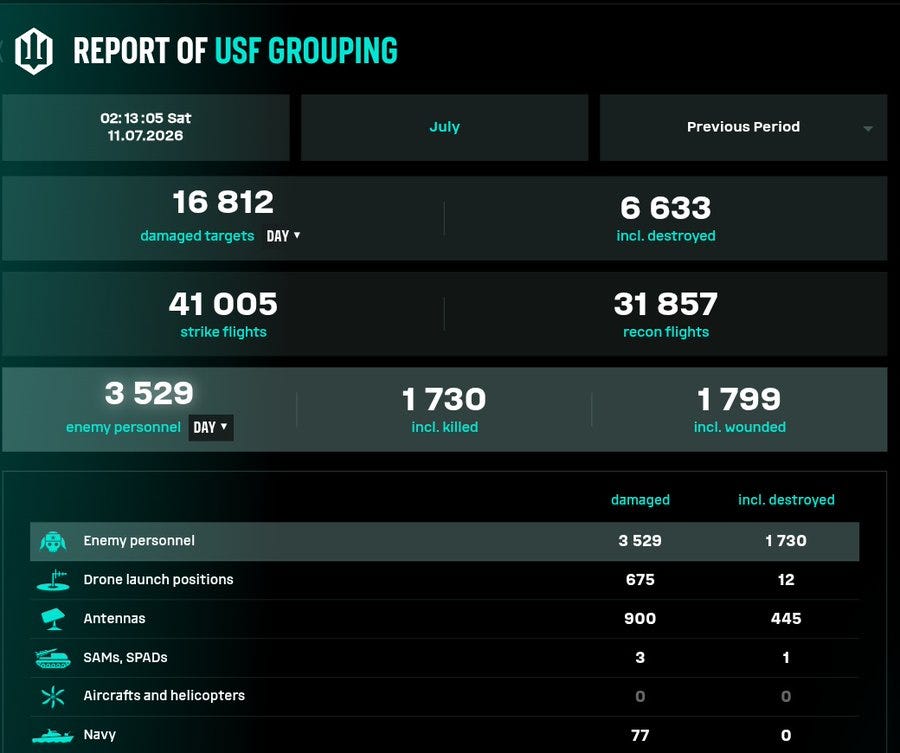
Economic risks are meanwhile growing exponentially in Russia. Business investment is nonexistent. All the banks are giving forced loans to military contractors who often fail to pay them back. While the war has produced GDP, it has not produced wealth in Russia. Political demand for a strong ruble has reduced revenues from oil and gas exports that are denominated in dollars. The result is a Potemkin economy in which government costs have soared while real growth has halted under high interest rates.
One part of the Ukrainian middle strike campaign has focused on trains, fuel trucks, and other Russian vehicles in occupied Ukraine. This is already showing results in reduced Russian operations. While this does not herald the end of the war, this shift in momentum is happening right as Vladimir Putin’s Russia achieves a new level of unsustainability. From high finance to the physical logistics of the economy, the damage is everywhere, and it is deep.


Almost one in five airliners is out of service because western-made parts are unavailable due to sanctions. Moscow airports experience near-weekly shutdowns from drone attacks on the Russian capital. Passenger delays, flight diversions, and flight cancelations have a vital economic impact in a country that stretches across 11 time zones without a connecting highway system.
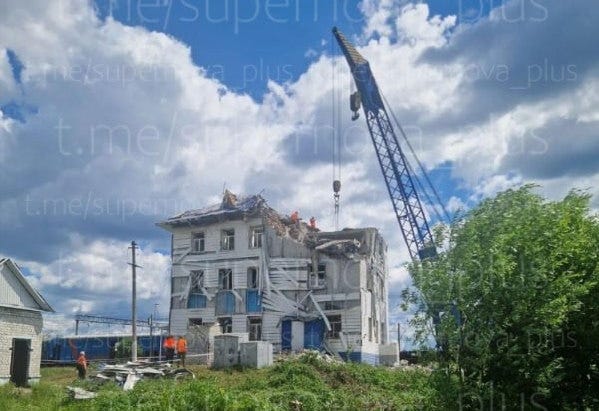
Only the railroads connect most of Russia on the ground. The state monopoly, RZD, is unable to replenish their locomotive stocks due to international sanctions. Rails and rolling stocks deteriorate while the lack of international connections hurts their export trade. Locomotives, oil cars, bridges, and key railroad infrastructure are predominant targets. By land, sea, or air, the logistical apparatus of the Russian economy is being degraded and delayed as it deteriorates.
Raising risks and cost ratios
This all has the effect of making the war more costly for Russia to fight. Making matters worse, Russian strategic culture only knows one answer to adaptation challenges. Inefficiencies have become policies under the ‘command-push’ model of military authority, further re-Sovietizing the war effort.
The Commander of the Unmanned Systems Forces (Войска беспилотных систем), Yuri Vaganov, is a vital case in point. He came to the drone warfare industry through his success as a plumbing oligarch. Known as “Yura the Toilet” to Russian military bloggers, he is despised for his “restrictive procurement system”.
The mechanism for these procurements allegedly requires all prospective drone models to undergo testing by operators at the “Rubikon” center for unmanned technologies. Following these field tests, operators are tasked with issuing a formal resolution regarding whether the equipment meets the declared technical specifications.
Yura the Toilet personally oversees the allocation of drones to the front, creating “hunger” in some units to the advantage of others. This top-down approach can pour drones and operators into one area, for example, but the priorities at the top are not necessarily in the best interest of the Russian forces on the receiving end of Ukrainian counterattacks.
Russian centralization of these resources is also problematic. Ukraine targets the Rubikon training sites and production points. Ukrainian ballistic and/or cruise missiles recently visited the Voronezh Semiconductor Devices Plant-Assembly (VZPP-S / Sborka), doing significant damage to production facilities and killing or injuring 5 workers.
VZPP-S produces the transistors, microchips, diode and transistor assemblies, and other electronic components for Kh-101 cruise missiles, Iskander-K systems, Pantsir-S1 air defense, and other Russian weapons systems that rely on semiconductors.
Last week, the Kremniy EL Group microelectronics plant in Bryansk, another of Russia’s leading producers of integrated circuits, power semiconductors, and electronic components for command/control systems, EW, communications, and weapons platforms, got a similar visit. Nearby, the Bryansky Chemical Plant, which makes propellants and explosives, was also set ablaze by Ukrainian long-range fires.
These strikes do not stop Russia from building new missiles to target apartment blocks in Ukrainian cities. Instead, these strikes make it much more expensive for Russia to launch high-value missiles at low-value revenge targets.


Fire Point weapons are developing quickly. FP-5 has a much-improved accuracy and enough explosive power to do serious damage to a building. In a June 26 strike on the Titan-Barrikady plant in Volgograd, a key facility for missile and artillery components including Iskander launchers, 3 out of 5 FP-5s succeeded in striking the target. Repeated strikes recently on the VNIIR-Progress plant in Cheboksary, which produces anti-jamming antennas for Russian drones and missiles, used FP-5. The weapon has likely done as much or more material damage to the Russian war economy now as it cost to develop.
Smaller attack drones have become the daily workhorse for long-range strikes. Fire Point reported at Eurosatory 2026, a defense conference in Paris, that FP-1 and FP-2 drones are used in strikes inside Russia on a near-daily basis, with 5–20 launches per day across the systems. Together, FP-1 and 2 account for about 60 percent of Ukraine’s deep strikes.
The more salient point is that the production of these weapons is distributed across hundreds of sites in Ukraine: concealed workshops, duplicated facilities, redundant sites that can be used if any one site is damaged or destroyed. Engines and some other complex parts are produced overseas. Ukrainian manufacturers can access a global market of microchips and electronics. There is no central node or point of failure for Russia to attack.
International partners are key to the success of Ukraine’s ability to scale up production. The allocation of resources has largely followed a points system on the battlefield. Destroyed Russian air defense systems are worth more points to a Ukrainian drone unit than a Russian tank or soldier. Resources flow towards success rather than access.
Ukraine’s single most important partner has been the United States. Not only has American intelligence continued to aid Ukraine in targeting and avoiding Russian air defense, American manufacturing has helped scale up the Ukrainian drone war machine, with positive results at every level of military operations for Ukraine: from the ‘drone wall’ that holds the frontal ‘gray zone’, through the depth of occupied territory, across European Russia, all the way to Siberia, now. In fact, the security relationship between Kyiv and Washington has never been so close.