

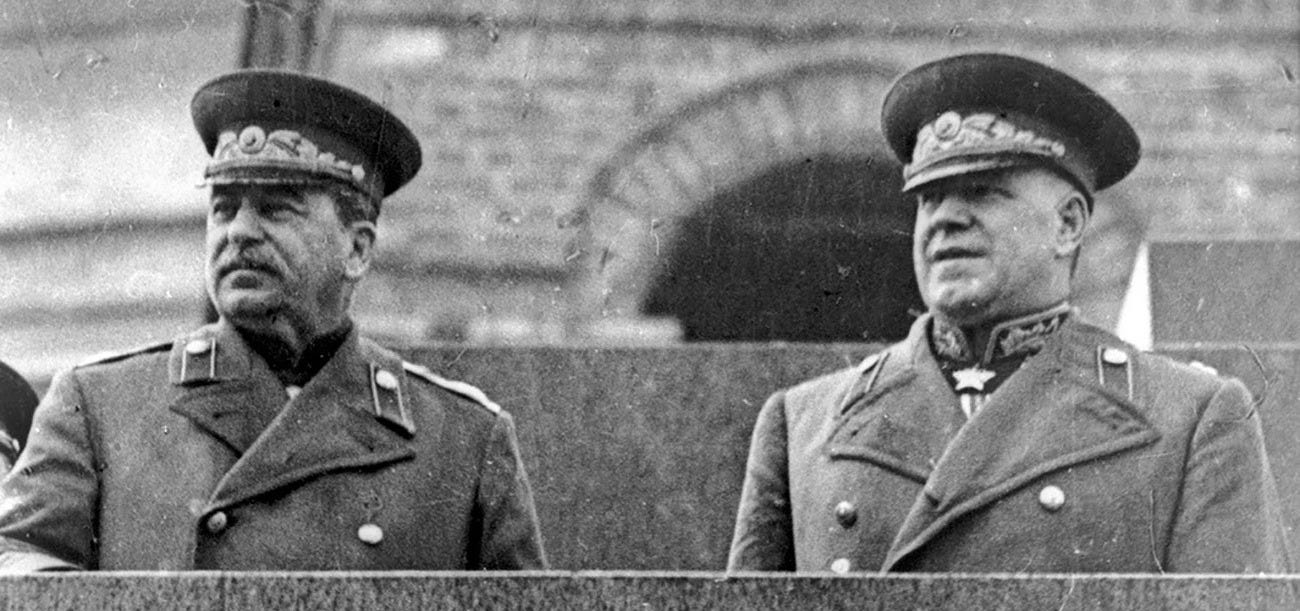
“People say that the allies didn’t help us”, Gen. Georgi Konstantinovich Zhukov told writer Konstantin Simonov in 1963, but he knew better.
Despite the comparative freedom of the post-Stalin USSR, it was still a hazardous admission.
We know about this conversation because the KGB was surreptitiously recording the interview, which took place in Zhukov’s Moscow apartment near the Kremlin.
In his memoir of command, Zhukov never mentioned the Lend-Lease aid from Stalin’s American ally, Franklin Delano Roosevelt.
The Cold War politics of such disclosure were too fraught to discuss in public. For “it cannot be denied that the Americans sent us materiel without which we could not have formed our reserves or continued the war”, Zhukov admitted to Simonov in private.
American steel and aluminum became Soviet tanks and airplanes. American trucks towed Soviet artillery. American food filled Soviet bellies. Zhukov rode in four-wheel drive Willys Jeeps on his legendary staff rides to the front lines.
In the first essay of this four-part series, I told the story of Zhukov’s first great victory at Khalkin Gol in Mongolia, a stunning defeat of Japan that set the terms for World War II to the advantage of Joseph Stalin.

In the second essay of this series, I explained how the German and Russian doctrinal modes of command in World War II still shape our 21st century understanding of operational art, combined arms, and deep battle concepts.
Beginning with the defense of Moscow in 1941 and throughout the bloody futility of 1942, Zhukov and his Red Army were constantly adapting and innovating as they absorbed the brutal lessons of Operation Barbarossa.
Zhukov was arguably the most consequential general of the 20th century and a standout example of the idealized Soviet man. During 1943, the Red Army systematized those lessons with more powerful weapons than before.

Disenchanted as he was with the postwar Soviet Union in 1963, Zhukov’s memoir impresses ideology on the reader as the secret of battle command. He names the kommissars who indoctrinated his formations and recalls their noble careers and glorious deaths from the opening pages. It is the wellspring of Soviet morale, in his telling.
The general’s book is reticent about the 1942 battles he oversaw in the Rzhev salient, which were unsuccessful. He is more effusive about the defense of Leningrad, which he personally oversaw, and the liberation of Stalingrad, whose commander he supervised.
Stalin’s right hand says nothing about the silent battle that made 1943 so different from 1942. Without American radioelectronic Lend-Lease aid, Soviet ideology might not have survived Hitler’s invasion. That was not a tale that Soviet leaders wanted anyone to tell.
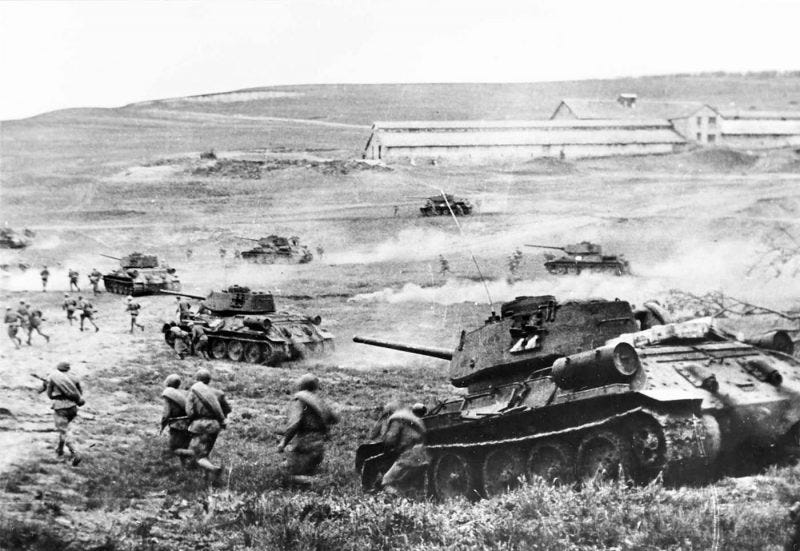
This third essay in our series on Zhukov will focus on the secret history of radioelektronika bor’ba (радиоэлектронная борьба), NATO translation ‘radioelectronic combat’, or REC. Formalized in the late 1970s, the term is in fact ideological.
“Bor’ba is more literally, and perhaps better, translated struggle than combat”, electronic warfare historian David G. Chizum writes in Soviet Radioelectronic Combat.1 Struggle has ominous meaning in the bloody context of communist history.
When Chizum published his survey of the Soviet literature in 1980, REC was a daily struggle of east and west in the form of western news broadcasts and Soviet jamming stations that struggled to drown them out. In the Soviet concept, REC was a wartime struggle that continued in peacetime.
For “the Soviets’ gravest concern is the West’s ability to penetrate Socialist territory without establishing a physical presence”, Chizum wrote. Radio waves had moral power to erode the Soviet mind and undermine the utopian socialist project.
In this respect, REC departs radically from [electronic warfare], which is implemented only in wartime. REC, like the ideological struggle from which it springs, continues as long as the enemy uses the electromagnetic spectrum to the Soviets’ disadvantage. It just would increase in intensity and scope should war break out between the Warsaw Pact and NATO.
Even today, NATO and Russia have two very different battle doctrines that both rely on radio technologies to command battles and wage wars.
Victory in World War II also required technological capacities that the Soviet state did not have in 1941, that had to come from the Anglo-American allies. For better or worse, President Roosevelt and Winston Churchill provided the Soviet Union with the material means of Red Army success at deep battle in 1943.
We begin where we left off in the second essay, as 1942 ended, with the German 6th Army trapped at Stalingrad, as the Red Army had began to use their new electromagnetic weaponry and tactics against the Wehrmacht.