

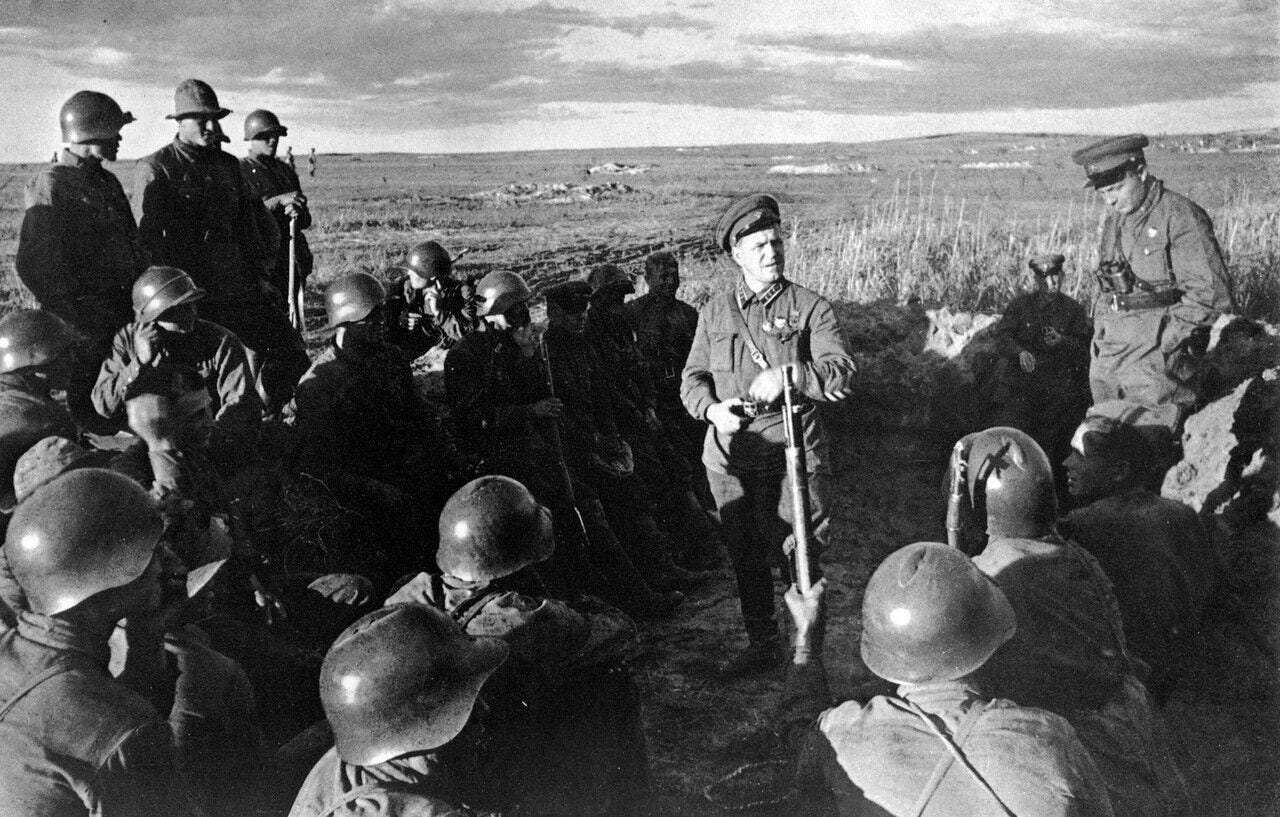
“He was a welcome friend, a true Communist”, Gen. Georgi Zhukov recalls of an acquaintance in his memoir.1 For Zhukov, it was the same thing to be a good friend as it was to be a good Communist. He credits ideology for victory, names the kommissars who indoctrinated his formations, recalls their noble careers and glorious deaths. “The heroic actions of our soldiers were inspired by the Communist Party and the army’s Party organization”, he writes of Khalkin Gol, the battle that started the Second World War.
“Politically naive” in 1917, Zhukov sided with the Bolsheviks immediately and deepened his faith with readings into Marx, Engels, and Lenin only later, during the 1920s. In the same decade, he also read the foundational works of operational art in the age of the tank. “Stormy discussions erupted around the book of V. K. Triandafillov, Deputy Chief of Staff of the Red Army, entitled Nature of Operations of Modern Armies, which immediately won broad popularity” among the officers leading interwar experiments in military science.
Whereas Triandafillov died in a plane crash, Mikhail Tukhachevsky was purged in 1938, and his ideas very nearly died with him. Tukhachevsky “came out with many far-sighted ideas on the nature of the future war, produced a profound study of the new tenets governing theory, tactics and strategy, and the operational art, and showed the indissoluble link between military principles and practices, on the one hand, and the social system and the country’s production potential, on the other”, Zhukov writes. He does not report on how Tukhachevsky died.
A humble, pious Communist in his writing, Zhukov was also a cavalry sergeant who understood the importance of morale and a personal touch. “When on the initiative of the political instructors of the 40th Regiment the worst disciplined men were gathered to find out in a frank talk the reason for their misdemeanors”, Zhukov had a ‘learning experience’. While he credits this success to socialist principles, this writer has experienced the same phenomenon in a ‘sensing session’ without any ideological principles involved.
It turned out that many offences were committed not so much through the fault of the soldiers but because their commanders and political instructors did not know their character and individual problems, and were often unfair in judging their behavior. This was detrimental to their own prestige. The men often committed offences merely to annoy these superiors.
“These friendly talks were of much benefit both for the men and their commanders.” This much is easy to believe without believing in ideological communism. In the manner of the best generals, Zhukov is eager to give credit to soldiers and officers. He does his best to recall the name of every significant person who helped along the way, and apologizes when he forgets a first name. Mongolian allies at Khalkin Gol receive his highest praise.
He was very capable of criticism, however. Upon arriving at Khalkin Gol in the emergency of the Japanese surprise attack, Zhukov’s first recommendation to Moscow was to sack the commander, whom he replaced. Eight months after the battle, Zhukov flew back to Moscow to meet Stalin, Kalinin, Molotov, and select politburo members. Stalin lit his pipe to ask: “What do you think of the Japanese Army?” Zhukov delivered a single-paragraph brief on strengths and weaknesses.
“Stalin had listened very attentively” throughout. Then he asked: “How did our troops fight?” In his answer, Zhukov praised his subordinate generals who had impressed him at Khalkin Gol and named one who had not. Because Russians had done most of the attacking in the biggest battles of the brief 1939 border war with Japan, Zhukov’s aggressive tactics had resulted in the loss of more men and tanks than the Japanese had lost. He had still beaten them, so that did not matter, to Stalin.
Good leaders know their subordinates as people, not just names, and this was true for Stalin and Zhukov. Both commander and unit must be capable and reliable. “A commander who has mastered the system of controlling a regiment and can keep it in constant combat readiness, will always be an advanced military leader at all other levels of command, both in peacetime and in war”, Zhukov writes. Regimental commanders — colonels, classically — are the talent pool from which generals are promoted to command many regiments at once.
By 1939, Gen. Georgi Zhukov had the broadest possible vision of battle. From grand strategy to squad tactics, nothing could be left to chance. Yet the Battle of Khalkin Gol, which the Japanese euphemistically referred to as the Nomohan incident, was defined by its limits. “Lasting four months, with thirty to fifty thousand killed or wounded, the Nomonhan conflict was a small undeclared war — the first instance in the modern age of limited war between great powers”, Stuart Goldman writes.2 Political reliability made limited war possible. Indeed, the war happened at all because the Japanese side was not so disciplined.
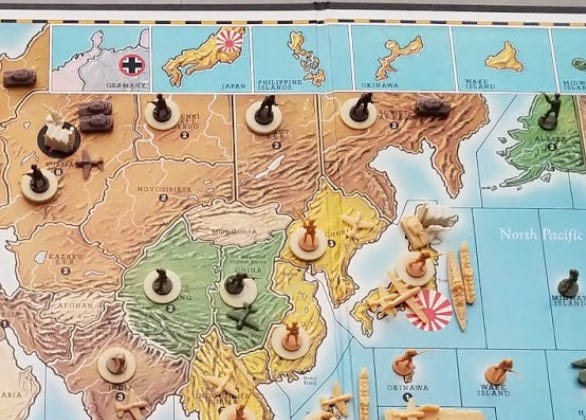
The Japanese had underestimated the fighting potential of Russian soldiers and paid a high price for their contempt. The Kwantung Army had poor intelligence, no experience against an enemy with artillery and air superiority, and an officer corps where gekokujo was rampant. Literally meaning ‘rule from below’, this insubordination prioritized honor over obedience to the emperor, with catastrophic consequences for grand strategy. This is how Japanese aggression in Asia during the 1930s had brought on the confrontation with Russia.
“The advent of Manchukuo and the Third Reich near the eastern and western frontiers of the USSR posed threats that Stalin could not ignore”, but then the Soviets won this limited war, so the Japanese agreed to a nonaggression pact with Stalin and sought a confrontation with the Americans instead. World history turned on the result of the Khalkin Gol battles.
“The Nomonhan conflict is directly linked to the German-Soviet Nonaggression Pact and the outbreak of the war in Europe”, Goldman explains. The Molotov-Togo agreement was concluded on 15 September 1939 and the ceasefire went into effect the next day, 16 September. Germans were two weeks into their invasion of Poland, wondering just when their putative Russian allies would observe the Molotov-Ribbentrop pact to invade a helpless Poland from the east, when the Red Army finally attacked on 17 September 1939. This timing was not accidental.
Stalin’s “paramount objective was to prevent the formation of a grand capitalist alliance directed against the Soviet Union.” He had no illusions about the intentions of Adolf Hitler, but be also knew the distrust of Neville Chamberlain and Édouard Daladier for Hitler would keep his western enemies divided. This was the context when Zhukov, who rose when original thinkers had been purged, did not hesitate to ask Stalin for guidance on grand strategy during the 1940 job interview. “How should one understand the extremely passive nature of the war in the West, and what turn might one expect the further events to take?”
Stalin chuckled, and said:
“The French Government headed by Daladier and the Chamberlain Government in Britain have no intention of getting seriously involved in the war with Hitler. They still hope to be able to persuade Hitler to start a war against the Soviet Union. They refused to form an anti-Hitler bloc with us in 1939, because they did not want to hamper Hitler in his aggression against the Soviet Union. But nothing will come of it. They will have to pay a high price for their short-sighted policy.”
Georgi Zhukov credits Triandafillov and Tukhachevsky’s ideas for his own success at operational art. Khalkin Gol was his first application of those principles. Western military theorists would develop their own language of operational art from the study of Russians, Zhukov foremost, during the 1970s. Many terms that became popular in military affairs during the 1990s, such as ‘combined arms’ and ‘AirLand Battle’ and ‘maneuver warfare’, derive from this line of study.3
Put another way, Gen. Georgi Zhukov was the first commander to perform the operational art of mechanized warfare at Khalkin Gol in 1939 and the entirety of modern military theory has grown from this beginning. It was also the first battle of the biggest war the world has ever seen, and it shaped that conflict in a historically determinative way right from the beginning. Communist or not, Zhukov was the most consequential general of the 20th century.
This essay series tells that story. It is exclusively available for premium subscribers.