

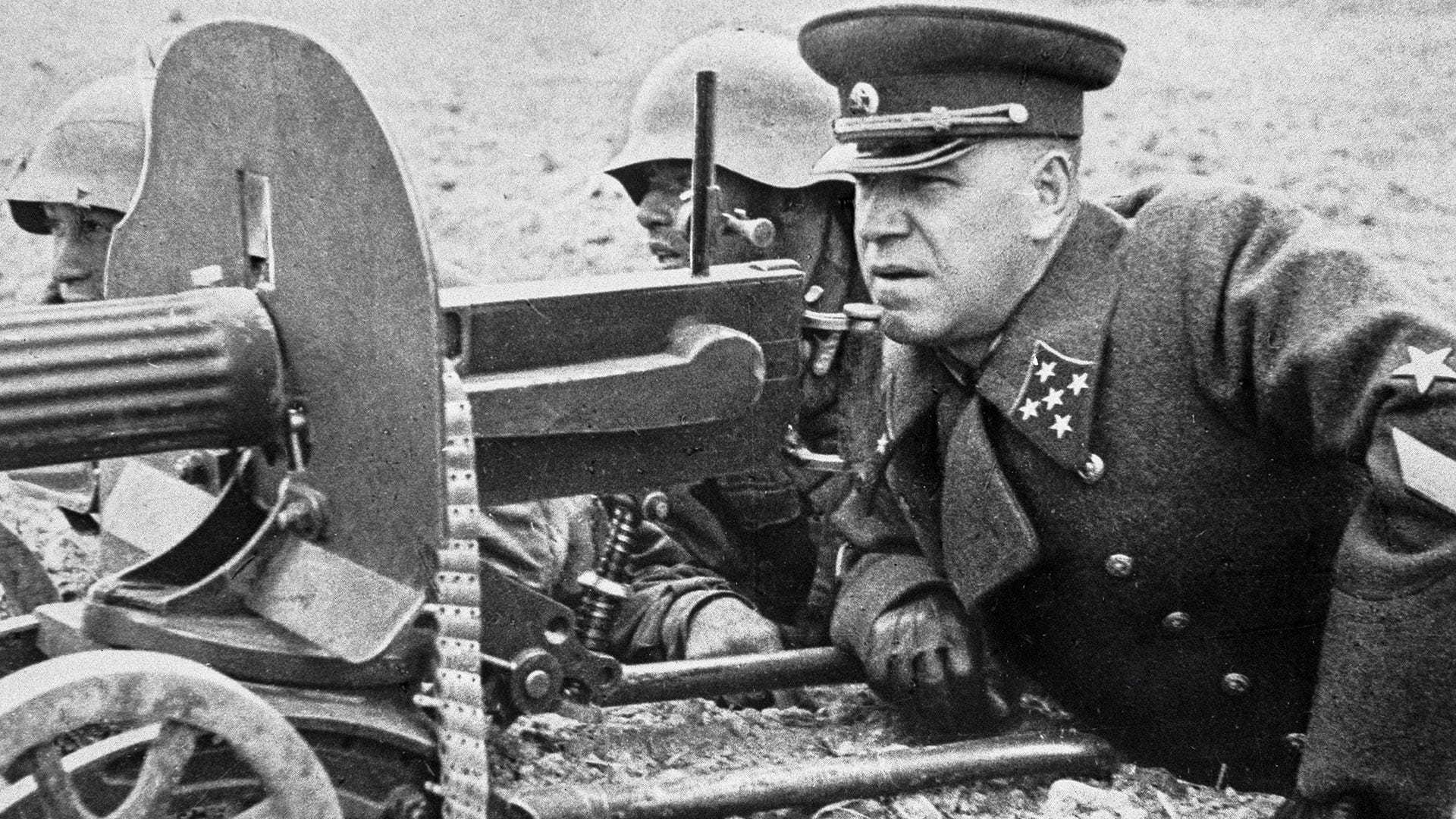
The dictator of the proletariat puffed at his pipe. Stalin was ready to take questions.
Gen. Georgi Konstantinivich Zhukov sat before the Politburo. His victory over Japan at Khalkhin Gol in 1939 had allowed Stalin to enter the war on Soviet terms. The Red Army had entered Poland the day after the ceasefire with Tokyo.
Now it was May 1940. When the current negotiations for a nonaggression pact were concluded, the Soviet Union would have no eastern flank to defend. Stalin would be free to intervene in the European war.
Gen. Georgi Zhukov was blunt, even if his phrasing was careful. “How should one understand the extremely passive nature of the war in the West, and what turn might one expect the further events to take?” Zhukov asked, according to his memoir.1
Stalin chuckled, and said:
“The French Government headed by Daladier and the Chamberlain Government in Britain have no intention of getting seriously involved in the war with Hitler. They still hope to be able to persuade Hitler to start a war against the Soviet Union. They refused to form an anti-Hitler bloc with us in 1939, because they did not want to hamper Hitler in his aggression against the Soviet Union. But nothing will come of it. They will have to pay a high price for their short-sighted policy.”
The next day, Zhukov was elected to the Central Committee, an elevation to elite status in the Soviet system. He received a house near the Kremlin and lived in it for the next 20 years.
In the first essay of this series, I told the story of Gen. Zhukov’s victory against the Japanese on the Mongolian frontier in 1939 and explained how he became the most consequential general of the 20th century. This is the story of Zhukov’s actions during the defense of Moscow in 1941, the problems he encountered in organizing offensives in 1942, and how he became Stalin’s most trusted general.
This is also the story of how two styles of command, Russian and German, clashed along with their armies. These two doctrinal modes of command still shape our 21st century understanding of operational art, combined arms, and ‘deep battle’. Zhukov remains consequential. This essay series is EXCLUSIVELY for premium subscribers.
