

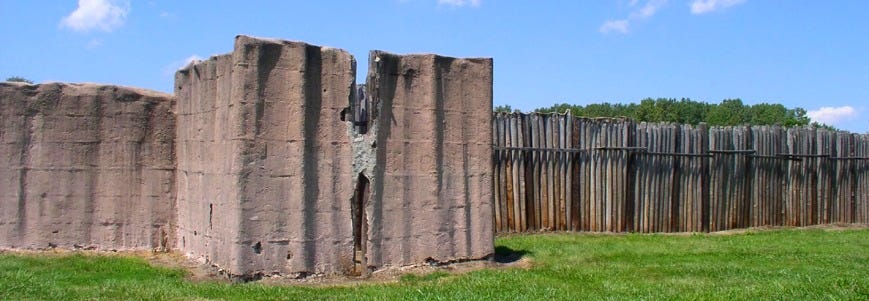
Defensive walls are a universal technology. When Hernando de Soto landed in Florida in 1539 to explore the American southeast, he found “a well inhabited and a fat country” with “some great and walled towns, and many houses scattered all about the fields, to wit, a crossbow shot or two, the one from the other.”1 These walls were built “of great posts thrust deepe into the ground and very rough, and many long railes as big as ones arme laid acrosse between them, and the wall was about the height of a lance, and it was daubed within and without with clay, and had loope holes.”
Defensive walls are also an entirely bourgeois construction; the concept of a gated community existed in the New World before Columbus. One Native American capitol called Pacaha was “very great, walled, and beset with towers, and many loopeholes were in the towers and wall” with “a great lake, that came neere unto the wall: and it entered into a ditch that went round about the towne, wanting but a little to environ it round”, suggesting enormous expenditure of community resources. Each fortified town was close enough to support the others, a peer among equals, but also separated from the others, the palisades creating exclusion rather than inclusion.
This pattern is not unique to the New World. A similar, if smaller, 10,000-year old Siberian site at Amnya was clearly meant to be seen and respected among peer sites. Similar ditch-and-palisade constructions appear globally in the archaeology.2 From the first appearance of palisaded communities, wooden walls and ditches were high-visibility markers of status, a form of conspicuous consumption before the invention of money. All defensive structures are designed to manage risks, however, and palisades are consistent with risk management in a world of raiding activity. Grim archaeology shows that these defenses were necessary, and not simply for show.
