

Most historians consider the Emancipation Proclamation of New Year’s Day 1863 to be the doom of the Confederacy, when President Lincoln ended any hope of foreign recognition for the fledgling secessionists. Many point to the result at Antietam in September, when Gen. Robert E. Lee was thrown back from his invasion of Maryland after a battle nearly as bloody as Shiloh in April. Few historians know as much about Braxton Bragg, who was simultaneously in Kentucky, or how Bragg and Lee were both disconcerted by their cool reception as they crossed the nascent boundaries of the Confederacy into enemy territory.
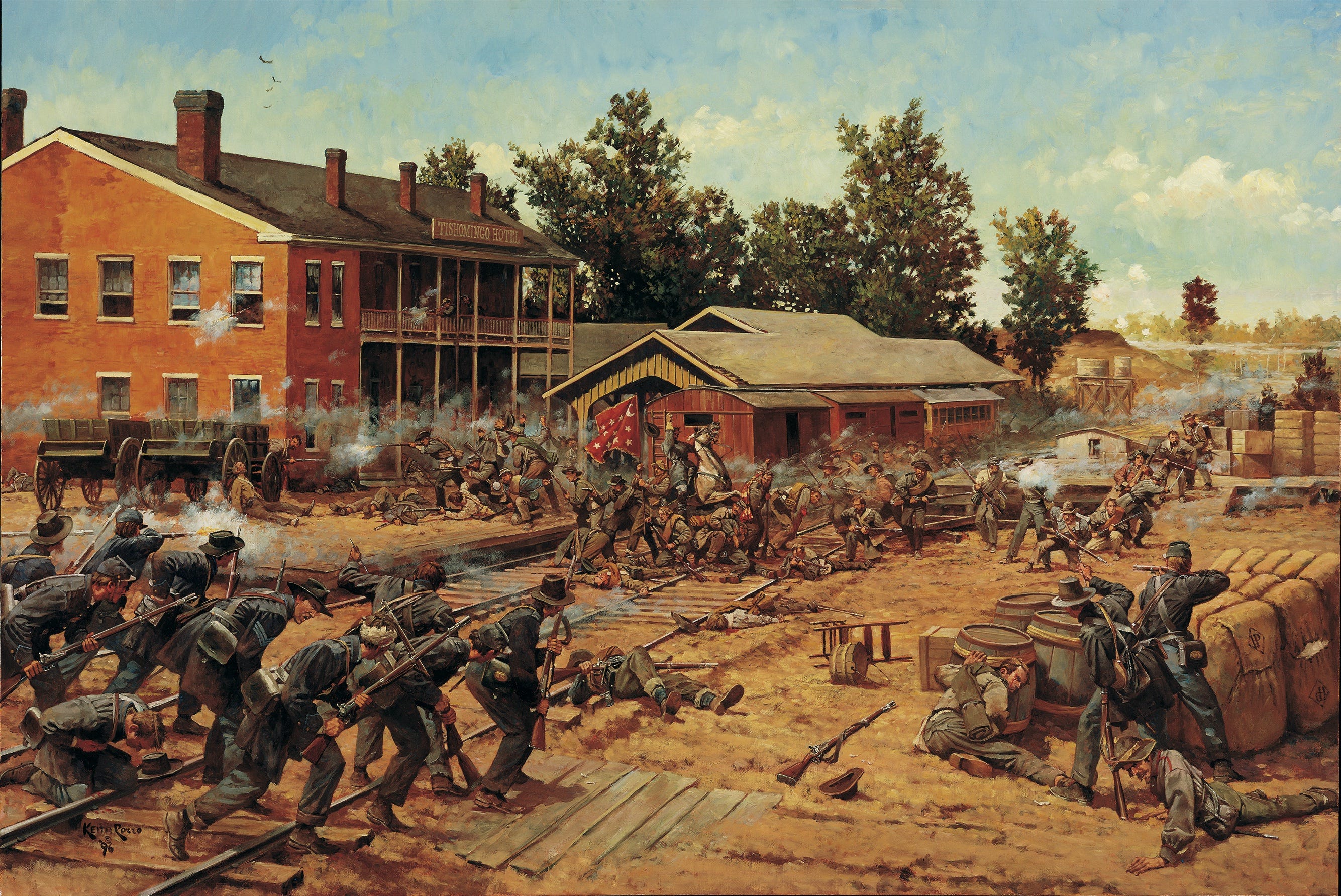
Battlefield historian Timothy B. Smith points out that the two generals were acting on a single plan, and that for the plan to work, the Confederacy had to retake Corinth, a coup that demanded “stealth, quickness, and surprise”.1 Maj. Gen. Earl Van Dorn did manage to sneak up on the Union army holding the Mississippi town, “but also managed to fool his own officers in the process”. There was at least the consolation of the welcome from locals as Van Dorn’s force marched north to the Tennessee line, passing west of Corinth, but he had a complex plan, and shared it with just two subordinates. “By the time the Confederates had reached Pocahontas”, a town in Tennessee north of the target, “the time had come to stop the game and make a run for Corinth.”
Van Dorn had kept the plan secret because his officers would have balked. “Madness,” Gen. Albert Rust called it. Delayed by demolished bridges and Union pickets, surprise was sure to be lost, and then the Confederates would have to storm defended breastworks. Gen. Ulysses S. Grant and Gen. William Rosecrans had surveyed the northern side of Corinth some weeks before with Captain Frederick Prime, an engineer. Five new forts, A through F, had been under construction since then, and nobody in the Confederate command was sure how complete any new defenses were. A full week had passed since Antietam. Only now was the end of Confederate fortunes really at hand, as the last leg of the three-part plan to save the cause disintegrated.

This essay is exclusively available to premium subscribers until December 2026. Consider a premium subscription to access the rest of this ongoing essay series on the western campaign that arguably won the American Civil War for the Union side. This series of battles cut the Confederacy in half and enabled the complete defeat of the C.S.A. Both sides adapted to the mid-19th century military revolution, but only one side could do it for very long.