

The Fine Art Of Assaulting Mesopotamian Walls
Site of ancient siege identified, matched with ancient artwork
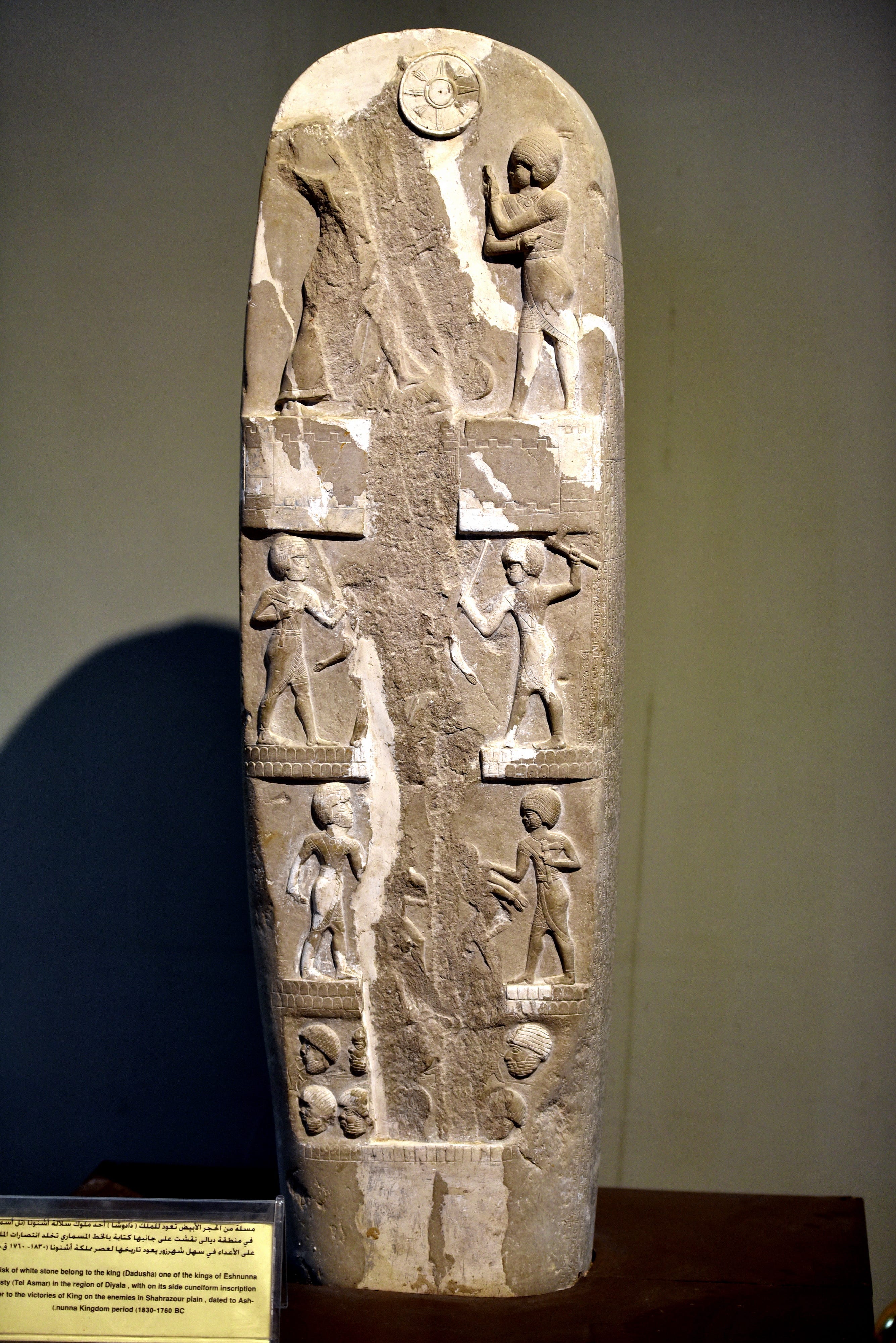
Kurd Qaburstan in Iraq has been identified as the ancient city of Qabara depicted in the Victory Stele of Dadusha. A new magnetometer survey of 180 acres by a team from the University of Central Florida has found a massive curtain wall with bastions surrounding the site, matching the fortifications portrayed on the stele.
Found in the temple of the Mesopotamian storm god Adad at Eshnunna, the stele is inscribed with 220 lines of cuneiform text in 17 columns on the sides commemorating Dadudha, a king of Eshnunna, conquering Qabara. The text is ekphrasis, a description of the art.
On it (is) an image of my heroism (that depicts me) smiting, majestically enveloped in the splendour of battle to overwhelm the enemy land. Above it, Sin and Shamash, who strengthen my weapon, appear shining in order to lengthen the years of my reign. Above the wall of Qabara (is) Bunu-Eshtar, the king of the land of Arbil, whom I relentlessly overwhelmed with my strong weapon, on whom my foot treads, standing with pride. Below it, ferocious heroes vigilantly hold captives.
The front side of the stele has four ‘registers’, scenes depicting this episode of siege combat. They are all damaged in the center from the accidental discovery of the stele during a well-drilling operation at Tell Asmar in 1983. Aside from a fragmentary ‘Mardin stele’, it is the only surviving royal victory stele from the Old Babylonian period, and the most complete.
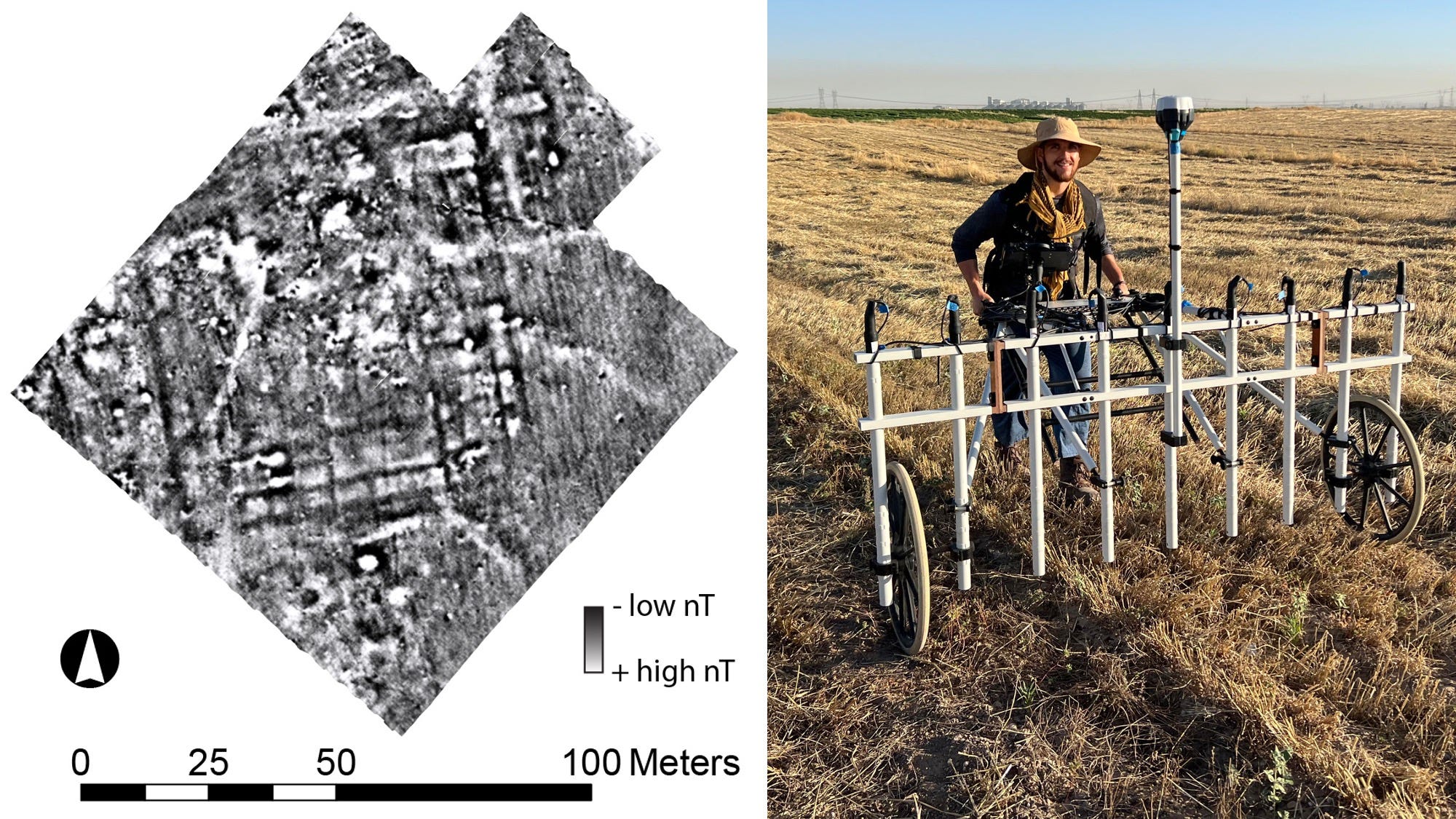
Eshnunna was an important city midway between Elam and Mari. In his 2012 book Reading and Writing in Babylon, Dominique Charpin describes a reformation of scribal practices that spread across Upper Mesopotamia and the Middle Euphrates from the city in the 1800s BC, representing a regional cultural hegemony. The conquest of Qabara happened in approximately 1765 BC, at the height of Eshnunna’s power.
On top of the stele is the sun-disc with its rays of Shamash, the sun god, combined with the crescent of Sin, god of the moon, wisdom, and cattle-herding. Dadudha was invoking heavenly favor with his victory. He has received the most damage, whereas the figure on the right remains. This may very well be his son, Ibal-pi-El.
“Since Dadusha died in the year after which the commemorated events occurred, Ibal-pi-El might have inherited the task of completing the stele that his father had commissioned”, Claudia E. Suter at the University of Bern has written.1 “Under this unusual circumstance Ibal-pi-El need not have been mentioned in the inscription in contrast to Old Babylonian kings who claim to have set up images of their deceased fathers or forefathers, images that they obviously commissioned.”
Suter interprets the stele as a depiction of the shared conquest. Dadusha sent a contingent of his own men to take the city with an ally, Samsi-Addu, the king of Ekallatum. “Ibal-pi-El may, in fact, have headed the contingent that Dadusha sent to Qabara.”
This may explain why the two sides of the stele front depict two warriors in “antithetical composition” in the middle registers, Suter argues. Politics required portrayal. For while “Dadusha alone claims victory over Bunu-Eshtar on the one hand,” he “bequeaths the conquered land to Samsi-Addu on the other.”
On the third register, second from the top, are two men wielding axes with one hand and holding a long, narrow object in the other hand. Copper axes were the favored weapon of Egyptian storming parties around the same time. The long objects are probably not spears, but ladders. The two men are depicted assaulting the wall, standing on top after climbing their ladders.
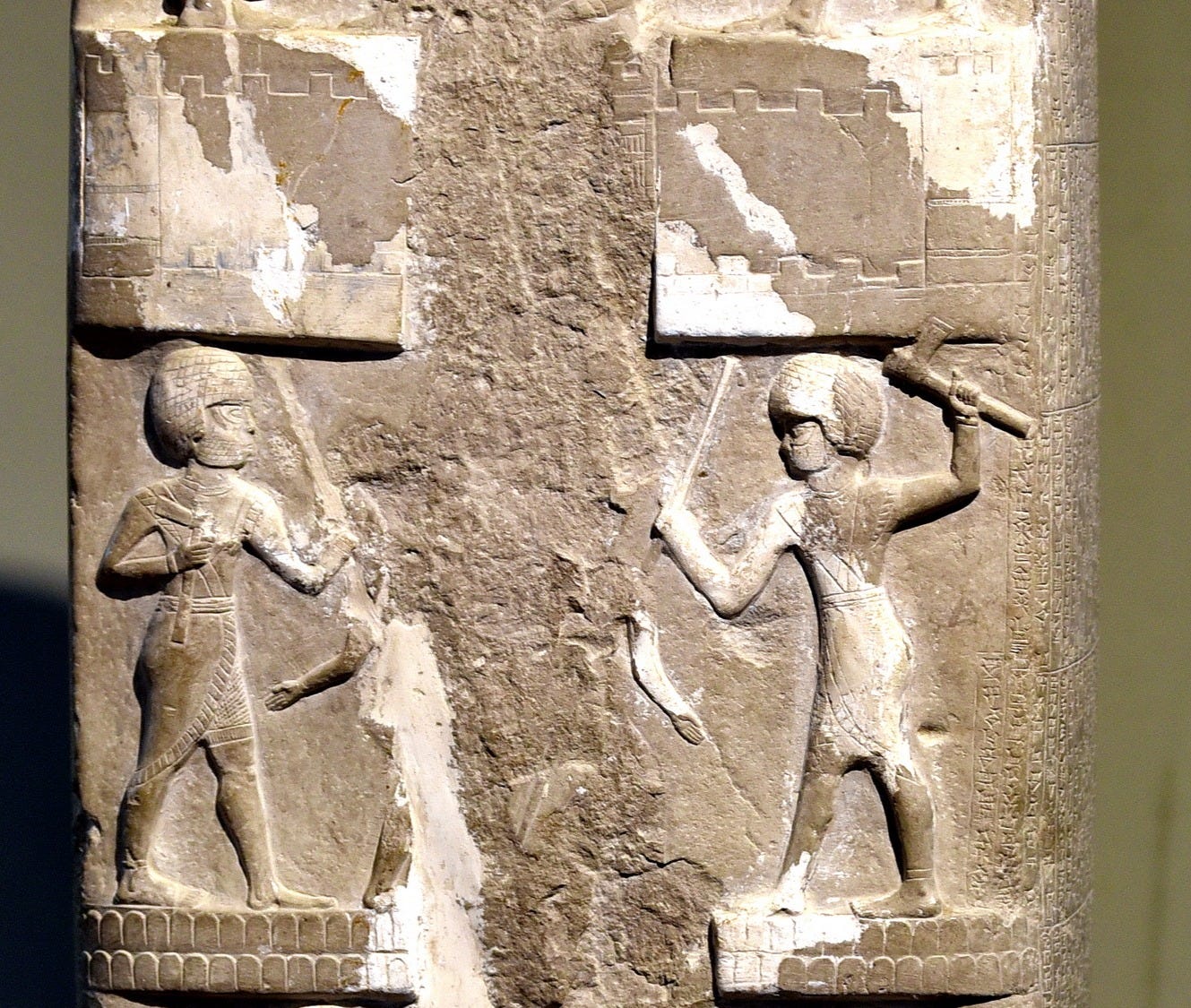
Above each man in this third register, at the bottom of the fourth (top) register, we see a depiction of substantial walls with battlements and bastions. According to Tiffany Earley-Spadoni, the survey team found “collapsed structures, burned layers and concentrated debris” that “suggest a coordinated and possibly prolonged assault” took place.
Digging in 2024 and 2025 located “the first significant group of cuneiform tablets found on the Erbil Plain”, “20 cuneiform tablets and more than 100 administrative sealings from destruction layers within the Lower Town East Palace.” According to Earley-Spadoni, director of the project, “Several tablets are dated within days of each other, matching the timeline of the city’s fall.”
Inside the palace destruction layers, the researchers found the remains of 17 people. They had not been formally buried, with grave goods. “Some appear to have been left where they died, including possible palace workers”, Earley-Spadoni says. “One individual was found face down over a stone basin.” It was a scene of carnage. Two rows of severed heads on the bottom register of the stele depict historical violence.
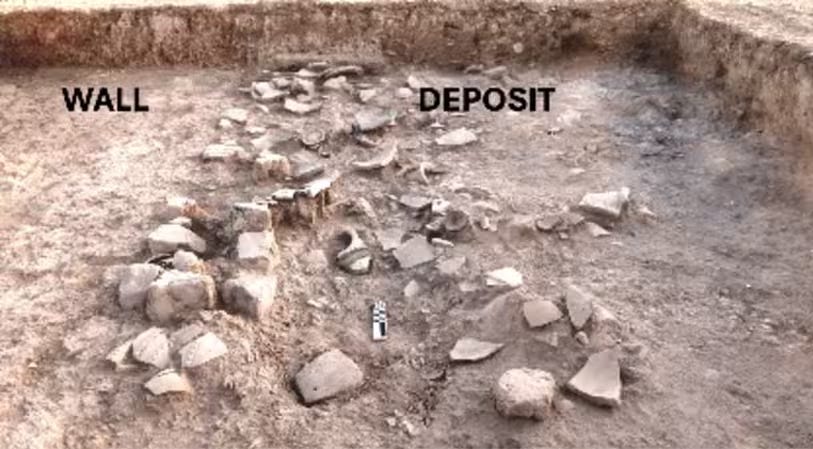
“The two superimposed destructions match the historical sequence of the siege of Qabra and its conquest by Shamshi Addu,” Earley-Spadoni says. “The charred debris, the large number of ceramic vessels and individuals who met untimely deaths and were buried in the destruction layers, provide the clearest archaeological case of Middle Bronze Age siege warfare yet discovered in northern Mesopotamia.”
Bioarchaeologist Andrea Zurek-Ost at Michigan State University is studying the remains. “The tablets are now being studied by epigraphers Paul Delnero of Johns Hopkins University and Parker Zane of Yale University, together with art historian Marian Feldman of Johns Hopkins University”, Arkeonews reports.
Earley-Spadoni is most concerned with recognition for the achievements of northern cities in the Mesopotamian world. Uruk gets all the glory as the wellspring of urban civilization, but northern cities could also be “large, complex, and politically significant, with administrative systems, fortifications, and infrastructure comparable to those of the best-known southern sites”.
For me, this is exciting new evidence that poliorcetics, the art of attacking and defending cities, is as old as the first cities. The art depicting poliorcetics does not often line up precisely with history in these early depictions, which makes the Victory Stele of Dadusha a very exceptional artifact.
The Fine Art Of Assaulting Mud Brick Fortifications In The Middle Kingdom

Originally posted one year ago when I had one-third of my current subscriber base.
Suter, Claudia E. “The Victory Stele of Dadusha of Eshnunna: A New Look at its Unusual Culminating Scene.” Bulletin of the Ancient Near East, Vol. 2, No. 2. Archaeopress Publishing, 2018.