

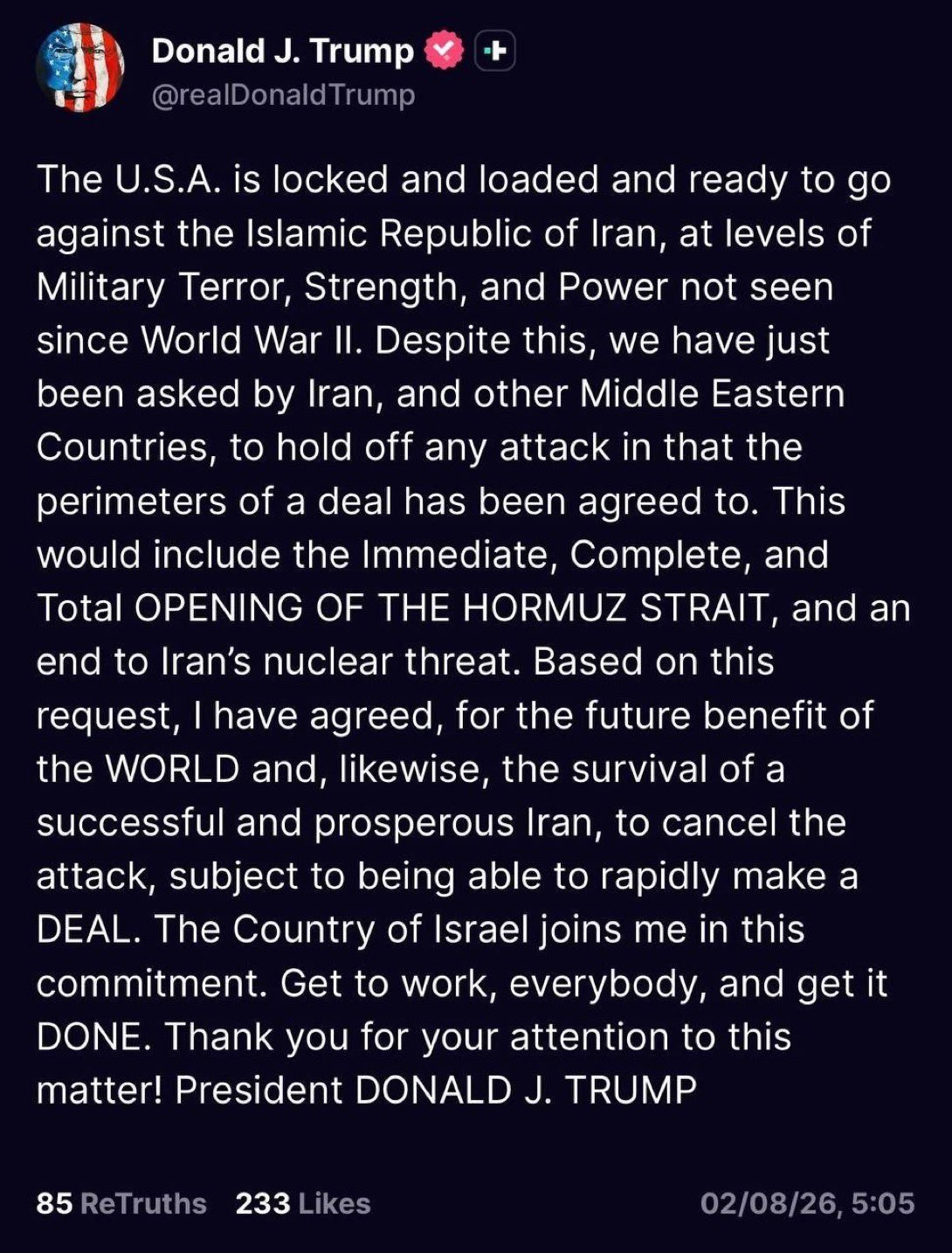
It all feels so familiar because it is familiar, by now. The president calls a timeout for negotiations at the behest of the Saudis, Qataris, and Pakistanis with planes in the air. Then Iran denies any negotiations are happening with the great orange Satan. Ships in the Strait of Hormuz report projectile strikes. Like clockwork, lone salvoes of IRGC missiles and drones lash out at Iran’s neighbors and American bases in the region. Rumors and speculations fill the cognitive gap of information.
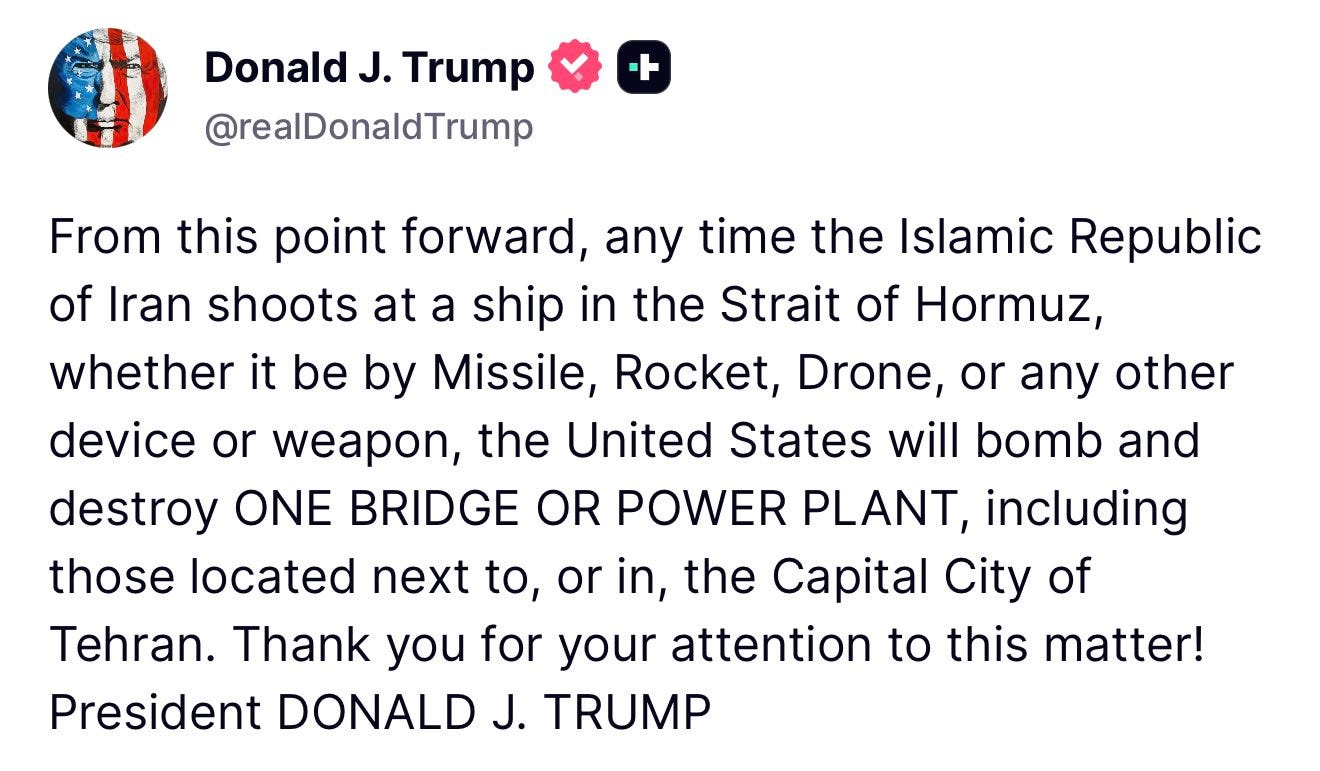
Among the least-informed takes are the ones that say Iran closed the strait. The truth is that Trump decided to stop keeping the strait open. The US Navy has only so many ships in the region, and they have been needed for strike instead of suppression. Trump has no interest in keeping the strait open without a deal, at American expense, forever. The United States is a net oil, gas, and petrochemical exporter. Gulf refineries are having a banner year in 2026, just in the Gulf of Mexico instead of the Persian Gulf. Why waste a good crisis?
All wars are fundamentally macroeconomic affairs. The potential costs of war with Iran, which includes the contest for the strait, were growing over time. Moreover, taken seriously at their own word, the IRGC could be expected to fight the longest possible campaign, dragging out the process of diplomacy to forestall defeat. The regime simply cannot survive a military defeat. They also cannot win a military conflict against the Department of War and the IDF, together.
Obstinacy competes with reality, inside Iran. Rumor has it that Mojtaba Khamenei, the cardboard cutout supreme leader, has endorsed IRGC Commander Ahmad Vahidi, a hardliner. Everyone uses the word ‘hardliner’ to describe men like Vahidi who adopt revolutionary resistance as an ideology. It is more correct to call him a terrorist and a fanatic. Vahidi founded the Quds force, led the crackdown on women in the streets in 2022, remains wanted by Interpol for the 1994 Jewish community center bombing in Buenos Aires, Argentina, which killed 85 people.
On Friday night, though, it appeared the end was nigh for any regime figure Mossad could find. American tankers and allied aircraft formed a visible guillotine around Iran on flight tracker websites. On Saturday, the Crown Prince of Saudi Arabia persuaded Trump to give Tehran one last chance to reach a diplomatic solution. To repeat: the Israelis were ready to join the American attack at Trump’s request, not the other way around, while it was Trump’s biggest Arab partner who intervened at the last minute.
Regular readers already know the punchline, here. Arabs, not Israelis, have applied decisive economic pressure on Iran since March. All of them are accelerating new road and pipeline projects, including a potential Saudi line that will go through Israel. They are circumventing the strait, and they would prefer to buy time for this project rather than have a regional war right away. Iran wants a regional war very badly, and they want it right now, because economic misery loves company.
The result, in macroeconomic terms, is a reduced hostage value to the strait over time. Markets have already priced the closure without shocking the American economy. Countries that are dependent on the one-fifth of the world’s oil supply that passes through the strait have absorbed the shock instead. Countries like China, for example. Chinese refineries cut their processing rates and China cut oil imports drastically throughout the Hormuz crisis, using national stockpiles in a display of strategic resilience.
Trump is an ironic beneficiary of this cushion on the global economy. He was, by all reports, ready to cripple the economy of Iran and the IRGC so badly that the regime would spend years just getting back on their feet. The last-minute reprieve was received in some Arab capitals, such as Abu Dhabi, with a measure of exasperation. Arabs are not united, even though they are cooperative in their strait-circumvention projects. Some want Trump to finish the job, others want him to spare the gulf region from greater destruction.
The cycle of IRGC ‘resistance’ works against Iran’s negotiating position by clarifying for Arabs that Iran cannot be trusted with any deal under current conditions inside Iran. Whereas Trump was content with ambiguity in the MOU negotiations, he is making his demands very clear, now. We can also discern a shift taking place in the White House policy team in charge of the negotiations: personnel is policy.
Whereas Vice President J.D. Vance was the front man in MOU negotiations, his time as the primary negotiator has ended. Secretary of State and National Security Adviser Marco Rubio has emerged in the last few weeks as a key figure in Trump’s relationships with the UAE, Kuwait, and Bahrain. Trump’s policy has increasingly reflected Rubio’s hawkish approach instead of Vance’s conciliatory diplomatic idealism.
The political press is framing this as a story of two potential Republican nominees for the presidency in 2028, and polls have shown Rubio rising in the esteem of Republican primary voters as the MOU collapsed. Domestic politics aside, the more interesting development is that Rubio now makes the on-the-record comments about the state of “progress” in Hormuz talks. Vance is still involved, but less verbal. Rather than an electoral rivalry, the story here is Trump changing tools.
Rubio is much better suited to holding a hard line than Vance. Vance is a grinder, whereas Rubio is a diplomatic closer. He is happy to extract maximum costs from the regime in Tehran, and from the IRGC, in closing any deal. Iran can either change their relationship with the United States or pay a price that gets higher, deeper, and longer-lasting every week. It will be measured in wellhead pressures that have no outlet, forcing permanent shutdowns, because the infrastructure that receives the oil is not working, anymore, when it isn’t on fire.
Under the rumored terms of the deal that Iran acknowledges negotiating with Oman, ship traffic would pass through Omani waters when leaving the Persian Gulf, and use the Iranian channel to enter it. Oman and Qatar reportedly sought official confirmation of the deal from the IRGC, which has not been forthcoming at the time I am writing.
No matter the negotiating partner, the regime is unable or unwilling to respect any deal it makes. The ‘hardliners’ are in charge, which is to say the fantasy of victory is still alive in Iran. Even these hardliners are realistic enough however to appreciate that their enemies are capable of extracting material costs they might not live long enough to overcome, even if they survive it.
The closer is coming. Either Marco Rubio approves of a deal, or the US and IDF impose a deal. The hardliners hanging on to power in Iran can go the way of Delcy Rodríguez, and survive through a new relationship with the United States, or they can choose to die — whether by bombardment, or economic strangulation, does not matter. Indeed, it will be some of both, if the supreme leadership pushes things that far. Time, costs, and a hard American negotiating line (‘American hardliners’) are raising the costs of IRGC ‘resistance’ faster than the regime can offset them.
The Wildberries Option

Ukraine has surpassed Russia in the scale of their long-range strike capabilities. Successive, overlapping campaigns have created gas lines in Russia, swept the Sea of Azov clear of Russian ships, hammered logistics, and in recent days has expanded to Wildberries warehouses.