
Robotic Warfare Comes Of Age In Crimea
Historic operation on the Kinburn Spit heralds a revolution in military affairs
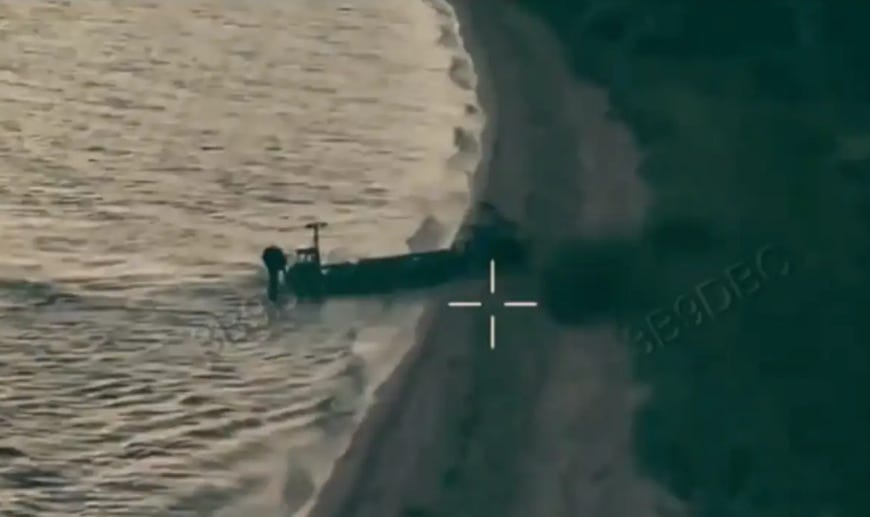
On July 13, 2026, Ukraine’s 123rd Separate Territorial Defense Brigade conducted what it described as the world’s first known combat operation combining an unmanned surface vehicle (USV) to land an armed unmanned ground vehicle (UGV) and engage targets on the Russian-occupied shore of the Kinburn Spit.
Here is what I wrote in September of 2025, less than one year ago, forecasting this exact scenario: an all-drone assault on a contested shoreline, sparing Ukrainian lives. I specifically mentioned the Kinburn spit because it is a narrow, exposed shoreline, the perfect terrain for a technological testbed.
In 2026, Ukraine will be fighting Drone War 3.0 with a combination of s-UAVs and armed UGVs. Conceptually, the amphibious invasion of Crimea becomes tenable when the beaches are to be stormed by robots: some shooting at anything that moves, others laying mines on roadways, all disembarking from sea drones in place of men, some of them driving inland to launch waves of tiny, buzzing drones for close air support in place of fighter jets. We are more likely to see Ukraine try that out on the Kinburn Spit instead of Crimea, first, but we will eventually see it, at this rate.
Here is a 57-second video released by the 123rd. After the usual music and graphics with the B-roll of the Ukrainian operator, we get about 20 seconds of actual video showing the drone land and fight. The Roboneers vehicle was equipped with a 7.62mm PKT machine gun — more or less equivalent to the US M-60 — to shoot at what appears to be a rectangular defensive structure, likely a concrete shelter. The spit is said to be riddled with them.
When Ukraine is able to do this at scale, landing many UGVs while also covering the beach with aerial drones (FPVs, fiber optic, Vampire bombers, etc), the Kinburn Spit will be nigh indefensible by humans alone. Russian defenders have minimal logistics, while the Crimean peninsula is increasingly untenable under constant Ukrainian drone attack. The spit is one of the decisive strategic terrain features of the war, so a robotic offensive could very well develop into an historic offensive.

When might this happen? I don’t know. A year, or two years. My scenario became a real experiment in 10 months. Drone warfare changes in the Ukraine theater every six months and no technological edge seems to last more than 18 months. Ukraine has built up a development lead in UGVs and USVs, however, and given the state of the Russian war machinery, it seems unlikely to me that they will catch up. This is a broad divergence between the combatants that may shape the end of the war.
Ukraine Blows The Lid Off Putin's Economy
The lids on large petroleum tanks like this one are not fixed into place. They float on the surface of the oil, sealed to the wall of the tank, so that pressure changes do not damage the structure. This one was reportedly struck by a Russian surface-to-air missile that failed to intercept a Ukrainian drone that reached Moscow. Iconic now, the images of this explosion have become a visual shorthand for Ukraine’s long-range campaign against Russian economic and military targets and the ineptitude of Russian responses.


