
Year Five Of The Three-Day Special Operation
Historic defeat and the delay of the inevitable

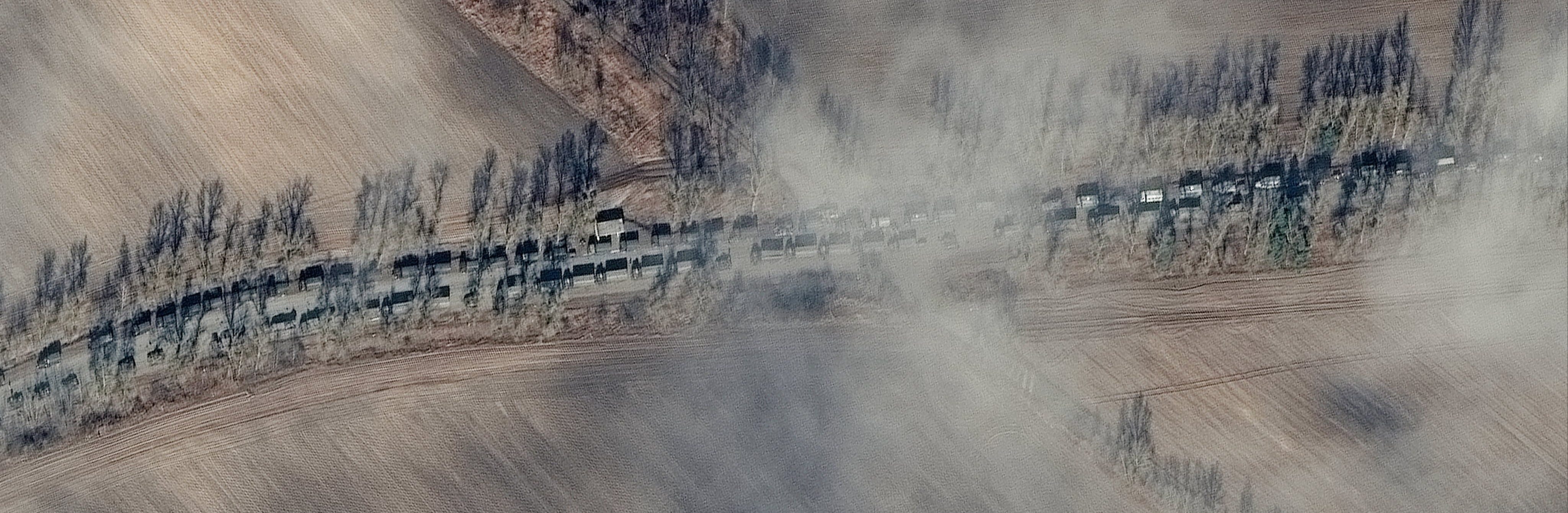
The renewed invasion caught the world off guard. It caught me off guard. I did not think Vladimir Putin was dumb enough to really do it. Turned out that the CIA and MI6 were right, he really was that dumb. As I plumbed sources of information, it became clear to me over the first 24 hours that something had gone catastrophically wrong for Russia. Huge columns of armor were stuck on the way to Kyiv and Ukrainian counterattacks were gathering in strength. The fight for Hostomel Airport was a very near thing, but a combination of early warning, preparation, and prompt response cut the airborne bridgehead that Russian special forces were supposed to secure for the mighty columns on the highways.
As Day 4 dawned, a belated reflexive withdrawal was evident north of Kyiv. Ukrainian fighters were inflicting huge losses on Russian units, the objectives were out of reach, and most annoying of all to Russians, the Ukrainian Air Force had failed to stand down and Ukrainian air defenses were resilient, so that Russian pilot and plane losses were unacceptably high. Some of the best units in the Russian ground forces were virtually wiped out. The invasion was already a fiasco. Over the next few weeks, before the Russian pincers all recoiled and redeployed to the east of Ukraine, one could discern major errors of military planning as the fog of war cleared.
Many Russian commanders were issued decades old, Soviet-era maps of Ukraine. Basic land navigation errors were inevitable and frequent. To resolve this command-and-control confusion, Russian officers used their radios. Most often, these were cheap Chinese-made sets, usually Baofeng brand, intended for civilian use and therefore unencrypted, single-channel devices. Even amateur Ukrainian radio operators were able to intercept and jam and exploit these conversations. Thus two failures compounded, with effects throughout the force. Those mighty columns seemed enfeebled because the Russian system of command and control was in fact very feeble.
Now the Starlink whitelist in Ukraine has exposed the fundamental lack of Russian independent adaptation in this domain because those intercepted and recorded conversations are once again abundant. “As far as I know, that Gazprom thing is f**king shit”, one Russian has now been intercepted saying. “The neighbors have a ‘Gazprom’ terminal. It works on those ‘Gazproms,’ yeah, sure — when it actually connects,” another Russian says in another intercepted conversation. Gazprom’s Yamal satellite constellation is simply no match for the stability of Elon Musk’s. It lacks the bandwidth for video uploads, and worst of all, does not support drone control like Starlink does.
Russia has a space program. They had four years to come up with their own Starlink, launch it into space, and avoid the trap of dependency on a technology that could be taken away so easily. This is one example of a broader Russian failure of adaptation. Centralization, even re-Sovietization, of the economy for war has succeeded where it favors specific war industries — for example, ramping up production of fiber optic wire for drones — at the expense of the civilian economy, especially the banks. Forced loans to favored state contractors have filled balance sheets with high-risk debt and it is just a matter of time before the crisis requires a federal bailout from a depleted sovereign wealth fund.
The result is that Russia spends more to get less. Likewise, the culture of command in Russia promotes corruption instead of confidence. This has not changed, and it is still resulting in occasional purges of generals and officials. Bad news is punished in this system, which rewards lies, creating the battlefield ‘gray zones’ that Ukraine has learned to crush. Rather than promote competence and reward innovation, Putin has systematically punished his most successful people. The survivors are the ones who told him what he wanted to hear and then did not get caught lying, yet.
Resource management has been a key question. How much real economic damage does Russia inflict on Ukraine by using an advanced missile against an apartment building? If memory serves, this happened the first time on Day 4, 27 February 2022, right as the attack on Kyiv was being canceled. It has always been a form of punishment for successful resistance. Ukraine’s Air Force was intact largely because Russia had failed to overwhelm it with missiles, and then it was too late. Strikes on power generation facilities have more obvious economic effects, but Ukraine now manufactures far more war material then it did four years ago, and Russia has failed to put a dent in production through long-range strikes. Instead, every flurry of Iskanders seems to be aimed at apartment blocks.
Setting humanitarian concerns aside, this is highly inefficient warfighting, just like the ‘meat wave’ assaults. It is a form of war that has been optimized for control at the center instead of achieving decisive strategic results. The reason we see so many stories about Russian commanders killing their own troops as they retreat, or try to surrender, is that results on the battlefield do not matter in the Russian chain of command. All that matters is the perception of results in the Kremlin. Sergei Shoigu did not go all at once; he went slowly, fading into the hedge like Homer Simpson, as he failed to produce results. His loyalty was absolute, however, and this keeps him alive, free from prison. Valery Gerasimov has likewise faded, fails to produce results, but stays alive, outlasting Shoigu, through even more doglike loyalty.
Of all the factors that I identified in Russian defeat four years ago that have gotten worse, dependency on fossil fuel exports — so-called Dutch disease — has become the most spectacular Ukrainian campaign of all: the drone war against Russian oil infrastructure. Conducted with increasing intensity, ferocity, and success, this campaign struck a new high point on Sunday. “The Kalyeykino station is described as a key node for transporting Russian oil. It receives crude from Western Siberia and the Volga region, blends it and feeds it into the Druzhba pipeline, a major artery for Russian oil exports”, Ukrainian Pravda reports. The target is more than 700 miles (1,200 km) from Ukraine, which had no such capabilities in February 2022.
So much for the ‘de-militarization’ objective of the special military operation. Now in its fifth year, the war is finally reaching a predictable, and long-predicted, moment when the economic fundamentals of Putinism simply fail. There was no significant tax base in Russia four years ago. Income taxes were flat, now they are progressive by income. During 2025, corporate tax rates went up along with VAT (value added tax) on everything. The Russian Ministry of Finance sees this as a harvest, but it is effectively punishing average Russians with every loaf of bread and bag of cucumbers.
The immiseration of Russia is now well underway. The price of defeat grows all the time, and the further it is delayed by stopgap measures, the deeper the reckoning will be. None of the fundamentals has changed because Russia has not changed, except for the worse. But that is true of Russian history in general.

