
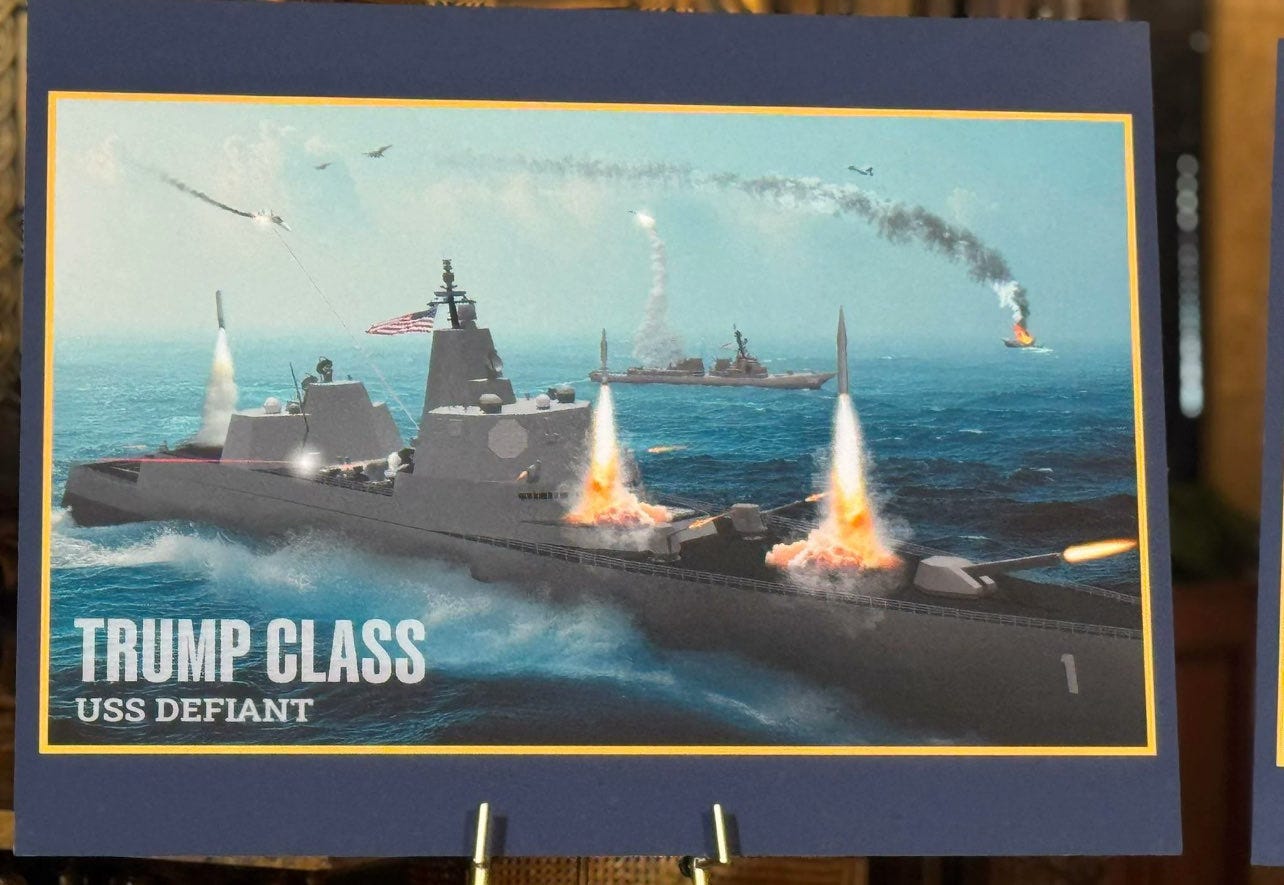
Why America Gets Battleships For Christmas
And a ton of half-baked opinions about them
We are used to thinking of ‘battleships’ as hulking metal monsters with great, huge guns because that is what battleships became in the 19th century. The western concept of a ship fighting mainly with broadside gunnery begins right around 1500 AD, when European carpenters first cut gunports in the sides of wooden ships.
The history of the all-metal, line of battle ship — the phrase from which we get ‘battleship’ — lasted from the launch of MN Redoubtable in 1876 until the commissioning of HMS Vanguard in 1947, a surprisingly short 71 years. Altogether, if we exclude coastal battleships and ironclads, the various navies of the world commissioned a total of 421 battleships during that time, or less than six per year on average.
Of those, over 400 ultimately ended up as recycled scrap metal. Just nine are intact as museum ships around the world, mostly in the United States. Many combat losses, such as the battleships sunk in Pearl Harbor, were raised to fight again and then scrapped, or else raised and then scrapped. Altogether, I count 57 combat losses of battleships from every cause. My research has located twelve battleships that sank from accidental internal explosions, all during the pre-dreadnaught and early dreadnought period.
The point of all this historical context is that while very large ships are expensive, and the battleship race was indeed the most expensive arms race the world had ever witnessed, obsolescence came quickly. The average battleship arguably served about eleven years before it was second-rate, and in many cases where final commissioning was delayed for budgetary or other reasons, its useful front-line service life was less than that. Things are different now. Ships serve much longer between refits because they can be upgraded with software.
A more subtle point is that almost all of those battleships were completed in peacetime. Historically, wartime causes an instant crash in large hull starts and an associated explosion in build starts for smaller craft. I have found this happening in the English Civil War, the Napoleonic Wars, the First World War, and the Second World War, all with remarkable consistency. I would even argue that the Cold War saw no new battleship starts because the same incentives applied.
It certainly wasn’t air power that ended the battleship, indeed the battleships of World War II were festooned with antiaircraft guns and served as the backbone of flotilla defense against aircraft. Battleships also served as gas stations and supply stores for smaller ships, such as corvettes and destroyers, that did not have fuel tanks quite as large — a function of the square-cube law that makes a larger ship have vastly more space than a smaller one. Aircraft carriers were not built to take punishment from bombs and torpedoes because their internal space has to be devoted to hangars and bays.
Lack of a mission, not politics or technology, has prevented the appearance of a new class of large warship designed to fight for control of the oceans since 1947. Or, to put it differently, the big guns of the battleship were the part that became obsolete, and no new technology has come along that required a very large warship to carry it around. Until now.
Now, there are weapons demanding a ‘deep magazine’ in the form of power supply, as well as solid-state radio electronics that take up space, power, and surface area. I have covered these topics here in my coverage of directed energy weapons and electronic warfare. Rather than 16-inch shells, the proffered ‘Golden Fleet’ design mainly fights with missiles — they are listed as the “main battery” of the ship. This vessel is not supposed to get anywhere near the enemy, it is supposed to destroy targets from standoff range.
The truly historic thing, which few naysayers seem to note at all, is the pair of powerful lasers on the ship. While the laser itself is not huge, it requires a substantial power supply and cooling apparatus that do take up plenty of space. The more powerful the laser, the more space it takes up, and 600kW is a very powerful laser, six times more powerful than Israel’s Iron Beam.
Before you get too excited, any laser will have a maximum range of about six miles, less in poor weather at sea. Mainly, they will be counter-drone weapons. Each ‘shot’ of laser energy will cost around $50 as opposed to the $950,000 RIM-116 Rolling Airframe Missile (RAM), the US Navy’s primary surface-to-air missile against close-in threats, which is carried in two launchers.
Likewise, the radar-guided 30mm guns fore and aft are cheaper alternatives against a drone than the Phalanx CIWS (close-in weapon system), which costs about $3,500 to fire for one second. Two more unspecified counter-drone (the Navy calls them counter-UxS) systems are listed in the specs. These might be high power microwave (HPM) weapons designed to fry the electronics of a drone.
The ODIN lasers on the other hand are dazzlers, used to blind a drone. As I have explained elsewhere, defending the Taiwan Strait will likely require a period of escalatory actions short of war to deter Chinese invasion. ODINs are not as powerful as the secondary battery lasers are supposed to be, but they still require power and cooling.
Of all the items listed in the secondary battery, the railgun seems least likely to be realized. While Japan has successfully fielded one, the US Navy has found them too delicate, getting only ~100 shots out of them before the rail gun begins to stop performing up to specs. In a war for the Strait of Taiwan, this will not be good enough to sustain a battle.
The two 5-inch guns are essentially a battery of 127mm artillery perfectly suited for shore action. While we are unlikely to see surface combatants engage with guns any time soon, even in the Taiwan Strait, there will always be calls for fire from troops on shore. “HVP” refers to high muzzle velocity projectiles, new ammunition that can be fired at targets over 40 nautical miles away. At that range, hitting a moving target will still be nigh impossible without further technology.
But it’s the cheeks of this thing that require it to the size of a battleship, so that we might as well agree to call it one, and this is not negotiable in the Navy’s next class of surface combatant. Anyone who has laughed at the ridiculous appearance of older Arleigh Burke-class destroyers retrofitted with superstructures that overhang the sides of the ship to accommodate these systems will have already perceived what is actually going on, here. American fighting ships must be wider, which means longer, which means more displacement. The above specs put this thing at 3.5x the displacement of a Ticonderoga-class cruiser. What other word would you like to use for it?
Referring to the above diagram, AN/SPY-6(V)1 is a radar system that can track multiple objects and guide the weapons on board the ship to target them. SEWIP Block III is the AN/SLQ-32 electronic warfare suite featuring an AESA (active electronic scanning array) that can create pencil-thin beams of radio energy to jam or spoof the control signal receivers on board those objects. The two systems are complementary by design. They proved their worth in the Red Sea, costing pennies per use. But they both require four large, flat surfaces and together they widen the superstructure. This is a hard engineering fact, not a political point.
At sea, form is function. The entire function of this proposed design is to fight the drone-centric 21st century war of attrition at the lowest possible cost. The US Navy has suffered a series of false starts in shipbuilding in recent decades (Zumwalt, LCS), but thankfully these classes were not built in the numbers planned. These ships will likely sail for decades, if they are built, and building them this way will probably make them easier to upgrade.
The new battleship is definitely the size of a battleship, it is built for 21st century naval battle, and that will all still be true no matter who the president is at the time. Donald Trump is a brand. He sees a building he likes, he puts his name on it in gold letters. This is more of the same. It is not complicated, it is not stupid, and it is in fact where American navalism needs to go, no matter who the president will be tomorrow. Everyone I follow who has been paying attention to these issues — shipbuilding, non-kinetic weaponry, and the advent of the drone war — understands these stakes, and they are excited. Maybe, just maybe, America can get a new ship class right, after all.
It is my observation on the other hand that the derision towards the above diagram is not coming from these experts, but from Dunning-Kruger expertise, the kind that has never studied the problem of marine architecture, let alone the current military revolution, and does not have an alternative solution. They are experts on battleships because they are experts on Donald Trump. Seriously: ask anyone who says this is a dumb idea what their ideal naval procurement strategy would be, and you will find out in under a minute just how dumb that person really is about the state of the art in naval affairs, let alone the history thereof. If they say his name even once, stop listening.
The most historically important point I wish to make here is that we need these ships to be under construction yesterday. Obsolescence begins at the point of design in naval architecture, not the date of commission, so the faster we build some, the better off we will be. If war breaks out, there will not be time to start building them, any that are under construction may stop, and any that are about to be built may not be started, all due to the pressing need for smaller vessels. Just ask the USS Montana. The most perishable resource in fleet development is time.
Hazardous Histories: Twelve Battleships Destroyed By Internal Explosions
A battleship is a great, big bomb waiting to explode. The naval architect must perform a balancing act between armor, machinery, and those huge, heavy guns. No perfect protection scheme was ever devised for the magazines of battleships. Famous examples of battleships exploding and sinking (or exploding while sinking) in combat abound: the IJN


