

Trump's Leveraged Buyout Of The Persian Rug Bazaar Is Happening Now, Cope With It
Peace with the Great Satan will require changes in the regime
We are supposed to get peace in the Middle East this Friday. Actually, we are supposed to get 60 days of peace while the United States and Iran reach a deal on neutralizing the enriched uranium stockpile, so that there can be permanent peace. The Strait of Hormuz is supposed to reopen for business this week. Actually, it will take a month. At the time of this writing, no one has seen the actual text of the agreement.
But it is still happening.
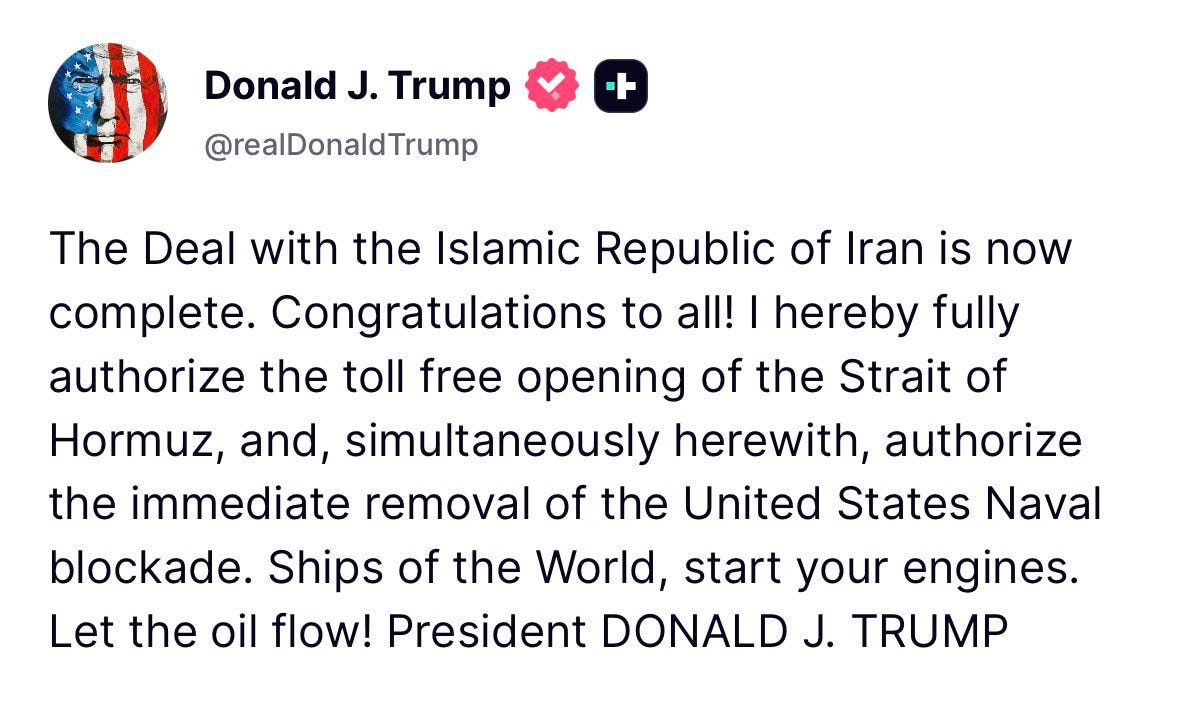
Trump was not supposed to ever get this far. He was not supposed to have any deal, and now that the ink is reportedly drying on a preliminary deal, it is supposed to be a bad deal.
If the deal sticks, and the restoration of frozen funds and the unwinding of sanctions follow on deliverables from Iran, that is not a bad deal. If the deal falls apart, and Iran gets loads of cash but never delivers, that is a terrible, no good, very bad deal. But we don’t know what sort of deal it will be until it is in place.
Not being psychic, I don’t know what comes next. I only know what keeps happening. Negotiations were in a quantum state again one week ago. Then things blew up. Trump made a threat of further action.
Moments later, he announced negotiations were back on, in fact a deal was closer than ever. Then Iran leaked a wish list of fourteen points, presenting them as if the American side had agreed. They did it again this weekend.
Last week, Vice President J.D. Vance refuted the Iranian leak in detail. “The president is going to get us a good outcome, one way or the other”, Vance posted on X. “First, the Iranians are not receiving any cash, and no funds are being released for simply signing a deal or attending a meeting”.
Vance is flying to meet with the Iranian side on Friday. Emphasis added: “The deal is structured to ensure that the US and its allies concerns are prioritized, and that if the Islamic Republic of Iran meets its obligations, then economic benefits will flow to them and to the entire region. This deal has the potential to remake the region and lead to lasting peace.” Historic, if it holds together.
This cycle of announcement and denial, in which Iran claims various diplomatic victories that don’t exist, happened again over the weekend. There were false reports that the UAE had already released billions of frozen dollars to Iran. Emirati officials shot the report down. The IRGC also launched a salvo of drones into the strait and the US Navy shot them down.
American forces are not leaving the region yet. They will stand down as Iran stands down. Destroying the uranium on-site requires Iran to admit Americans to the country. In 107 days, Trump has made more progress towards a comprehensive peace deal with Iran than the other six presidents who have served a term since 1979.
I lived through the 444-day long hostage crisis, so this little dust-up has been a blink of the eye, for me. I remember what a gasoline crisis looks like and this little war was never at all like that.
Once again, I am told that this is all bad for Trump, that he has surrendered to Iran because he negotiated with the regime instead of destroying it. In fact the Islamic Republic is tapping out at last, trapped in an economic snare by the iron laws of material war.
On Friday, they must shake hands with the Great Satan and go the way of Venezuela. If Iran learns to respect the new set of rules, then the regime is altered, and it will never be the same. No Iraq-style regime change was necessary.
Peace through superior economic power
“Iran will have to pay a price”, Trump said last week. An Iranian drone struck an American attack helicopter, forcing the pilots to ditch. They were recovered by an unmanned surface vehicle (USV), a sea drone. On Wednesday, American bombs struck multiple IRGC targets across Iran. A control center in Robat Karim, a city in Tehran province, was destroyed. Hashtgerd, Abyek, and Varamin, all in the north, were hit along with the port cities of Bandar Abbas and Sirik.
“Based on the fact that discussions with the Islamic Republic of Iran have been brought to the highest level of Iranian leadership and approved, I have, as President of the United States of America, cancelled the scheduled strikes and bombings against Iran this evening”, Trump announced Thursday on Truth Social.
Discussions and final points have been, in both concept and great detail, approved by all parties involved, including the United States, Israel, Saudi Arabia, UAE, Qatar, Turkey, Pakistan, Bahrain, Kuwait, Jordan, Egypt, and others. The Naval Blockade will remain in full force and effect until this Transaction is finalized — Time and place of the signing to be announced shortly.
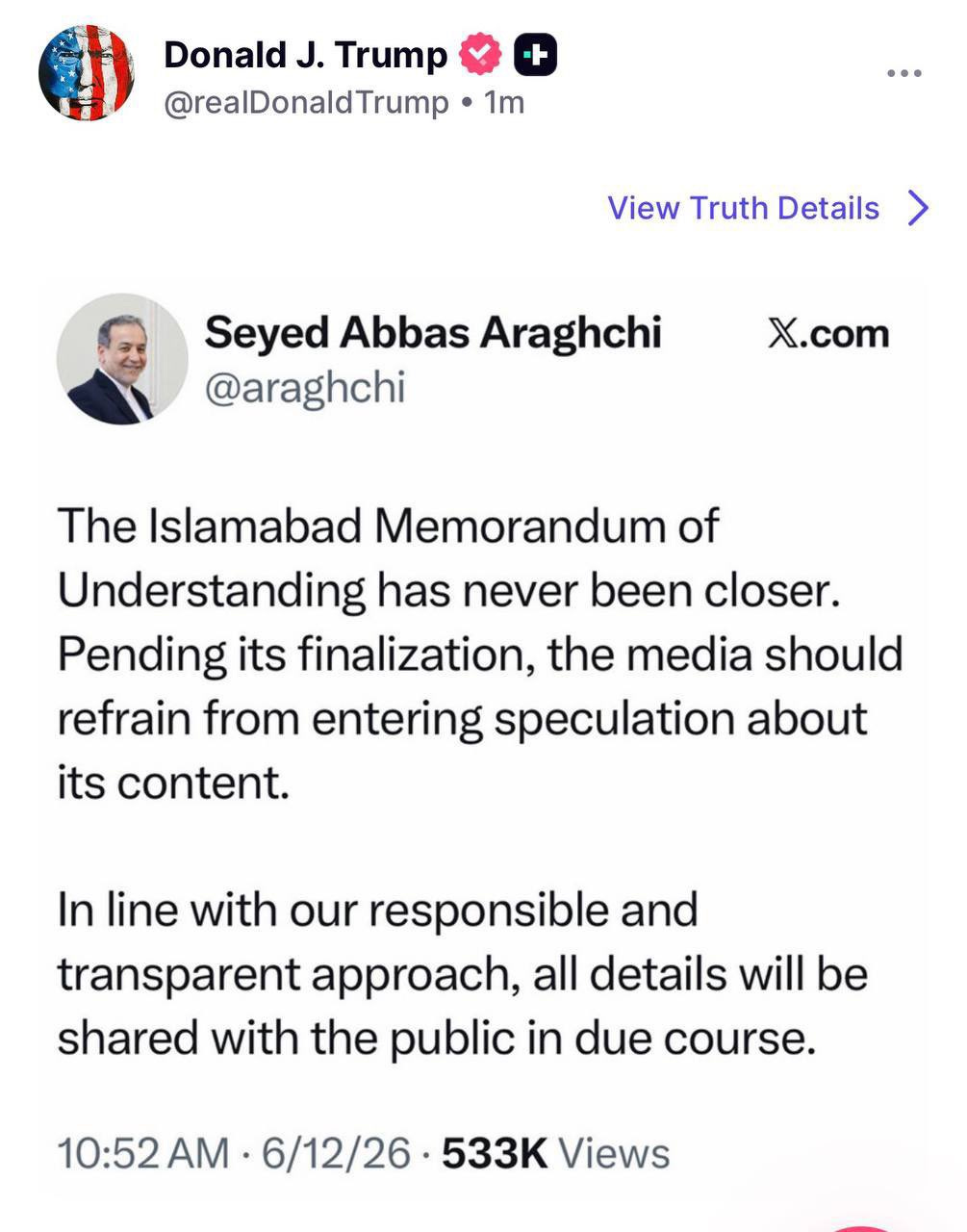
On Friday, Iran’s foreign minister tweeted a confirmation that the negotiations are close to agreement, indeed they “have never been closer”. Abbas Araghchi took the unusual step of dispelling rumors. Power is so fractured in Iran, and the remaining regime so disunited, that Trump’s hardest problem was finding negotiating partners to represent the Islamic Republic. Note that his partners were the civilians, not the clerics or the generals.
Mojtaba Khamenei, the hidden and maimed cardboard cutout supreme leader, reportedly insisted on having his opinion consulted before the Islamic Republic could agree to sign the peace deal. Just as the clerics have declined in power relative to their generals for many years, they have played a reduced role in the negotiations.
His stamp of approval gave the civilians some leverage over the IRGC, however, which is how the consensus for an agreement happened in Iran. Meanwhile, American kinetic action has been laser-focused on degrading IRGC leadership and capabilities throughout the economic phase of the conflict.
The most recalcitrant part of the regime has been targeted the most during Operation Economic Fury, which has lived up to its name. Iran’s ‘resistance/shadow economy’ has likewise been greatly diminished. About half of Iran’s GDP has already been destroyed, according to some estimates.

This point bears emphasis: Tehran does not have the money right now to rebuild a nuclear program, and also rebuild a missile program, and also build infrastructure to circumvent the Strait of Hormuz, and also stop the soaring inflation that is killing Iran’s economy. Getting back to February 27 is impossible, right now, for Iran and the IRGC.
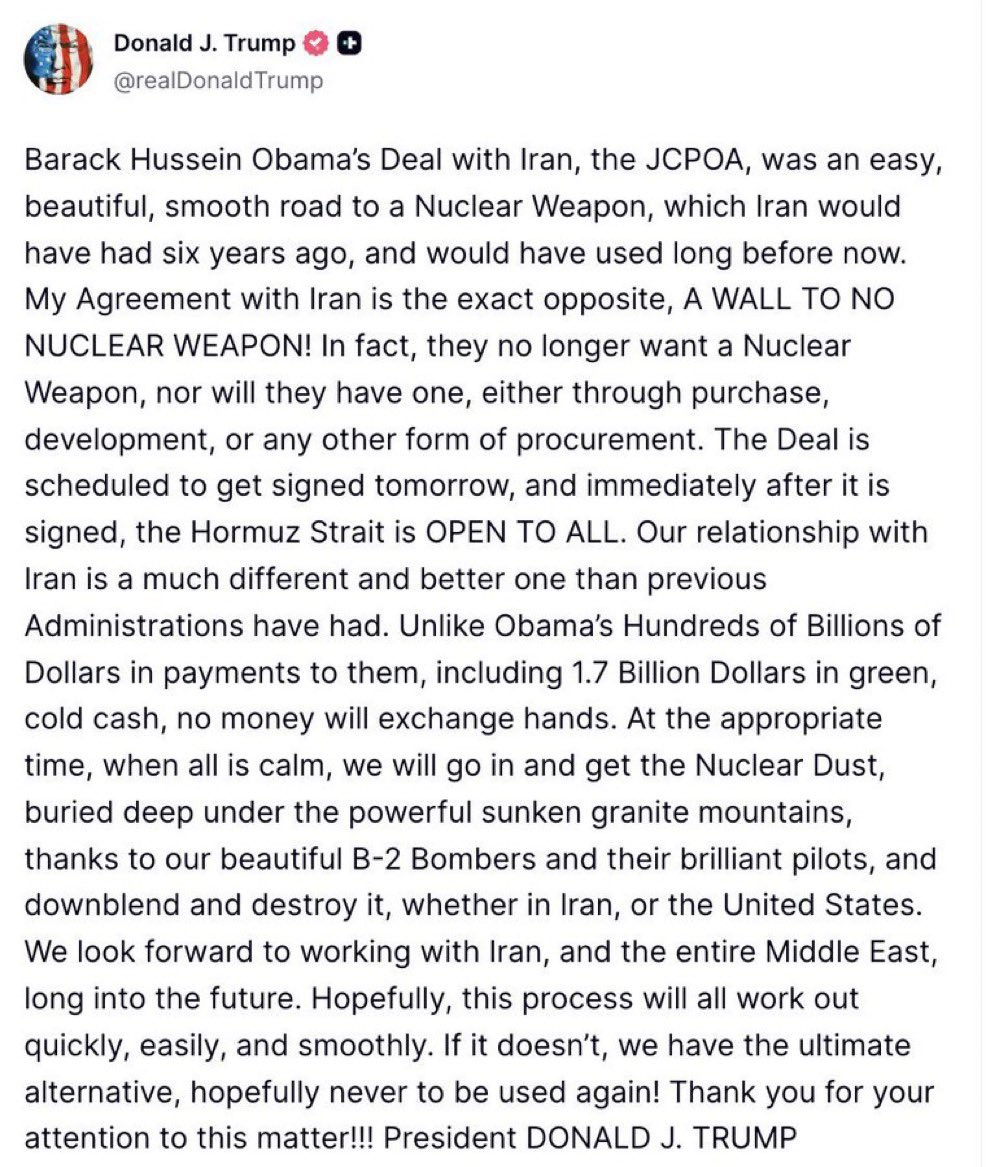
Trump offers economic incentives in return for performance. This has never been tried in the history of American diplomacy with the Islamic Republic. If Iran does surrender or neutralize their uranium, and does give up on enrichment, then his biggest victory point will have been achieved.
To quote Ronald Reagan, “trust but verify” is the best instruction, here. Trump is making it clear that if he doesn’t get what he wants in the time frame that he wants it, he is willing to use force again. This is a leveraged buyout with military force as one form of coercive leverage.
Iran is still claiming that the deal will involve a new cooperative authority over the strait they share with Oman. This same talking point has been mentioned for weeks, and like the immediate handovers of cash that are not happening, this could very well just be the regime inflating claims of diplomatic success to avoid the shame of admitting defeat by the US Navy.
How Iran lost their Hormuz leverage
Donald Trump also claimed last week that American forces had quietly helped “between 14 and 26 vessels” a night transit the Strait of Hormuz in both directions by destroying or suppressing IRGC radars. Altogether, more than 200 vessels had reportedly passed through the strait via this “Omani route”. There is plenty of evidence to support his claims.
“Whilst underway in the route, the US advise that the ship should be blacked out with navigational lights off. Radar use should be minimised and AIS turned off,” reads a 5 June advisory from INTERTANKO. Per the name behind the acronym, the International Association of Independent Tanker Owners is a membership organization for owners of oil tankers.
“According to the association, vessels provide transit timings and waypoints to U.S. forces before entering the route.” The program has been relatively popular. “In May, 67% of vessels not involved in Iranian trade passing through the strait turned their AIS off”, Lloyd’s List reported this week. “Security concerns drive the blackout as ships aim to make it harder for Iran to identify, target or attack them”.
Of course, before February 28th, when the US and Israel began their 38-day kinetic campaign, over 100 commercial ships passed through the Strait of Hormuz every day. Breaking Iran’s hold on Hormuz had not restored traffic altogether.
But now contrast Iranian propaganda claims that two dozen oil tankers had evaded the American blockade in recent weeks. These claims are contested. Even if they are true, the US Navy is helping the same total number of ships evade the IRGC on a single good night.
Most of this battle was invisible to journalists because it took place in the electromagnetic spectrum. Iran could not overcome the imbalance of air and sea and electronic warfare power arrayed against them. It was eroding their leverage throughout the economic phase of the conflict. Iran was losing by resisting.
The approach seems to have worked. I was repeatedly assured that it would never work. Trump on the other hand understands that he can bring these capabilities back into force any time he wants, that it will work again if need be. He retains the military leverage.
Tehran has capitulated to reality. Pride won’t let them admit defeat, of course, which is why we see all their propagandistic effort to spin the agreement as a win for Iran. They have the help of western critics who spin every event as a loss for Trump, but also the amplification of pro-Israel hawks.
Many Israelis and supporters of Israel don’t want the war to stop at all. They oppose a comprehensive peace plan because they do not believe Iran will ever agree to actual peace. They have their reasons and I will not debate them.
Rather, I was repeatedly assured that these Israelis control Donald Trump, that it is entirely their fault that all of this happened. If so, then it was the most unsuccessful mind-control exercise in the history of psychological operations. Trump is reportedly upset at Netanyahu and the Israel lobby is upset at Trump.
Peace was not part of many plans, and those people are the most upset. Unpossible! I was repeatedly assured that Benjamin Netanyahu controls Trump, and this is why the war would never stop until boots were on the ground doing regime change. We were having World War III because of Israel, they said.
The peace deal exists between three forces that wish to undermine it: Iran, Trump’s domestic enemies, and the advocates of permanent war with the Islamic Republic. To sustain his peace, Trump will need the continued support of his Arab allies.
Trump leveraged his alliances
Turns out that Trump has his own plans independent of the Israelis. Perhaps the Israelis feel a little used. Whereas the IDF was America’s only partner during the kinetic phase, Israel now plays the spoiler role.
Today, Netanyahu has reportedly told Trump that Israel is not bound by the Lebanon clause in the US-Iran agreement. He has complained at not seeing the agreement in writing. After Operation Epic Fury gave way to the ceasefire trap of Operation Economic Fury in April, Israel steadily became less important to Trump while his Arab allies applied economic pressure.
Tehran appeared to be feeling the pain of the Arab-American economic war during May, and we are right on the time-horizon of forecasts for permanent economic catastrophe in Iran during June. The regime needs relief immediately, whereas time is leverage for Trump.
The result has been a furtive process. Trump has consistently applied force and then time. During the third week of May, Trump announced that serious negotiations were underway, so he had suspended action. He said that this occasion was “a little bit different” from previous diplomatic contacts. It was true.

Last week was another fitful effort by some in Iran to break out of the ceasefire trap. When it failed, there was an agreement, at last. Arabs, not Israelis, were the allied partners that turned out to be decisive.
During May, Trump said he was negotiating on behalf of Qatar, Saudi Arabia and the United Arab Emirates. This also turned out to be true, and the Arabs have applied the decisive economic pressure on Iran.
The Islamic Republic attacked their Arab neighbors anticipating an uprising and jihad. Instead, the Arabs redoubled their efforts to circumvent the Strait of Hormuz. Each has gone their own way, in some way, while all of the Arab gulf states have cooperated in starting or speeding up infrastructure projects to circumvent the strait.
Qatar reportedly reached a modus operandi with Iran in which Tehran received cash in return for safe tanker transit. Qatar also served as a key partner negotiations with Iran. Some Israelis see Jared Kushner and Steve Witkoff as Qatari stooges influencing Trump to sign a bad deal.
The reader is free to believe what they want. Duplicity is not unusual in Persian Gulf politics. More important, from Trump’s perspective, was that Iran stayed inside the ceasefire trap. As long as his close confidants were in regular contact with negotiating partners through Qatar, Trump did not have to depend on Pakistan or the formal diplomatic process. He had parallel flows of information.
Compared to the IRGC, Trump clearly had a more realistic idea of what the Arab response would be when Iran began to shoot missiles and drones at the crown princes. Instead of street uprisings and jihad, the Arab states stayed calm, carried on, and pursued peace through economic pressure.
Trump’s Arab partners are the most interested in peace. Instead of boots on the ground, burning oil, and an oil-slicked sea, they wanted a deal that ended the conflict with as little destruction as possible. Their influence, rather than the favor of Benjamin Netanyahu, has shaped the character of this deal.
Shaking hands with the Great Satan
Lebanon has the highest chance of derailing the process. Of all the players in this peace plan, Hezbollah is the least cooperative. Israel has all the military leverage in Lebanon, which complicates Trump’s ambition to end Iran’s proxy war. This will be his hardest goal to realize. Trump does seem determined to end the proxy wars, which would effectively snuff out the IRGC’s foreign mission.
A lot of people will have to get over a lot of stuff. Trump does not care to leave any part of the conflict frozen. He wants a comprehensive peace. Rather than purchase the uranium carpets, the missile program carpets, the Hormuz carpets, the capital flow carpets, the proxy militia carpets, and the oil carpets one at a time, over a long time, Trump aims to buy out the whole carpet bazaar at once. This is a leveraged buyout in the structuring and financing phase.
Donald Trump has already done the valuation. After the transaction is executed, he aims to create value and withdraw American military power from the Middle East, cashing out of the decades-long scheme in which American taxpayers underwrote the world’s gas station. Regional bases damaged by Iranian drones are merely distressed properties being leveraged for the buyout. Americans will not miss them.
Altering the relationship between Washington and Tehran alters the regime in Iran. Connecting Iran to the international banking system, for example, would also bring the regulatory power of the Treasury Department to Iranian banks.
Different factions will have different reactions to these developments. The IRGC does not want Scott Bessent looking over their shoulder, whereas the business community would welcome dollars in their accounts. Remember, the regime started cracking in late December, when US sanctions against Iran’s shadow fleet spiked inflation, and the bazaaris led the resulting protests.
Regime change is underway, if incomplete. New players hold more power, while the hardest hardliners hold less power. A new, diminished supreme leader has only perfunctory power. The people have never had any real power in Iran, a condition that is made possible by economic isolation.
Now the regime must smile and shake hands with the Great Satan. Economic normalization is to be the reward for behaving like a normal country. If it works, nothing inside Iran can stay the same as it was before. If it works, then the Islamic Republic will change, despite itself.
Those are big ifs. They might still not happen, but then again Trump was never supposed to get this far. We are here now, and everyone must get used to this new normal.
Iran Is Caught In A Ceasefire Trap

By Monday morning, the Islamic Republic had fired a “limited number,” “barrage,” or “salvo” of “about 10 missiles” at Israeli airbases. First Ramat David was targeted, then Nevatim, and then Tel Nof on Monday mor…
New subscriber here
Thanks for another incredible article. This is the kind of analysis you’ll never see in a million years from the media or the “experts.”
Keep up the great work Matt and thanks