

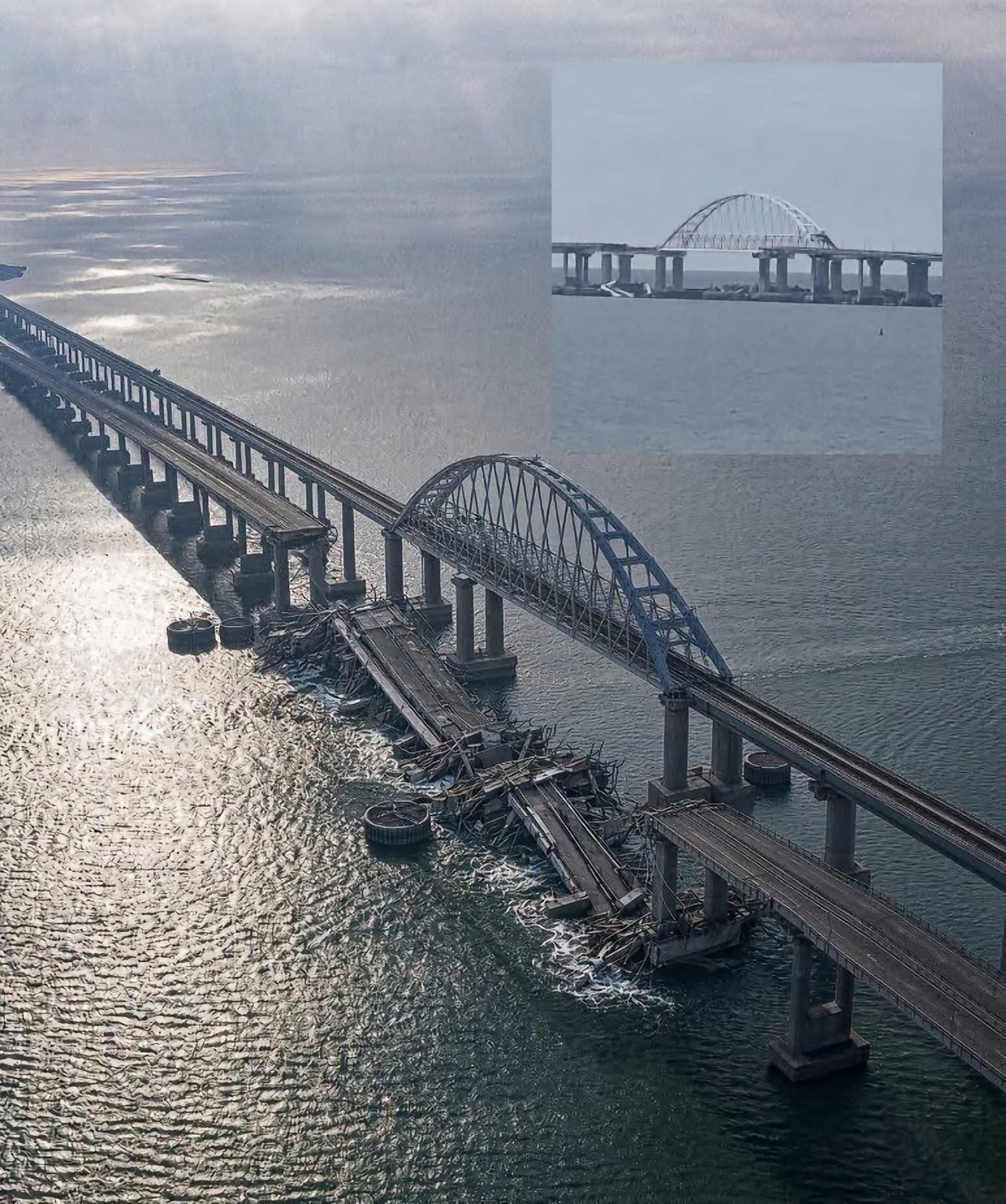
Russian news agencies are reporting that the Kerch Strait bridge is out of service today. Multiple views of the damage show the shipping channel completely blocked by the collapsed arch, effectively cutting off Russian surface ships from passing between the Sea of Azov and the Black Sea.
On Telegram, President Volodymyr Zelenskyy described the strike as the culmination of a weeks-long campaign responsive to Russian strikes on Ukraine, including bridges — a counter-escalation.
Over the course of one month, the campaign “gradually destroyed air defense systems, radars, electronic warfare systems, and other designated targets along the route to the final objective”, cutting a corridor through some of the heaviest Russian air defenses anywhere.
Drones struck the bridge itself on Monday night, with at least one powerful detonation deforming the archway as much as 15 degrees, compromising the safety of the structure. The road surface also appeared to be damaged in at least two places, causing a temporary suspension of traffic. Rail traffic was restored by noon, with alternating traffic on one road lane.
Russian officials tried to minimize the strike, releasing a tightly-shot video of inspectors that did not reveal the extent of the damage. Ukraine was not done, however, and this pause was probably deliberate. Ukrainians have learned to exploit the ‘gray zone’ between what Russians say they do, and what Russians can actually do.
Overnight, during the wee hours of Tuesday 17 November, a second attack combining heavy drones (Palianytsia, Ruta, and F-5, as well as a new jet-powered Liuti, for those keeping track) and Neptune missiles struck the road arch and road span, collapsing it into the shallow strait. Zelenskyy posted telemetry video from what appears to be an FP-5 on final approach to the bridge. An eyewitness video online shows at least ten direct hits along the arch span.


Kremlin spokesman Dmitry Peskov said the bridge would be “even better than before” after repairs. The bridge will not be repaired quickly or easily, though. Winter storms are common in the strait, producing high wave action on the shallow waters. Ice frequently drifts into the strait as well, along with fog during the long nights.
Even if uncharacteristically good weather permits repair crews to arrive and begin clearing the debris, Ukraine will still have the means to strike any barges, ships, equipment, and machinery that Russia brings on site.
Rail traffic has resumed across the remaining railway span of the bridge. This may be Ukraine’s choice to reserve the target for another counter-escalation strike, if necessary, or it might be destroyed tonight. In the meantime, it is the last rail link to Crimea.
Ukraine’s middle strike campaign has covered the Zaporizhzhia Oblast “land bridge” for months, destroying hundreds of Russian trucks and shutting down the railway built to support the defense of Crimea in Kherson. All the key road links between mainland and northern Crimea pass over bridges that Ukraine has also targeted in the past, and with increasing ferocity this year.
For example, the Chonhar crossings, a set of road and railway bridges that link the isthmus with Crimea, started getting hit in June 2023. A series of Storm Shadow cruise missile strikes diverted traffic and forced repairs, but arguably the results were not worth the cost of the expensive foreign munitions. Ukraine resumed targeting the same points with their own, much cheaper, strike drones in 2026.
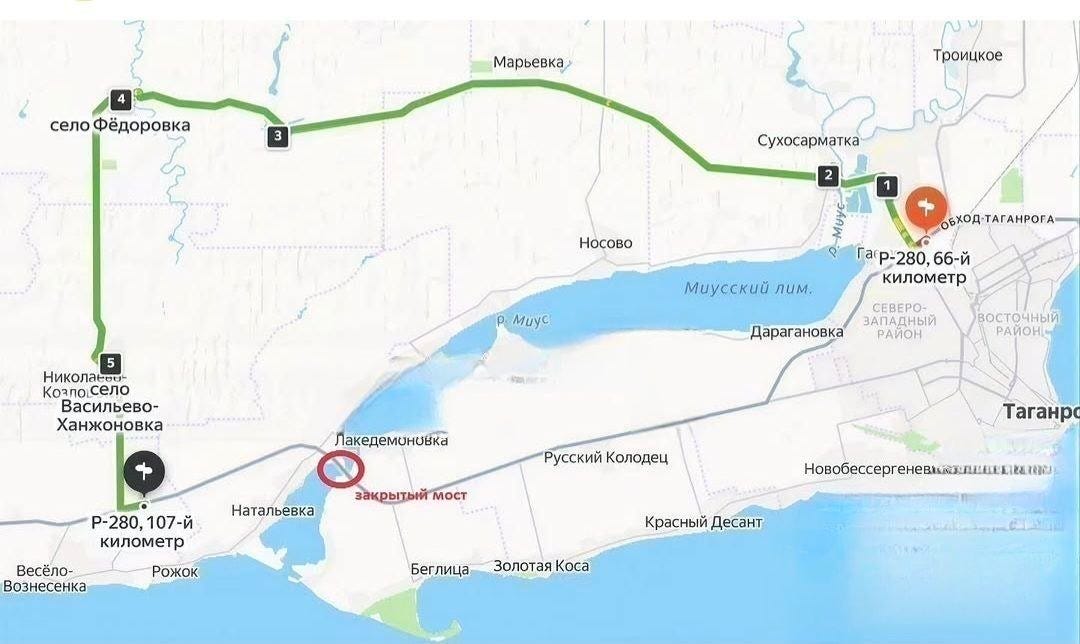
Russia has responded with rapid repairs, pontoons, and embankments, but the Chonhar crossings are still under fire. Traffic slowdowns add time and risk to every logistics trip, and the southern front is long. Moreover, most of these trips are taking place in civilian vehicles now, often in pursuit of black market profits. A reported post-strike exodus of civilians from the peninsula will increase prices in Crimea, if true.
Ukraine is not about to liberate Crimea any time soon. Reports of Ukrainian progress in the east are likely local follow-ups to local successes. The destruction of the Kerch Strait bridge merely raises the costs and risks of maintaining the Russian occupation of Crimea as well as the ‘land bridge’.

Operation Molochka, the June 2026 drone campaign against Russian maritime logistics around Crimea, reportedly struck 300 vessels, with 134 in the Sea of Azov, according to Unmanned Systems Forces (USF) commander Robert “Magyar” Brovdi.
Dozens of tankers were reportedly damaged. Because the Sea of Azov is ecologically vulnerable Ukraine specifically disabled these vessels rather than sink them and create oil spills. After months of Russian naval absence from the Sea of Azov, it is now cut off from Black Sea Fleet access altogether.
The logistical siege of Crimea is a long-running project made possible by native weapons manufacturing. Despite Russia’s continuing bombardment of Ukrainian cities with long-range missiles and drones, Ukrainian drone and missile production has grown exponentially and improved in quality. Whatever accuracy problems the FP-5 had when it was first used, Fire Point seems to have solved the issue.
Vladimir Putin will be very upset. The bridge was his vanity project, the symbol of his restoration of power over the storied peninsula. The more practical effects will be blackouts, water and food shortages, and increased labor costs in Crimea. Putin will want the bridge repaired, whatever the risk and expense.
The siege of the peninsula by fire has been underway for years, intensifying in stages. It has definitely reached a middle, and may even end sometime before the next decade. The larger war of infrastructure was bound to come for the Kerch Strait bridge again, sooner or later. Perhaps Ukraine will have to destroy it more than once. The point is that they can, whenever they want, and that is new.
Can The UK Even Defend The Falklands?

What if they had a war, and nobody could make it? The above image is a visualization of the Royal Navy. The entire Royal Navy, in effective terms.