

The IRGC Has Chosen Death By Strangulation
The humiliation of surrender was too much for them to handle
The cultures of the Middle East value public reputation and perceived dignity (‘face’) over material realities. To admit defeat is to ‘lose face’. In Iran, this concept is called aberu (آبرو, ‘water of the face’). To lose aberu is catastrophic to the individual, their family, and their larger group identity. Shi’a Islam intensifies this cultural characteristic. The Nahj al-Balagha (Sayings of Imam Ali) advises the faithful to “Attack them before they attack you. By Allah, no people have ever been attacked in the heart of their own home without being humiliated.”
Credibility suffers by the admission of defeat. Used in reference to military loss or weakness, the word dhull (ذل) implies disgrace, wounded honor, and loss of standing in the world. A strike on Iranian soil (the “heart of the home”, per Imam Ali) is experienced as symbolic violation and submission, to be expunged with the projection of shame on the attacker. This is why regime propaganda routinely describes the devastation of Israeli and American airstrikes as a ‘shame’ to the enemy. It only makes sense as psychological projection, a rationalization of defeat. Put simply, the louder Iran claims victory right now, the closer the regime is to defeat.
Regime defeat looms larger all the time. This week, the U.S. Department of the Treasury’s Office of Foreign Assets Control (OFAC) sanctioned 35 entities and people behind the shadow banking architecture of Iran. The targeted rahbar (رهبر, lit. ‘leader’) networks were built to circumvent western sanctions with shell companies so that the Islamic Revolutionary Guard Corps (IRGC) could access the international financial system. This is how the regime sells illicit oil, buys everything needful for war, funds their terrorist proxies, and builds their personal corruption nest eggs in western banks.
Operation Economic Fury is the new phase of operations that I told readers to expect even in the middle of Operation Epic Fury, that has the highest chance of success versus the least military risk, since Iran is ill-equipped to fight back. Regime messaging thus reflects the frantic avoidance of dhull at any cost. “The enemy is attacking our infrastructure and putting us under siege so that people become dissatisfied”, Iranian President Masoud Pezeshkian said last week. “We currently do not need the people’s sacrifice, but we request that people reduce electricity and energy consumption. For example, at home instead of having 10 lights on, let 2 lights be on. What is wrong with that?”
Meanwhile, the IRGC is clearly annoyed with their civilian leadership. Mohammad-Bagher Ghalibaf, the speaker of the majlis, has received pointed criticism for supposedly betraying the ideals of the supreme leader by agreeing to a ceasefire. “This isn’t an agreement. This is total surrender. The war happened, and Ghalibaf sold everyone out”, complained one source. Another demanded “the public execution of Ghalibaf, Zarif, Rouhani, and Araghchi.” Preserving the nuclear weapons program has become paramount to hardliners. Iran International reports that Ghalibaf has stepped down over his willingness to include the issue in talks, with the more radical Saeed Jalili replacing him.
“In Iran, there are no hardliners and moderates”, Marco Rubio said in a Fox News interview this week. “They’re all hardliners. It’s just that one group of hardliners understands that people need an economy and food, while the other group of hardliners has an apocalyptic mindset.” We might refer to these factions as realists and fantasists, since what separates them is magical thinking about the possibility of victory. Iran is not going to win this war without a genuine miracle.
If surrender is not an option for Iran, then the annihilation of Iran’s economy — which is dominated by the IRGC — absolutely is an option for the United States and Israel. Economic Fury threatens the very basis of Iran’s export economy, not just in the short term, but for many years to come. The damage is potentially irreversible without intensive foreign investment.
Capping an oil well under the very best conditions means it will be a 50/50 coin-flip whether the well can be restarted later. Sediment and subterranean materials can clog the pores in the rock or the wellbore, lost pressure can cause scaling and corrosion, while fluids injected in drilling can redistribute unevenly. Restarting a well is difficult, expensive, and often produces less flow than the original well. The geology of Iran, where the most productive oilfields are limestone, dolomite, or deeper carbonates, increases the risks of failure at restart. Because most of Iran’s wells are very old, they also produce more water than usual, making them even harder to restart.
Oil cannot stop flowing out of the ground without creating this risk, so the IRGC has scrambled to create new storage, for example by filling empty tankers and anchoring them at Kharg Island. “The regime is using containers and “junk storage” — disused tanks in poor condition — in the southern oil hubs of Ahvaz and Asaluyeh”, The Wall Street Journal reports. “Iran is also trying to send oil by rail to China, said Hamid Hosseini, spokesman for Iran’s oil exporting union.”
This is not a viable alternative to shipborne oil trade, however. Rail capacity to China, Iran’s primary buyer, can only carry about 8-10% of total exports. (It is also worth noting that Russia was exporting oil through Iran by rail to circumvent sanctions not too long ago.) At best, this measure will buy the regime a couple of weeks, more likely days, before well flows must be shut down.
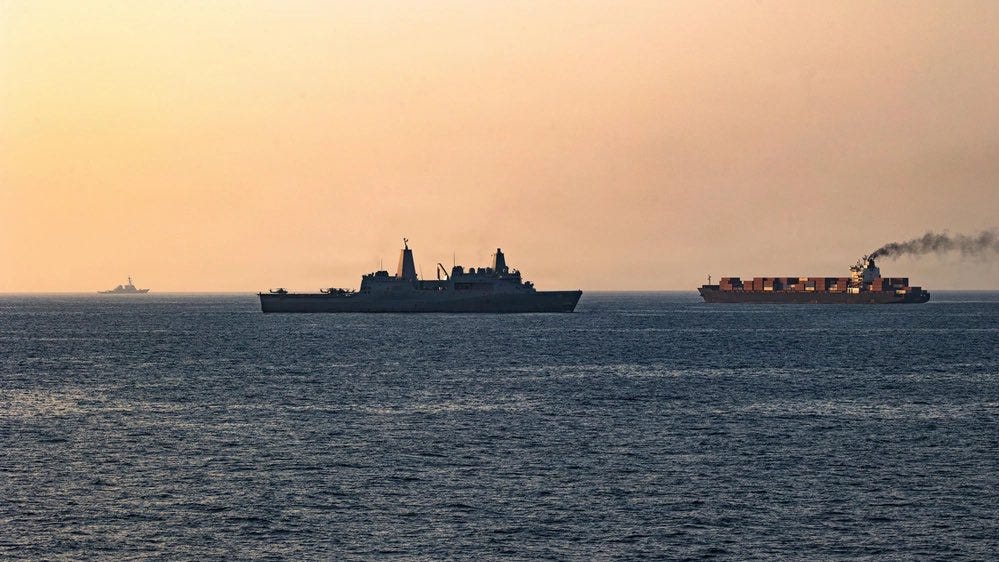
To make shutdowns happen, it is not necessary for the US Navy to capture every tanker carrying Iranian oil. For the moment, shadow fleet vessels are still operating, often transferring their oil to other ships, so that Iran continues to sell product that came out of the ground before the blockade. However, this is a finite supply that will run out. As empty tankers cannot return to Iran to refill because the Navy has blockaded the Strait of Hormuz, they will eventually become both expensive and irrelevant.
Iran’s neighbors do not face this choice because they have pipelines. Saudi Arabia has opened the Yanbu pipeline to the Red Sea and has it flowing at full capacity, while the United Arab Emirates have actually left OPEC in order to open the Fujairah Pipeline, which bypasses the Strait of Hormuz with 2 million barrels a day. The UAE spent years planning and developing this contingency route for just such an occasion.
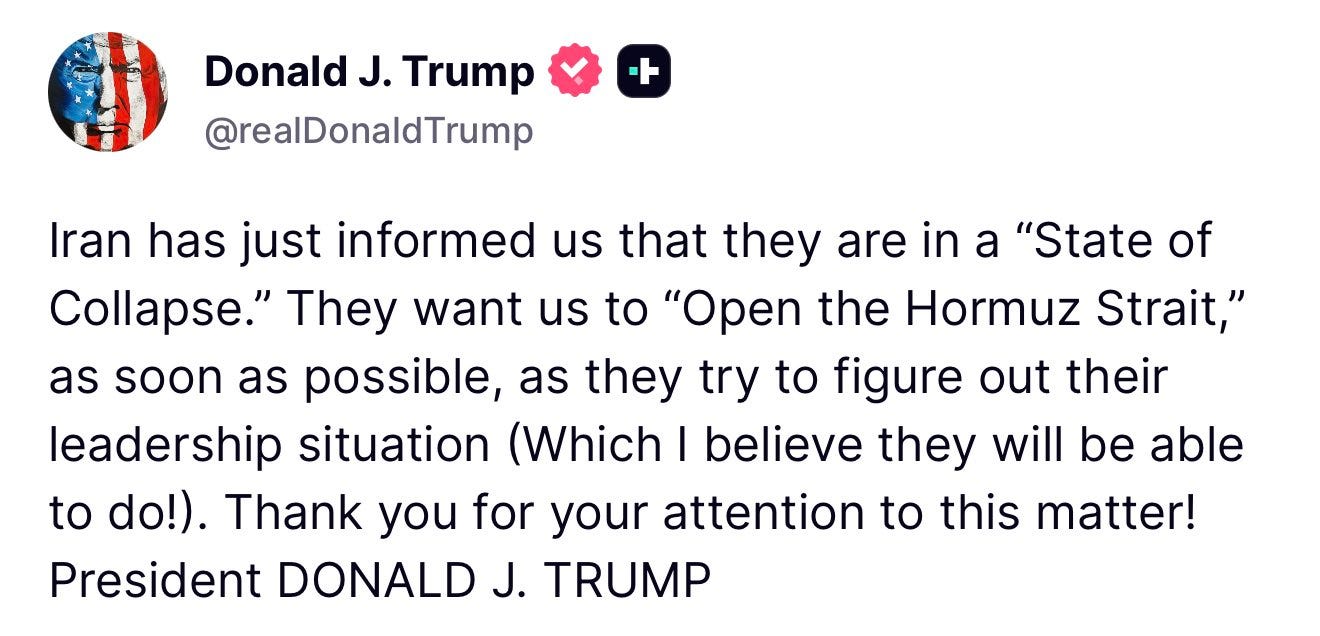
One estimate puts the limit of Iran’s ability to keep the oil flowing some time during the first week of May. Let us be charitable and assume the IRGC will find a way to last until June, as more liberal estimates have suggested. This is still close enough that a regime led by realist hardliners will be desperate to cut a deal that lets Iran resume exporting by sea, whereas a regime led by fantasists will embrace the risk, doing tremendous economic damage to themselves, limiting any military ambitions they might still have, just to avoid loss of face. Not least of these considerations is the exorbitant cost of building, let alone maintaining, a nuclear deterrent.
Fractured, the regime cannot coalesce around a supreme leader who remains absent, and the IRGC is caught in a trap of its own making. Like Haman, the Persian official who built a gallows 50 cubits high to execute Mordecai, only to be hanged on it when Esther revealed his plans against King Ahasuerus, the IRGC has made the choices that will now choke it to death. Victory over such an enemy is not defined by their capitulation, but their self-destruction. Refusal to surrender is a choice to die by economic strangulation.