

The Edge Of Drone War 3.0 In Ukraine
Notes on the current military revolution
Last week, Ukrainians posted this historic video clip of a small, cheap first-person view (FPV) drone intercepting a Russian Lancet drone that cost at least ten times as much. While these intercepts have been common for over a year, producing extensive highlight reels from the intercepting drones, the more interesting, hence historic development here is the independent view of a third drone: we see two Ukrainian drones hunting one Russian drone. While the Lancet is an impressive weapon, Russia cannot sustain this exchange rate.
Russians are apparently trying to avoid Ukrainian interceptors with complex maneuvers. Rather than give up on deep reconnaissance and attack drones, during August rear-view cameras started showing up on downed examples. At the same time, Ukrainians were already developing new, reusable interceptor drones armed with shotguns. ‘Mongoose’ uses AI to complete an intercept, so electronic warfare will not stop it. How long before there is a tail gun on the deep strike drone? How long do we have before the waves of Shahed-style attack drones resemble the bomber waves of World War II, pursued by drone fighters?
During Phase 1.0, Ukrainians used small UAVs (s-UAVs) to direct artillery fires on Russians while Russians used them to see their surroundings and fight from inside of tanks. The drone war changed in 2023 with Ukraine’s long-range strikes inside of Russia, which have become more numerous and far more damaging, as well as full embrace of s-UAV tactics by both sides. The aerial drone-on-drone engagement was expected before 2022 as a technological certainty, it became common during Drone War 2.0 in Ukraine, and now it shall be ubiquitous. Sea drones also came of age during this second phase, and now land drones are becoming common, at least on the Ukrainian side. Drone War 3.0 will combine these technologies to achieve operational effects. That is fancy talk for ‘winning’.

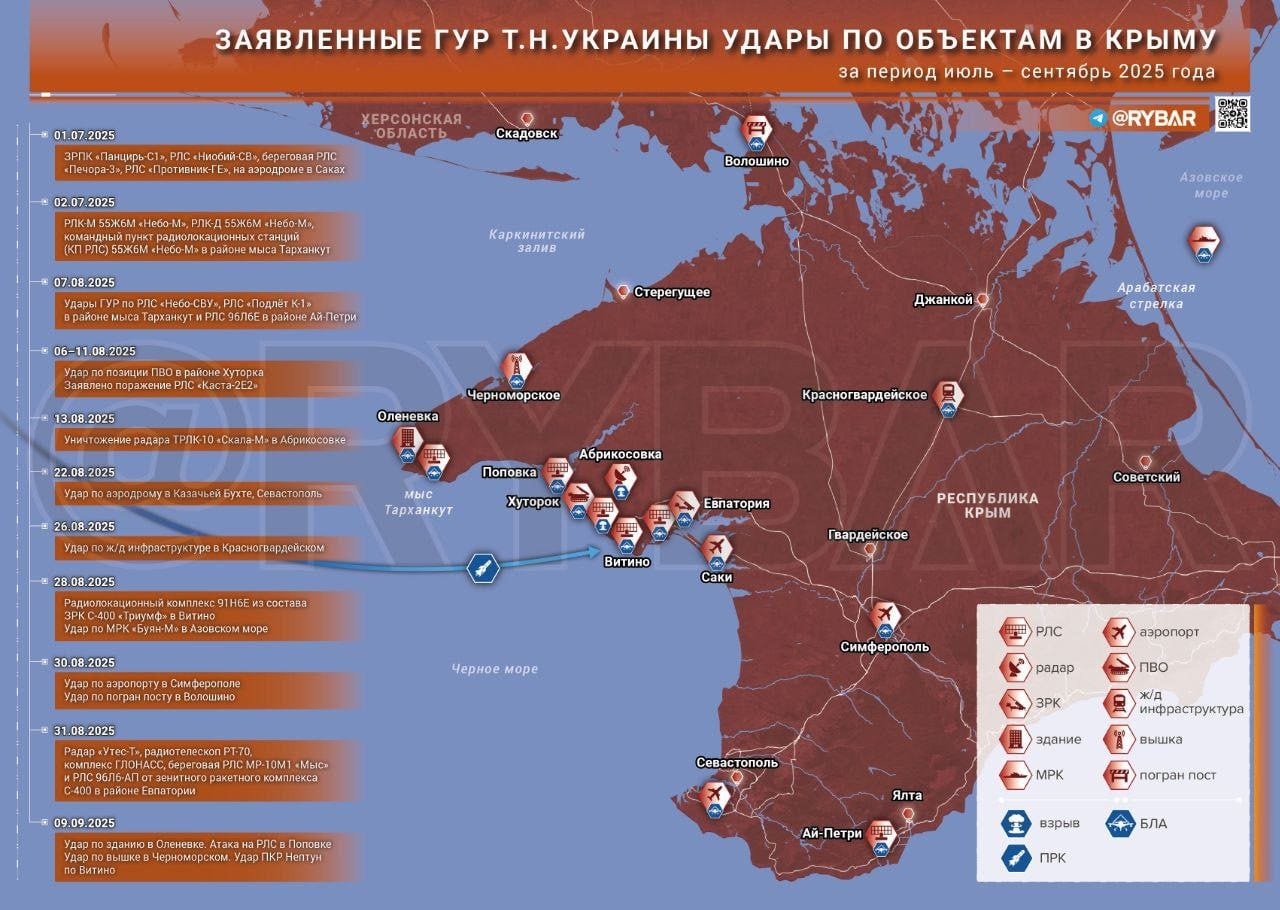
“Drone war is always changing”, writes a Russian Telegrammer. He reminisces about “the situation two years ago, when the trees were big, there were more mavics, but nuclear spoofers, amps with extensions, and [linked drones] had not yet appeared on the scene. It was a good time, understandable and inexpensive.” Except that Mavic 3 drone operators kept falling victim to satellite signal jamming. “At a frequency of 1.5 [MHz], a powerful emitter broadcasts white or pink noise. Satellites are far away in space, their signal is weak. Suppressing navigation is technically the easiest task.”
Ordinarily, this one system failure was not fatal to the mission. “When all systems are working properly, even a kombucha [mushroom] can control the drone — it hangs on its own, holds its position and altitude, parries the wind to critical values” thanks to a visual positioning system, “machine vision cameras that remember the underlying surface under the drone and hold the drone in the position specified by the operator, stupidly remembering what to hang over”.
But then “night, haze, lenses scratched during a previous landing in corn or smeared with dirty hands on the belly,” or “a low-contrast underlying surface: a lake, sea, snow field, etc.”, or even “high altitude (the manufacturer claims 250 meters, in practice we believe in 200 m)” will confuse the Mavic 3 so that it “moves with the air mass. That is, it is simply blown away.” To the novice, it appears as if the enemy has seized control.
The drone switched to ATTI mode, that is, “altitude hold”. The [female voice] screams “Alarm!!” from the remote control. The fighter, who held the Mavic in his hands 5 times and flew up and down 3 times, gets lost. At this time, the drone is dragged away by the wind to a distance exceeding the power of the remote control. If the wind direction coincided, for an inexperienced warrior it looked like this: I raised the drone, and it rushed to the [Ukrainians]. They stole it, assholes.
It is nostalgia for a time already long gone. Last week, the Two Majors Telegram channel called out “official and departmental channels” still maintaining that the Sumy offensive has created a “buffer zone.” The reality is very different. “Let's start with the fact that the ‘buffer zone’ must be several tens of kilometers deep. Because cheap enemy drones fly such long distances and fly in large numbers. Not everything can be shot down.” As seen around Pokrovsk, where Ukrainian drones seem to outnumber Russian infantry 5-1, “the enemy's concentrated UAV units are providing them with hundreds of drone strikes against our forces per day” in Sumy (emphasis original). The Ministry of Defense is wishcasting.
Efforts to extend drone range fall into two categories. First is the drone carrier. As seen in the recent videos of Ukrainian attacks on Crimea using s-UAVs launched from drone boats in the Black Sea, as well as Operation Spiderweb, which decimated Russia’s long-range bomber fleet with s-UAVs deployed from truck trailers inside Russia, or the Mossad operation that built and used s-UAVs to knock out Iranian air defenses, getting into range of the enemy target can be 90 percent of the mission.
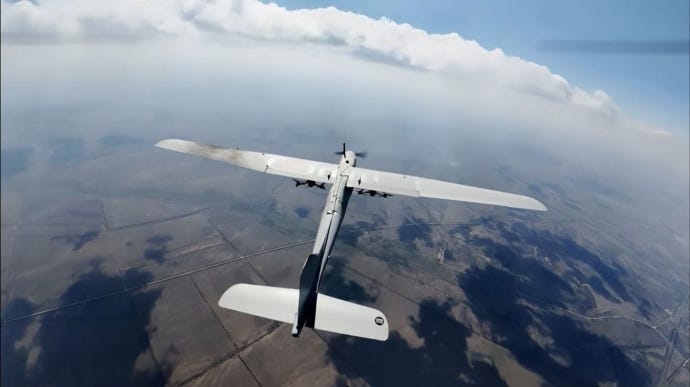
This is now a purpose-built type, not just an improvisation. “German drone manufacturer Quantum Systems says it is working on developing a mothership drone called Sparta,” reads a recent article at German defense news site Hartpunkt. Sparta “is expected to reach series production by the end of the year. By that point, “individual features — such as the landing system — could be adapted in the production configuration” to meet the ever-changing needs of the battlefield.
Ukrainians developed a front-line defense system of radio receivers and signals intelligence (SIGINT) centers that identify the control signals of Russian drones. With the aid of Lithuanian crowdfunding, from 2023 a network of Israeli-made Rada MHR radars, usually emplaced a few kilometers behind the line of contact, has increasingly swept the sky long enough to vector the intercepting drones.
“Strike FPV drones are sometimes equipped with corner reflectors to enhance their visibility on radar, allowing for their flight correction relative to our aircraft,” the Victory Drones channel explained in March. “This has significantly reduced the effectiveness of the Lancet strike drones, which operate only in tandem with the Zala reconnaissance drone,” therefore “these radars are among the highest priority targets” for Russian deep strike drones.
Another way to increase drone range is a stronger signal. Both sides use aerostat balloons as radio repeaters to increase signal range. Alternately, balloons can carry cameras, directional antennas for super-secure communications, and electronic warfare packages. They can even hold s-UAVs and drone interceptors ready aloft, dropping them as needed for missions. Ukrainian company Aerobavna is just one example of this new industry.
To make best use of it, Ukrainian company Chimera has developed an encrypted military radio that operates as a ‘mesh network’, a group of wireless devices connected to a single network, each of which acts as a repeater for the others. Mesh networks are already being used to control drones in Ukraine. The more drones there are in a network, the more resistant to jamming the whole network will be. “Furthermore, the operator can switch to any other attack drone online at any time,” another Russian Telegrammer complained in August. “For example, the MavLink 2 protocol can support several hundred devices simultaneously.”
Despite being hardy and waterproof, the one-watt Chimera repeater is so disposable and cheap that it “can be dropped onto the terrain (heights, roofs of buildings) on the eve of the operation and will create extensive radio coverage for soldiers [for] 48 hours,” a Ukrainian beta tester wrote in March. “A similar practice is used by US special forces”, he notes, naming the most likely source of inspiration for this tech. Chimera is integrated with Ukrainian reporting networks, so that a soldier can use one to transmit a secure message about a target.
Mesh networks have been around for a few years, but the price of the modem technology has only just dropped far enough to be economical for combat drones. (It is also important to distinguish interlinking technologies from ‘swarming’, a concept that has yet leave the conceptual stage and actually fly.) Mesh networks are proving to be the key battlefield utility, and importantly, they are already part of the bourgeoning Ukrainian ground drone fleet. This will prove key to future interoperability of ground and air and sea drones.
Journalist David Kirichenko was recently embedded with the 92nd Assault Brigade on the Kharkiv front to see how mesh networks fit into the communications patchwork of Ukrainian ground drone operators. More labor-intensive than tactical drone aviation, unmanned ground vehicles (UGVs) also need multiple overlapping networks just to operate, since the ground and foliage can block terrestrial signals. Starlink connections are inconsistent, so teams also use ground drones as relay stations for controlling other UGVs.
Mesh networks have become an important tool for this, but they are not enough on their own. “Depending on the terrain, the unit also uses Wi-Fi bridges, fiber-optic lines, and multiple mesh networks to communicate with its vehicles,” Kirichenko explains. Altogether, one UGV in the 92nd will usually have sixteen connection points. “In the future, we want ground robots to serve air defense roles, with turrets to shoot down enemy drones, clearing the way for others to move in,” a company commander tells him. That will be Drone War 3.0, when it happens.
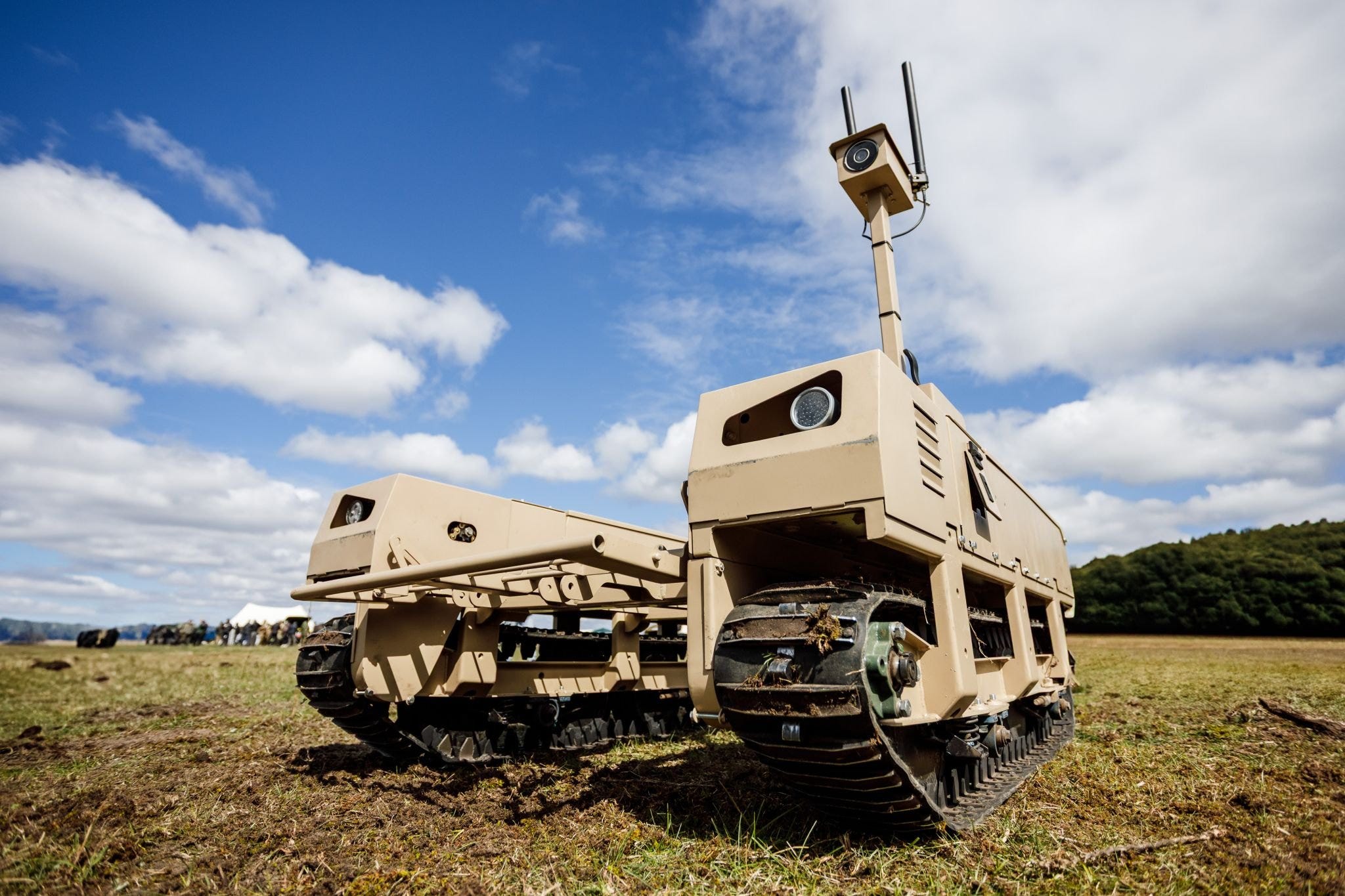
In 2026, Ukraine will be fighting Drone War 3.0 with a combination of s-UAVs and armed UGVs. Conceptually, the amphibious invasion of Crimea becomes tenable when the beaches are to be stormed by robots: some shooting at anything that moves, others laying mines on roadways, all disembarking from sea drones in place of men, some of them driving inland to launch waves of tiny, buzzing drones for close air support in place of fighter jets. We are more likely to see Ukraine try that out on the Kinburn Spit instead of Crimea, first, but we will eventually see it, at this rate.
“We never send people closer than 5km [3 miles] to the front if a robot can do the job,” the company commander tells Kirichenko. Right now, UGVs are primarily used for casualty evacuation and resupply. Recently at Pokrovsk, armed UGVs have been used to attack Russian infiltration teams hiding in buildings. It is reasonable to expect UGVs will replace fighting men entirely in the attack role as much as possible, too.
As we noted earlier this month, the two sides have diverged in their drone doctrine. Whereas Ukraine has stood up an Unmanned Systems Force (USF) with minimal dilution of the drone operators in regular units, Russia has created ‘Rubikon’ units at the deliberate expense of drone operations in the regular units. Kyiv has organized procurement through distributed market mechanisms, while the Kremlin has Sovietized and centralized it. This is already having impacts as the Mavic 3 goes out of production and the Mavic 4s arrive. I wrote about that here:

In 1918, the First World War ended with each side making key production decisions a year or more before the end which then shaped the ending. Among the what-ifs of history, for example, are whether Germany might have performed better if Erich Ludendorff had not chosen to cancel tank development, or better-managed the costs of aviation production, which exploded.
Germany had all the same kinds of machines as the Entente allies, but not enough of them. Technological barriers did not stop the Central Powers; material exhaustion did that. Their enemies simply learned to combine the new armaments together as they out-produced the Central Powers.
We have also noted in recent essays how the Rubikon units have been created to maximize available Russian infantry for assaults. Likewise, Russians adopted fiber optic guided (FOG) drones at scale before Ukraine because immunity to signal jamming gives them a higher success rate per drone. Fewer drone operators can score more hits with them.
FOG drones are particularly useful for reaching far back behind enemy forward positions to strike logistics and other priority targets, such as enemy drone operators. This interdiction role is a successful Russian innovation that Ukraine is copying.
Whereas Ukraine was slower to adopt FOG drones, they have been catching up in 2025. Russian milbloggers refuse to believe that Ukraine can make a fiber optic wire spool more than 15 miles (25 km) long, though. “They landed a Ukrainian drone near Stepnogorsk. They have a 60-kilometer fiber optic cable. Come on!” the Rogozin channel recently reacted.
“It's a horror story for amateurs. It's just done to scare us and drive our artillery away” out of range of the battlefield. Meanwhile, Russians are bragging about their new 50-km (30 mile) fiber optic spools. Contempt for the enemy is dangerous.
Artillery, the king of battle just one year ago in Ukraine, is increasingly sidelined by drones, which account for a supermajority of material and personnel losses on both sides and reach deep enough to push artillery out of range of one’s own near-rear positions. Just about the only solution for FOG drones is tactical anti-drone radar and interception with a drone or destruction with ground fire, perhaps from a UGV.
Drones have also come to dominate the long-range strike war, and here again, the drone-on-drone engagement comes into focus. Whereas the world is buzzing about Russian attack drones violating Polish airspace, Ukraine is scaling up production of interceptor drones that, like the example at the beginning of this essay, cost a tenth as much as the attack drones they intercept.
Contrarily, the “three or four” Shahed drones that Poland shot recently down cost as much or less than the air-to-air missiles used to shoot them down. The danger for NATO is complacency. Russia might not be ready for Drone War 3.0, but the western nations are not ready for Drone War 1.0 right now, either.
On that note, the annual Zapad-2025 exercises were scaled back by half at the insistence of Belarus and removed from the borders of Ukraine and Poland this year “to reduce tensions, demonstrate openness and tolerance, and avoid accusations of provocation”. Russian Z-Patriots and milbloggers are complaining that the resulting maneuvers were “another circus act for the generals sitting on pedestals with binoculars.”
“The backlash reflects growing frustration among military bloggers and analysts who say Russian generals are recycling tactics that failed in Ukraine”, Defense Blog reports. “While Russian forces have adapted in some areas, such as the widespread use of glide bombs and drones, the decision to showcase traditional tactics has raised concerns among observers who fear that leadership remains insulated from front-line realities.” It would hardly be a first for Russia.
But the more instructive point is that Europe is already participating in Drone War 3.0 by financing and building it. Ukraine signed four contracts in July worth $72 million to build interceptor drones to deal with the scourge of Shaheds and defend front line soldiers. Kyiv enlisted foreign partners in this endeavor.
Denmark is a partner in developing an AI interceptor. The UK is a partner in mass producing the OCTOPUS interceptor drone, too. Germany has a substantial investment in Ukraine’s deep strike drone development as well.
Comparative economics are revealing. The new Flamingo cruise missile everyone is buzz-bombing about lately carries a one-ton munition and uses an AI-25TL turbofan engine, common as dirt on the international market, which costs a little over $40,000 online. The engine is one reason why Flamingo only costs about 20 percent more per unit compared to the new shahid despite being a much more powerful weapon.
According to Pavlo Narozhnyi, a military expert quoted by the Kyiv Post, the new jet engines for the latest version of the Geran-2, the Russian copy of the Shahed, cost over $50,000 each, helping to raise the overall unit cost “close to $1 million” to deliver a smaller warhead than previous versions: about 50 kg, or one-twentieth the payload of a Flamingo. At $1.2 million, the Flamingo offers more far more bang for the buck.
No war ever begins with perfect weapons, and no arsenal can be perfected in the course of any war. There is no such thing as the perfect weapon. There is simply the side that figures out how to win with the weapons they have, or can make, and the side that fails to figure it out. Replacing men with machines transforms the conflict for Ukraine from a war of attrition to a war of production.
In that sense, Drone War 3.0 will indeed be a ‘game changer’. Ukraine is clearly working on it. Whether Russia can keep up remains to be seen, and victory will likely turn on the question.
The Pokrovsk Gambit

The First Battle of Pokrovsk began more than a year and a half ago. Since then, up to 60,000 Russians have been killed trying to take the Donbas stronghold, according to a spokesman for the Dnipro Operational Strategic Group. Starting the second week of August, a new Russian offensive east of Dobropillya sought to exploit a gap in Ukrainian anti-tank ditches on the New Donbass Line with a combination of infiltration tactics, long-range fiber optic drones, and rapid advances on motorcycles.