
Pacifism Is A Lie And The Noble Savage Is Racist
Pernicious false beliefs about war and peace endanger societies, civilizations
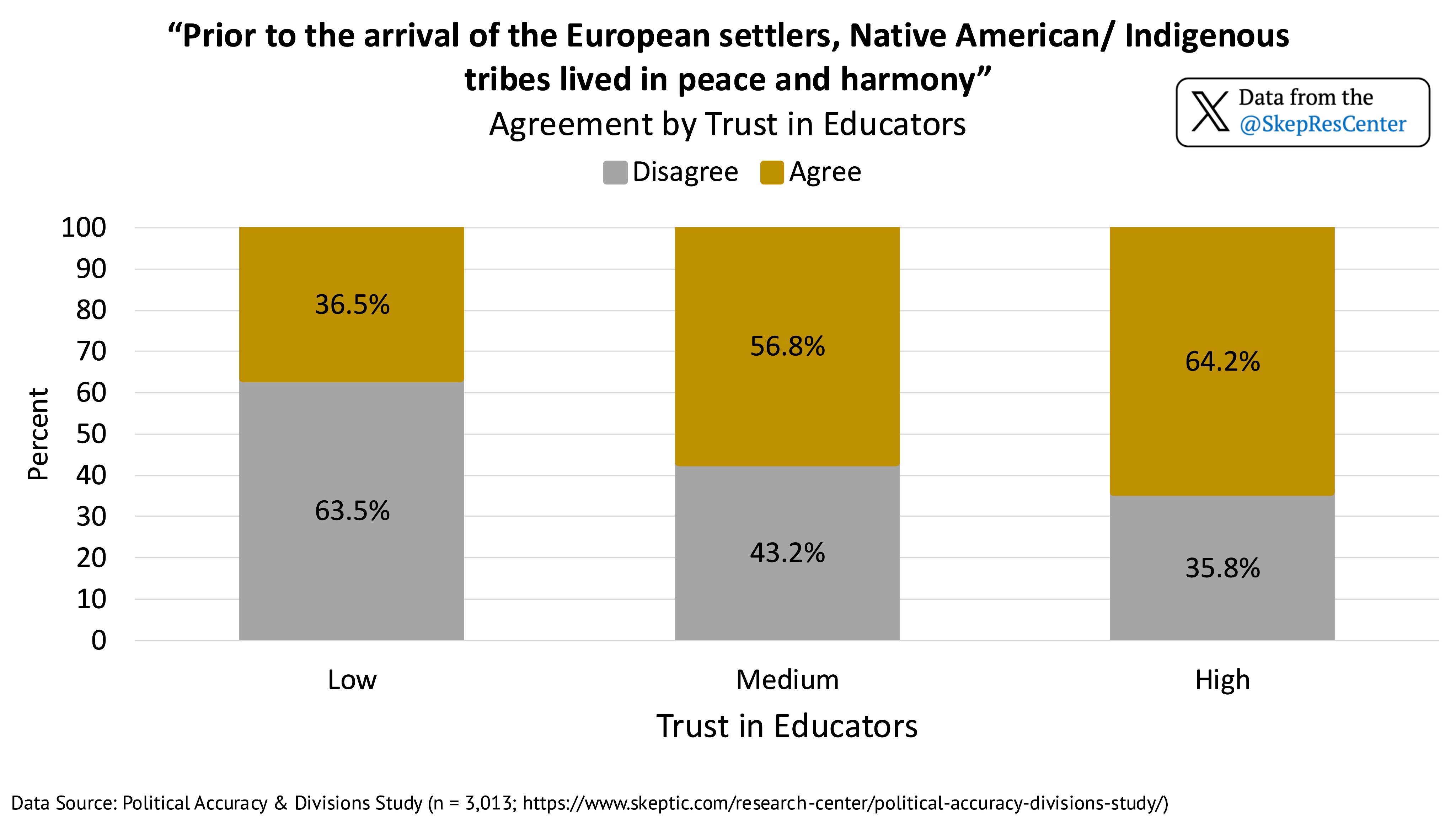
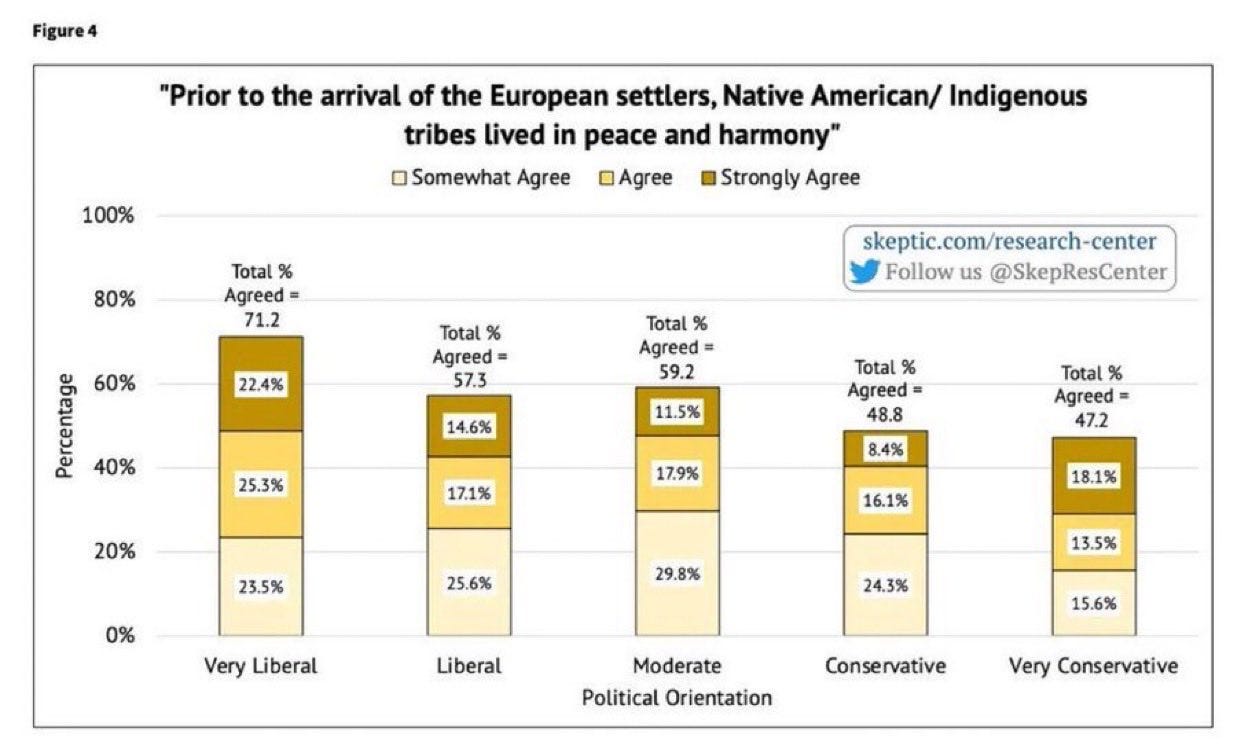
These survey charts from Skeptic.com reveal something fundamentally broken about the way the western academy views human conflict. War is intrinsic to being human, but the most cultured people always pretend that humanity is intrinsically pacifist.
Military history has waned in the academy because any fair reading of archaeology, ethnography, and historical text completely debunks the pleasant notions of the human past that highly-educated people prefer to believe.
I learned this in 2020 when I asked a tenured professor of military history for a reading list on origins of war and primitive warfare. He gave me the list, but then confessed he no longer teaches the topic because female freshmen and department heads will lose their minds over any acknowledgement of binary human sex difference.
It is just easier to let them carry on with their feminized world-view than educate them about the real world.
Academic incentives are entirely inverted against an honest reading of the violent human past. While this is ostensibly aimed at eliminating bias, the ‘noble savage’ is in fact incredibly racist. It positions primitive peoples as inherently pacifistic when archaeology shows exactly the opposite, worldwide.
If Native Americans were perfectly peaceful, never ever fighting any wars before the evil white man showed up with his evil guns and his evil patriarchy and his evil capitalism, then the virtuous native is a political instruction for achieving perfect human harmony through the elimination of those supposed evils.
Contrarily, the fact that Native Americans were never peaceful or free of greed, while the tribes with matriarchal organization were equal in violence to the patriarchal ones, challenges any political program that proposes a progressive, peaceful utopian future.
Just as Marxist economics and social pseudoscience appeal to the hyper-rational academic, a false view of the violent past has become predominant among ‘the experts’ in the academy, regardless of the actual evidence.
The pacifistic view of Native American prehistory is simply untenable as a material matter. “Scalping has often been claimed to be of European origin. However, while Europeans may have encouraged and promoted the practice, the ethnographic and archaeological records indicate that it was present before European arrival”, Ashley Kendell writes.1
“There was no terminology to describe scalping in English, French, or Spanish, so when the Native American tradition was first encountered, new words had to be developed or old words were used ambiguously to refer to the practice.”
Kendall has studied 77 craniums of men and women killed in a massacre at Crow Creek, South Dakota in approximately 1375 AD that bear signs of perimortem scalping. This happened approximately 76 years before Christopher Columbus was born, so exactly zero white Europeans were involved.
Archaeologists have determined that the village was in the midst of replacing a dry moat with a new defensive earthwork when an overwhelming force attacked and destroyed the community, killing at least 486 people. Skeletal injuries include signs of torture, beheading, and dismemberment.
Nor is any distinction between soldier and civilian evident in the data. According to Kendall’s findings, the female skulls show a higher number and breadth of cuts consistent with scalping. The war party that overwhelmed the village was able to take their time killing the women after killing the male defenders.
In fact, there seems to have been a perverse incentive to slaughter and scalp the most helpless members of the community with the most care.
Historically, men gained honor and prestige by killing not only their male enemy, but also their enemy’s wives and children. In some ways, the humiliation and killing of another man’s close relatives, such as his wife or daughter, conferred a higher status upon the attacker than killing the warrior himself. Greater honor was associated with sneaking into an enemy village. Infiltration of an enemy village required greater bravery on the part of the warrior than killing an enemy warrior on the battlefield.
Nor was slavery mysterious to anyone in the New World when Columbus got there. Warfare was endemic in the Americas and it provided captives, many of whom were sacrificed in funeral rites for elites. Slaves used for agricultural labor were routinely mutilated onthe Mississippi, having their Achilles’ tendons cut or toes removed to leave them hobbled.
“Deeply rooted in Native history, slavery was already present when the first Europeans and Africans arrived in the sixteenth century”, historian Christina Snyder explains.2 No one had to explain the concept of the ‘outsider’ to them. Indeed, Native peoples recognized outsider groups by their hairstyles, which is why scalping became so important to their warrior cultures.
What they lacked were early notions of ‘race science’ and concomitant ideas about human rights that developed in Europe. “In the Native view, as in many African societies, the opposite of slavery was not freedom: the opposite of slavery was kinship.”
Enslaving the outsider was fine, no matter their race, a backhanded sort of equality that is also present in the Muslim rules about who can be enslaved. Equality was nonexistent in the pre-Columbian Americas. Mississippian culture was in fact “an era of unprecedented social inequality” in the American southeast, according to Snyder.
Nor was urbanization to blame, for suburban settlements “had much greater rates of mortality than palisaded capitals such as Moundville. About 10 percent of those at outlying sites suffered violent death due to scalping, cranial fractures, severed limbs, and embedded arrows; they were sometimes interred at mass graves.”
I am not just picking on Native Americans, either. Massacre and slaughter are endemic to pre-literate humanity, and we have abundant evidence from anthropology that inter-group violence is normal in the state of nature. Modernity is not necessary for violent conflict. If anything, rates of violence decline with civilization.
Homicide rates among the Bushmen of the Kalahari Desert from 1920 to 1955 “was four times that of the United States and twenty to eighty times that of major industrial nations during the 1950s and 1960s.”3 Raiding, feuding, and even frequent battles fit the Hobbesian formulation of prehistory as “nasty, brutish, and short”.
Humans everywhere come from the same violent stock. Excluding any single ethnic or racial group from this legacy is always special pleading.
“Cross-cultural research on warfare has established that although some societies that did not engage in war or did so extremely rarely, the overwhelming majority of known societies (90 to 95 percent) have been involved in this activity,” the late Lawrence Keeley observes. Ironically, colonialism accounts for most of the societies that gave up warfare.
Keeley’s book War Before Civilization: The Myth of the Peaceful Savage offers the single most useful analysis of why the academy continues to reject the evidence of a violent past.
“Anthropologists were again directly confronted with the realities of warfare among small-scale societies” during the two decades after World War II, as they observed Stone Age warfare in the wild. Unable to analyze what they saw without the prism of modernity, these academics “revived the mythologizing impulses that have invariably attached themselves to this debate.”
Those “mythologizing impulses” are inherently political. When anthropologist Napoleon Chagnon published Yąnomamö: The Fierce People in 1968, his exhaustive study of the Amazonian tribe was rejected by most of his profession for allegedly ‘harming’ native people.
Chagnon linked violence to reproductive success, framing it as a form of natural selection, as he calculated that unokai (killers) had more wives and children than non-killers. His findings were attacked as deterministic and culturally biased. In 2000, journalist Patrick Tierney accused Chagnon of eugenics.
Inquiries by the National Academy of Sciences, Chagnon’s university, and the academic process have debunked the most extreme allegations of Tierney. Nevertheless, Chagnon was barred from Yanomami territory by Venezuela, faced early retirement pressures, and became an academic pariah in his field for the crime of correctly describing high intra-tribal homicide rates.
Above all, this cancel mob was upset by the word “fierce” in the title of the book. Chagnon had supposedly dehumanized a group of humans by framing them as warlike instead of pacifistic.
With a few prominent exceptions, academia actively resists the truth that humanity can be fierce, that fierceness is inherently human. This magical thinking does not preserve civilization or promote peace. On the contrary, denial of humanity’s fierce nature creates dangerous gaps in the prescriptions of educated elites.
Pacifism is a lie, and pacifistic views of the past are hazardous. They make war more likely, not less. Societies that lose the ability to defend themselves are doomed to be conquered by less ‘advanced’ and ‘progressive’ societies. We have the bones to prove it.
The Walls Of Cahokia And The Palisaded Communities Of The Middle Mississippian
Defensive walls are a universal technology. When Hernando de Soto landed in Florida in 1539 to explore the American southeast, he found “a well inhabited and a fat country” with “some great and walled towns, and many houses scattered all about the fields, to wit, a crossbow shot or two, the one from the other.”
Kendell, Ashley. “The Crow Creek Massacre: The Role of Sex in Native American Scalping Practices.” Archaeological Perspectives on Warfare on the Great Plains. University Press of Colorado, 2018, pp. 318-335.
Snyder, Christina. Slavery in Indian Country: The Changing Face of Captivity in Early America. Harvard University Press, 2010.
Keeley, Lawrence. War Before Civilization: The Myth of the Peaceful Savage. Oxford University Press, 1997.


