

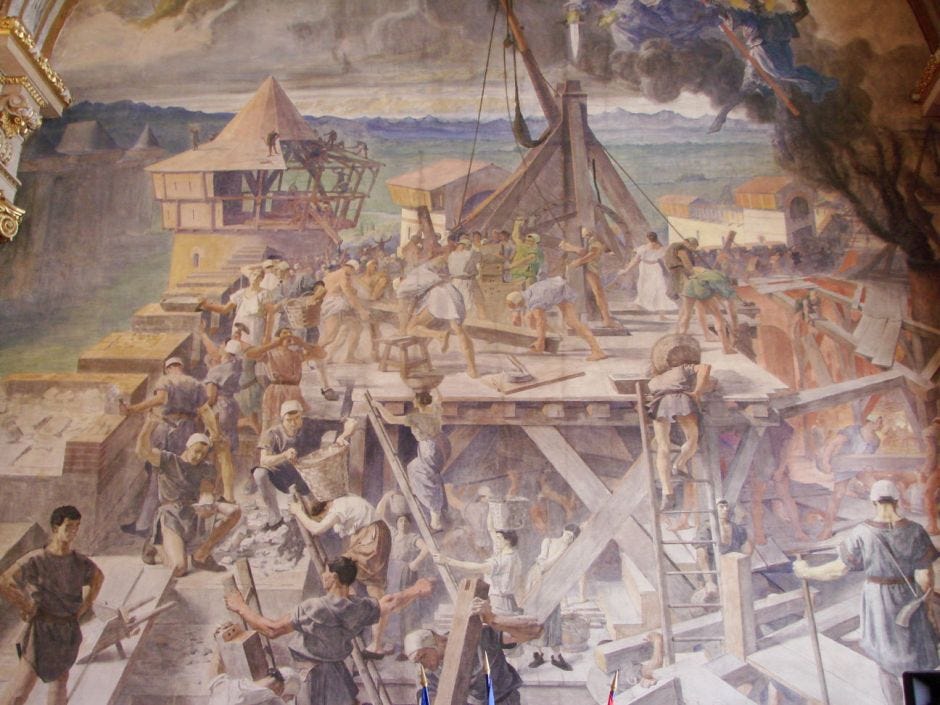
“[T]here was in the town a [siege engine] built by a carpenter and dragged with its platform from St. Sernin”, writes the anonymous author of Chanson de la Croisade Albigeoise, or Song of the Cathar Wars.1 “This was worked by noblewomen, by little girls and men’s wives, and now a stone arrived just where it was needed and struck Count Simon on his steel helmet, shattering his eyes, brains, back teeth, forehead and jaw. Bleeding and black, the count dropped dead on the ground.”
The stone arrived just as the brother of the unfortunate Count, Sir Guy, “was speaking and beginning to shout and yell” because of the danger to the “cat”, a siege tower so large that Simon de Montfort intended it to house 400 horsemen and 150 archers. The career of the cat had already been cartoonish.
During the first attempted assault with the siege engine, a stone from a trebuchet inside Toulouse struck the upper part of the tower and knocked the protective hide armor loose. Now vulnerable to attack with fire, the siege engine had to be wheeled away again in ignominious retreat — and was struck again in the back by a second stone, destroying part of the machinery and killing several men inside it.
All the men outside the cat who were helping to push it ran away, ignoring Montfort, who shouted for them to return. The episode had symbolized the decline of his command during the ill-advised siege. Unable to ever actually invest the city, for he never had enough troops to fully surround it, Montfort had turned to an engineering solution that became a liability.
It was during the second attempt with the cat, now improved with reinforced hide shielding and wicker shields (cledis) to protect the men outside it, that Simon de Montfort fell. Once again, trebuchet stones damaged the cat as it approached. ‘‘By God, Dame Traitress Cat, you will never catch rats!” the Toulousains joked, according to Anonymous. They had increased the defensive obstacles in front of their walls, hindering the advance of the crusaders and their cat.
Montfort’s knights endured a barrage of stones and crossbow bolts from within the walls. The horse of Guy de Montfort, the brother of Simon, reared up when it was struck in the head by a bolt, whereupon a second crossbow bolt struck his groin. Guy was struggling to rally support from the dwindling knights as they continued to take hits. Montfort received multiple crossbow wounds before the great stone smashed his head, ending his misery.
The death of Count Simon de Montfort on 25 June 1218 is certain. All the sources agree he was killed by a stone from a pre-gunpowder siege artillery weapon. Everything else is a contested detail. Peter of les Vaux-de-Cernay, who wrote the Historia Albigensis from his perspective as a Cistercian monk closely aligned with the crusaders and an admirer of Montfort, presents the death in hagiographic terms: it is a scene of martyrdom.
“Suddenly a stone from an enemy mangonel struck Christ’s knight on the head. The blow was lethal. Twice beating his breast he commended his soul to God and the Blessed Virgin”, Peter writes.2 The detail seems dubious, as death from a crushed skull would be instant.
Peter emphasizes five prior wounds from crossbows and compares Montfort to St. Stephen, the first martyr of Christianity, who was stoned to death. Peter also uses the Latin word mangonellus for the machine that threw the killing stone. He does not mention women operating the mangonel.
Anonymous tells us the death of Montfort was instantaneous. The Chronicle of William of Puylaurens, who wrote a history of the siege decades later, says Montfort “died at once” from being struck by the stone.3 He says that Montfort was actually inside the cat when he was struck, and that a mangonel threw the stone.
William also reports that the Count had begun “to pray to God to give him peace by the remedy of death” during the siege, for he “was worn out by his labours, despondent and weakened and exhausted by the drain on his resources; nor did he easily bear the prick of constant accusations by the legate that he was unthinking and remiss.”
Pope Innocent III had declared the Albigensian Crusade, but then failed to finance it. His legate had pressed Montfort to continue the siege against the advice of the Count’s military advisers, then turned on Montfort when the first attempt with the cat had failed so badly. Pressures of leadership under the failing conditions of the crusader army likely did contribute to Montfort’s fate. He took one too many risks, and lost his life.
For modern military historiography, the more interesting divergence in the primary sources is the identification of the machine that killed Montfort as well as the composition of the crew that operated it. Writing in Occitan rather than French, Anonymous uses the word peireira, from the Latin word petraria, which is a more general term than mangonel. Literally translated, it means ‘stone-thrower’. This is not an esoteric engineering point, either. The distinction actually does make a difference.
