

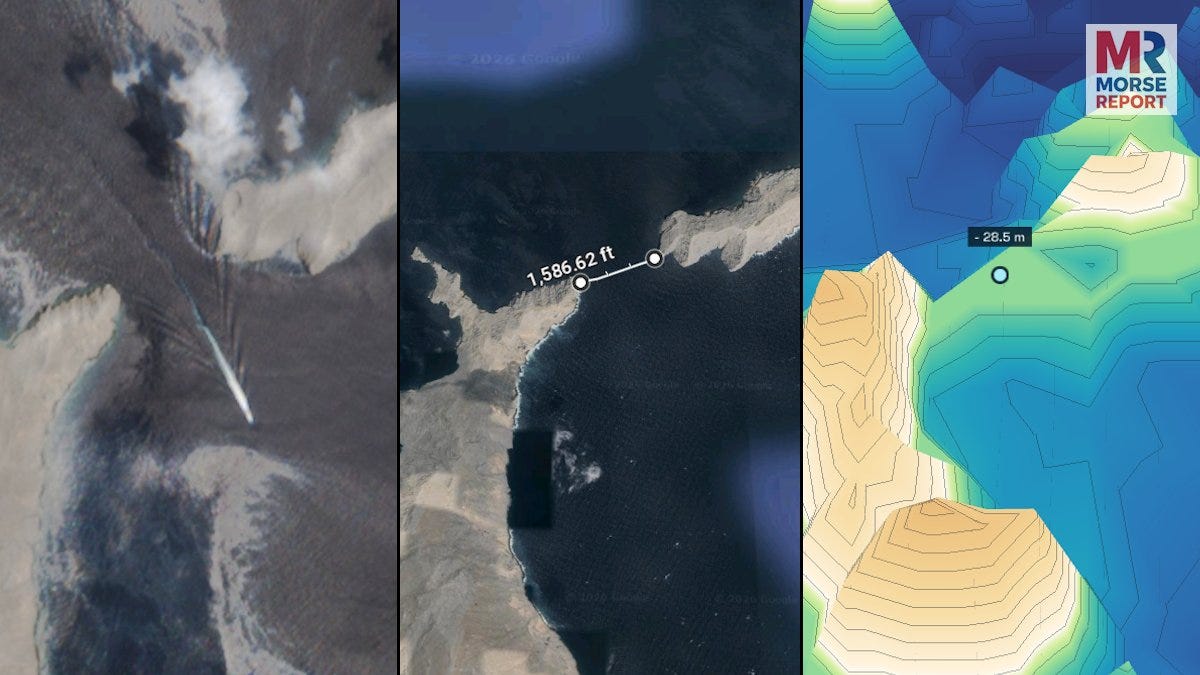
Last Friday, a YouTube content creator named Matt Morse started a fake news cascade when he reported that a new passage had been dredged in the Strait of Hormuz. In fact, the passage between the Fakk al Asad peninsula and the island of Bab Musandam has been charted for many centuries, and powered vessels use it all the time, including the present hostilities.
A typical loaded VLCC (very large crude carrier) has a draft somewhere between 20 and 22.7 m. The channel is 28.5 m deep, which is enough under-keel clearance to transit the route without any dredging. No spoil banks, cut benches, or new channel geometry appear in satellite images. If they did, we should expect to see the peninsula shrinking and appearing elsewhere as rubble. Sorry Roman Helmet Guy, it’s not the cool labor project you’re thinking of.

The idea is not inherently absurd, of course. If the Omanis did widen the channel, or even remove the island and put it somewhere else in the shape of a flower or a tree or something, it would hardly surprise me. That is exactly the sort of infrastructure solution the Arab princes are into, these days: pipelines, railroads, and even highways are expanding all around the Gulf. The story did have a measure of verisimilitude.
More problematic for navigation, even if the story was true, is that a 1,600-foot wide (.49 km) channel is still a bit chancy for VLCCs, which average 1,200 feet (330 m) in length. Going through at speed, at night, as CENTCOM has been doing, would increase the maritime hazards. This is hardly worth the trade-off of using the island to mask the ship’s movement from Iranian radar — which, to be fair, is something of a minor point for Morse.
The milk run shuttle tanker traffic told the tale
What actually happened in the contest for the strait is a story of risk management. A total of not more than four dozen shuttle tankers, classed as LR2 (long range 2), assumed the risk of transiting the strait, then conducted ship-to-ship (STS) transfers with VLCCs parked in the Gulf of Oman.
The larger ships never transited the strait, so they never got attacked or mined. Everyone involved in these transfers operates with their AIS (automatic identification system) transponder switched off to make it harder for the IRGC to track them. Open source analysts see ships disappear, then reappear many days later, thousands of miles away.
Markets abhor restrictions. Rather than put up with Iranian demands, the market circumvented their restrictions. The IRGC ‘closed’ the strait as much as markets would allow. By late August, ships on the Iranian blacklist had conducted 284 shuttle runs, and more than half of the LR2 ships involved had done four or more trips.
London-based Navig8 and Abu Dhabi were first to use this method to circumvent Iran, followed by South Korean shipper Sinokor, then the rest of the Arab princely petrostates. Oil traders have referred to them as “Adnoc milk runs”, a name coined from the role of Abu Dhabi in facilitating them.
Iran has used this method to circumvent the US Navy before, but more recent imagery shows their shuttle tankers at anchor instead of lining up at Kharg Island. There are currently 52 laden tankers parked off the coast of Iran. No Iranian crude tanker has successfully left the Gulf of Oman and dodged U.S. enforcement since 12 July.
Meanwhile, open source news aggregators like Kpler, which just retroactively found almost a billion barrels of oil on the market, did not observe the trend until late in the game. It was off their radar, so to speak.
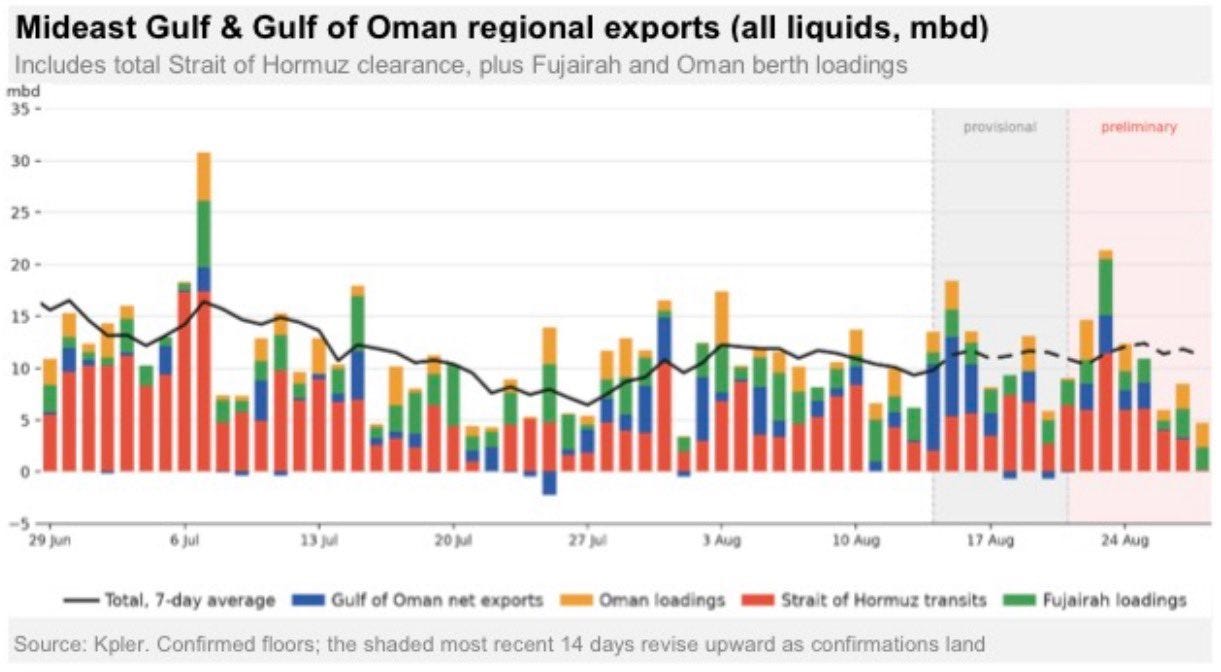
Indeed, the contest for the strait is defined by electronic battle more than big explosive boom-booms. Matt Morse at least got that much right by suggesting the island would mask ship movements for a little bit of the journey. Radar is subject to destruction, but it also reconstitutes with time, indeed radar coverage is restored much faster than missile production, or the component industry plants that were hit during the opening kinetic phase of the war.
Electronic targets must be identified and pruned back occasionally in the course of such a campaign (“mowing the lawn”). That is what we see happening today as I publish these words. During the last several hours, American strikes have targeted Iran’s air defense sites, radar systems, maritime assets and facilities, mine laying capabilities, and communication nodes.
No one had to dredge a new channel through the strait. The markets were more powerful than any navy. America already enjoyed full-spectrum supremacy. This combination of imbalances has created a no-win situation for Iran. As I publish these words, the regime is acting out once again and the United States Armed Forces are punishing them for it. Iran cannot win, but also does not know how to lose.
