

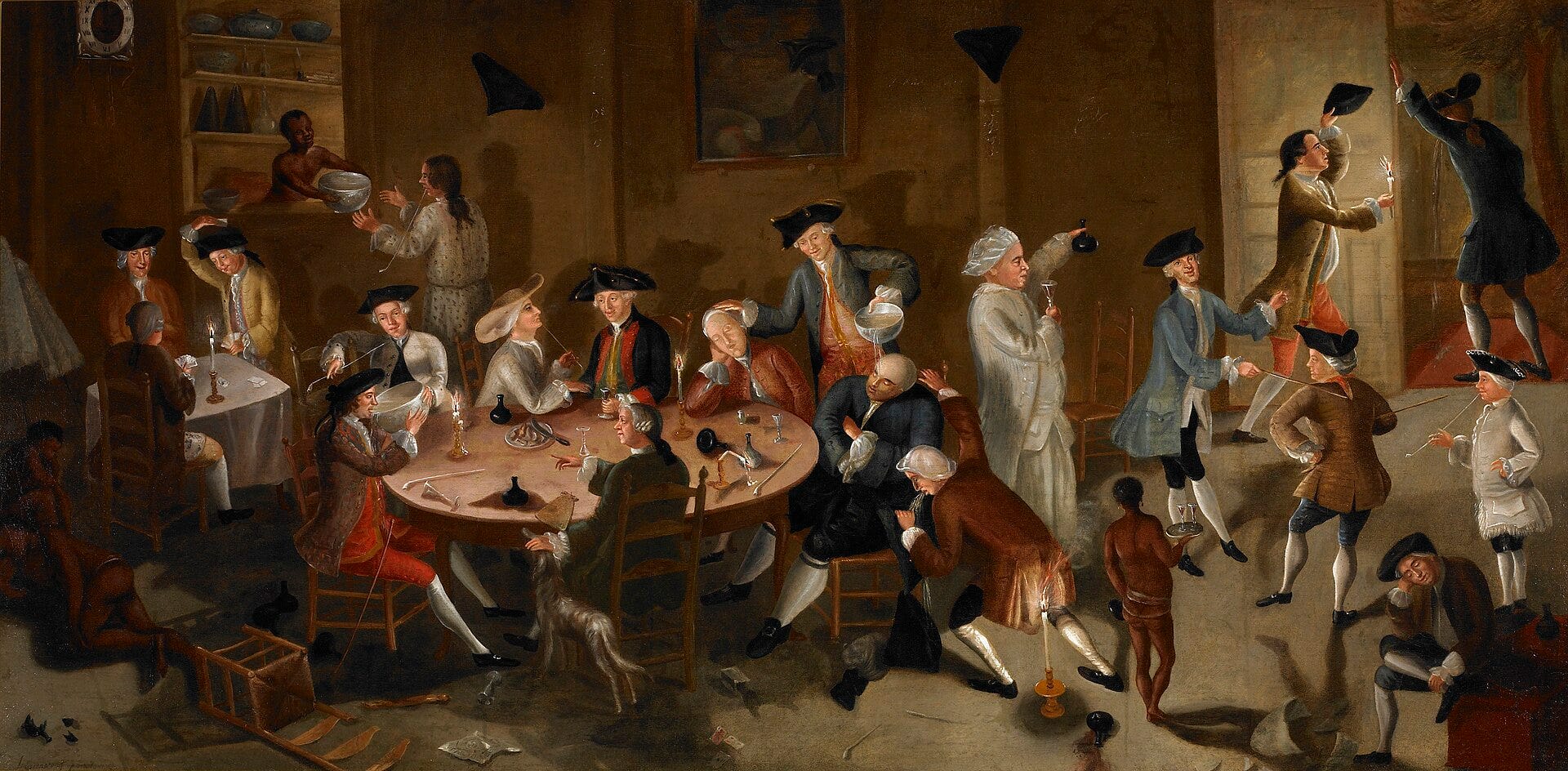
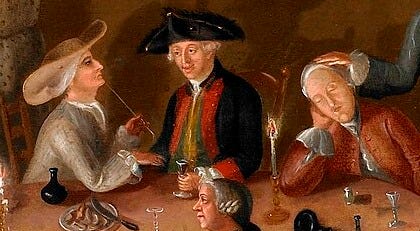
Located at the Saint Louis Art Museum is a scene of binge-drinking by the men who made America great in the first place. They are abroad in South America as trading sailors. Esek Hopkins is sitting at the table in the hat with red facings on his coat, talking to his fellow Rhode Island shipmaster Nicholas Cooke, who is smoking a pipe. It is the only known portrait of Hopkins.
The painting is a comical panorama. The man passed out at the table is a future governor of Rhode Island, Joseph Wanton. Esek’s brother Stephen, who later signed the Declaration of Independence, is pouring water on Wanton’s head in a vain attempt to rouse him. Captain Ambrose Page is vomiting in Wanton’s pocket. John Greenwood, the Boston-born artist, recorded that he is the man in the doorway being sick at top right.
The carousers drink from great bowls that are probably filled with cassava beer. Esek Hopkins seems to remain more sober than the rest, for his drinking cup is small, and he is engaged with Cooke in conversation. Soon enough, every man here will be at sea again. Some of them cope with numbness, others learn as much as they can, Hopkins is regaling his interlocutor Cooke, who seems to take an interest in his sea story.
“An aggressive, outspoken man with a hot temper, [Hopkins] was described by General Henry Knox, George Washington’s chief of artillery, as ‘an antiquated figure’ who might have been mistaken for an angel, ‘only he swore now and then’”, Nathan Miller writes in his authoritative work on the history of the US Navy.1 Hopkins was a pirate with a heart of gold. One cast from melted doubloons, perhaps, but still.
Esek Hopkins was by all accounts a very good captain. His one and only foray into slave trading, on the Sally in 1764-65, was a disaster at the shore. Much of his human cargo was sickly when he arrived in Africa to take them onboard. Some of the slaves tried to mutiny and were killed. Most of them died during the voyage, while the survivors at the end were too few and frail to make the voyage profitable. From the website Providence Eye:
Four Africans died in the first week at sea, and the survivors staged an uprising. Hopkins noted in his log “Slaves Rose on us was obliged to fire on them and Destroyed 8 and Several more wounded badly.” He told the Browns that the slaves became “so Desperited” that “Some Drowned them Selves Some Starved and Others Sickened & Dyed.” By the time he reached Antigua after 57 days at sea, sixty-eight Africans had perished and twenty more died before they could be sold. Altogether, 60 slaves died, or 39%. (The average mortality for the Middle Passage was 15%).
The debacle was a stain on his record. Still a capable captain who had distinguished himself as a privateer in the Seven Years’ War, Hopkins was rebuked by William Pitt and returned to sea with other duties as a captain for the Browns. Moses Brown, future co-founder of Brown University, was so offended by the incident that he turned against the slave trade altogether. Three more Brown brothers left the slave business in ensuing years.
A decade later, as the colonies were dividing themselves from England, they were already dividing from one another over slavery, too. The new American nation was born in a state of dispute between imperfect people. The founding fathers were men, not gods, and they went to sea for profit, just like everybody else, and agonized over the immorality of their new fortunes, like humans do.
In the musical 1776, which portrays the tortured decision-making of the Continental Congress before the Declaration of Independence, South Carolina delegate Edward Rutledge calls out the hypocrisy of the New England delegates condemning his state for slavery. After all, the captains of the ships bringing the slaves across the Atlantic were New England men. Good, Puritan souls with great moral virtues to signal. Many frontier Americans found men like the Browns insufferable, when they became abolitionists.
Composer Sherman Edwards placed “Molasses To Rum” at the crucial moment of crisis in the show to foreshadow how the issue would divide the new nation. Performed by John Cullum in the cinematic version, it is a powerful scene featuring lighting, cinematography, and visual storytelling skills that current-day Hollywood has forgotten.
Southerners were leery of building a Continental Navy. “The opposition . . . was very loud and Vehement,” according to the recollection of John Adams. “It was . . . represented as the most wild, visionary, mad project that had ever been imagined. It was an Infant, taking a mad Bull by his horns.”2
The southerners changed their minds when Lord Dunmore began raiding the shores of the lower Chesapeake, however. Someone had to stop him, they demanded. Esek Hopkins was supposed to be that man.
Aside from the Sally disaster, his career as a captain was otherwise successful before he went ashore in 1771 after 25 years at sea. He was 53 then, and quite ready to retire. With hindsight, we might say it would have been best. Nobody knew this at the time, however. They all just needed someone who knew how to lead a fleet.
Hopkins, like most New England shipmasters of the time, would have been used to operating in squadrons as a privateer. Appointed a general in October 1775 in the wake of Concord and Lexington, Hopkins was commissioned in the fledgling United States Navy on 5 November and received command of the country’s first flotilla the next month.
As 1776 dawned, Hopkins was fitting out eight vessels of “varying tonnage”, all merchant ships converted to gunnery with “pierced sides”, at Philadelphia. The former Black Prince became his flagship Alfred, named for Alfred the Great, the king who became famous for defending England from Vikings.
Philadelphia had already identified what would become the objective of his first mission: a ready supply of gunpowder with a reasonably light guard. Edward Field records in his 1898 biography of Esek Hopkins that Congress first considered Great Abaco, also called North Providence Island, on November 29 when “information was laid before a secret session”.
According to this intelligence, “there was ‘a large quantity of powder in the island of Providence,’ and it was forthwith ordered that the foregoing committee ‘take measures for securing and bringing away the said powder’”.3 The would-be nation was critically short of saltpeter, the primary ingredient in all black powder mixes.
When the fleet sailed, they had orders to head south and confront the British flotilla under Lord Dunmore in the Chesapeake Bay. This proved unfeasible with the seasonal winds and storm patterns.
In accordance with the options in his instructions, Hopkins altered course for Nassau and the Bahamas. One ship was damaged in a storm during this voyage, lost sight of the rest, and returned to port. The second became separated from the flotilla until after the mission. Things were off to a poor start, but the force could still be effective.
Fields writes that the remaining six ships “arrived at Abacco on the first of March, and on Saturday evening the second day of March, two hundred marines, under the command of Captain Samuel Nicholas, and fifty sailors, under the command of Lieutenant Thomas Weaver, of the Cabot, who was well acquainted with the island, were embarked on some small vessels that had been captured”.
North Providence Island seemed unaware of their approach. “The men on board were ordered to keep below deck until the boats got in close to the island, it being Hopkins’ intention that they should land instantly and take possession by an assault from the rear, before the inhabitants could be alarmed”, Fields writes. “This, however, was rendered abortive, as the forts fired an alarm on the approach of the fleet.”
Running in his sails, Hopkins “anchored at a small key three leagues to windward of the town of Nassau, and from thence Hopkins dispatched the marines, with the sloop Providence and the schooner Wasp to cover their landing” at the east end of the island, where the assembled force moved immediately on the smaller of two forts.
“Fort Montague, situated halfway between the place of landing and the town of Nassau”, was likely undermanned. “Only a slight resistance was made by the force within the fort, five guns being fired at the attacking party, but without doing any damage. The garrison then withdrew to the larger fort, and the marines and sailors took possession of the abandoned work, where they remained and rested that night.”
Hopkins learned that only about two hundred men, inhabitants of the town unlikely to shed their blood without a good reason, formed the militia defending Fort Nassau. A negotiated surrender ensued. They were all Englishmen, after all, so there were social expectations to meet.
“Two weeks were occupied in transferring the captured property to the vessels, and it was not until the seventeenth that the fleet got under way for the homeward voyage” with their loot, Fields writes. “Eighty-eight cannon, fifteen mortars, and other military equipment of immense value to George Washington’s army were captured”, Miller adds.
Hopkins also got away with enormous stores of naval goods and military supplies, but alas, no gunpowder. For upon hearing the alarm signal of the flotilla’s approach, the governor of the island — now a prisoner in Hopkins’s ship — had ordered the 150 casks of gunpowder stored at Fort Nassau loaded onto a sloop and sent away.
Despite this, “the expedition was undoubtedly the most successful Continental Navy operation of the war”, Miller writes. “Early on the morning of April 6, 1776,” however, “the remaining ships encountered the 20-gun British frigate Glasgow off Block Island.”
A “four-hour melee and chase” ensued. “She should have been easy prey for the Americans but escaped after badly cutting up her opponents.”
Miller is critical of Hopkins in this battle, for he “did not issue a single order except to recall his ships.” His inexperienced crews were afflicted with smallpox and other sickness, but “this inept action made it all too clear that patriotism was not enough to create a navy. Experience, training, and a heritage of victory were all required.”
Neither Fields nor Miller analyzes that Hopkins may have attacked a Royal Navy vessel with the expectation that its captain would react in the same way that merchant prizes react to the appearance of an overwhelming privateer fleet.
He likely expected a parley and surrender on the same terms that he had received the same from Fort Nassau. Instead of the social connection Hopkins sought, HMS Glasgow resisted violently until she got away. Hopkins had feared confronting the British without a trained fleet, and now fulfilled how own fears, for he had no tradition of hard-fought victory behind him.
“Away we all went Helter, Skelter, one flying here, another there,” wrote Nicholas Biddle, captain of Andrew Doria, one of the five vessels that engaged the Glasgow, to one of his brothers. “A more ill conducted Affair never happened”, he wrote to a second brother.4 Like the Browns, their shipping trades were a family affair.
Biddle would continue as a Revolutionary War captain. So would John Paul Jones, another officer on the expedition who took command of the Alfred after Hopkins.
But Esek had failed to drive Lord Dunsmore away and also failed to capture the gunpowder at North Providence Island, which infuriated the southern men at Philadelphia.
In selecting Esek Hopkins, the Congress had “unfortunately followed the principles of patronage and nepotism traditional in the Royal Navy”, Miller explains. Esek was the brother of Stephen Hopkins, a member of the Naval Committee, a man respected by his peers with at least some sort of naval-ish experience, who rose to the occasion when his country called.
Esek Hopkins did not lead another squadron. He was suspended in 1777 and dismissed in 1778. The new US Navy needed aggressive commanders who dared to attempt the impossible. Their enemy was the most powerful military force on the world’s seas. ‘Good enough’ was not good enough.
The US Navy was indeed a “wild, visionary, mad project”, but that is also the story of America itself. Next month: America’s first victory on land.
Molly, Her Myth, And Her Pitcher

“There are no first-hand contemporary sources from the time of the Revolution that mention Molly Pitcher at the Battle of Monmouth,” David Martin writes in the single most comprehensive volume on the topic. Only three contemporary sources from after the American Revolution m…
Miller, Nathan. The U.S. Navy: A History. Naval University Press, 2014.
Adams, John. Diary and Autobiography of John Adams. Harvard University Press, 1961
Field, Edward. Esek Hopkins, commander-in-chief of the continental navy during the American Revolution, 1775 to 1778: master mariner, politician, brigadier general, naval officer and philanthropist. E.L. Freedman & Sons, 1898.
“Commodore Esek Hopkins’ signals for the first Continental Fleet”, Naval Documents of the American Revolution. Government Printing Office, 1964–). Vol. 3, pp. 1287–1291.