

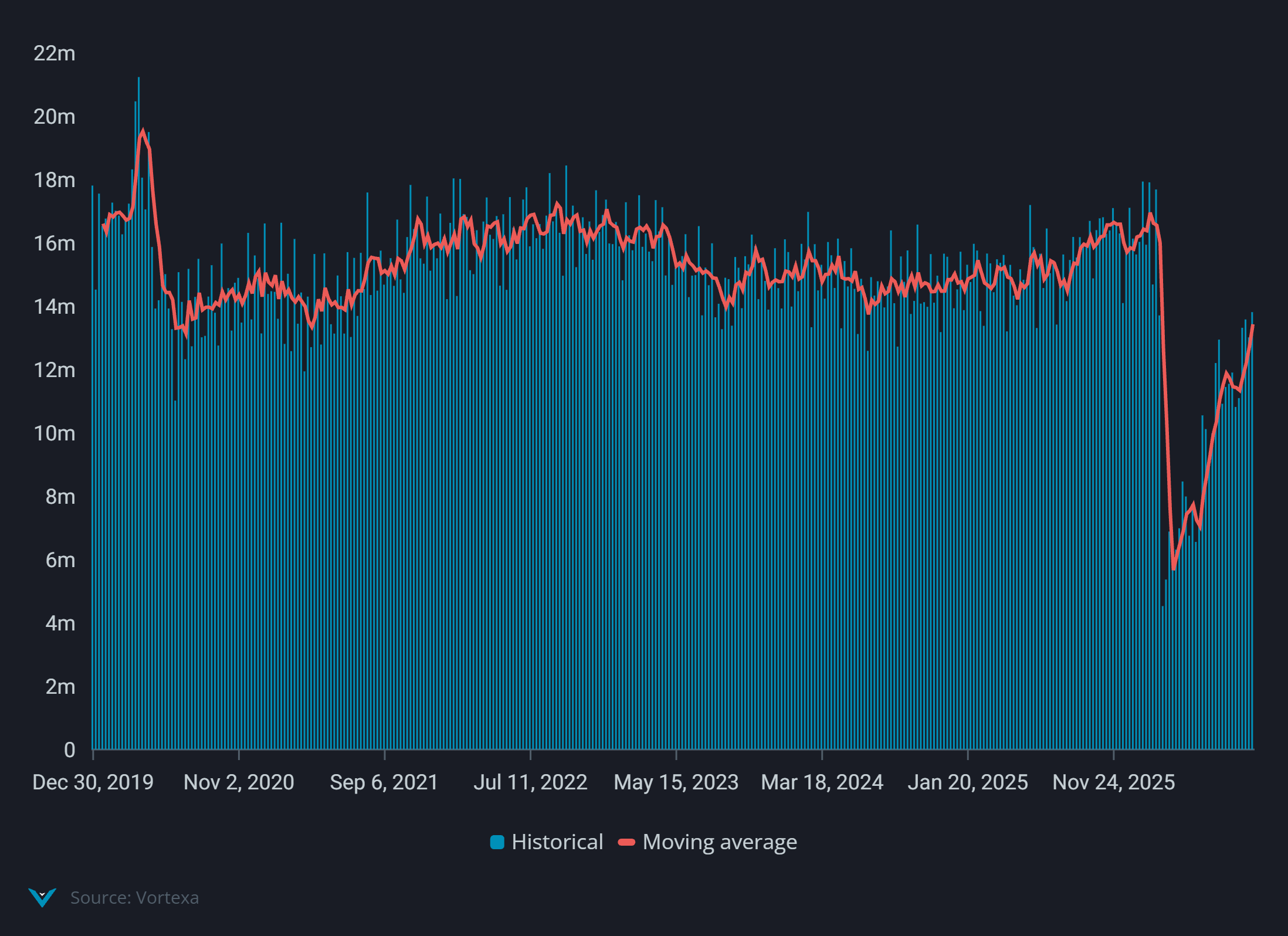
According to equity investor Alexander Stahel, who specializes in energy markets, there are currently “some 116 hulls active in the Shuttle trade around the Strait of Hormuz, most of them using the Oman Lane, hugging the coast of Oman instead of using the Middle Lane (IMO Lane) or the Tehran Toll Booth hugging the Persian coast.”
All the gulf states are using shuttle tanker fleets to assume the risk of transfer through the strait. A “Saudi Shuttle” (‘Bahri’) “now has 23 hulls positioned in the Arabian Gulf-Gulf of Oman area, which is more than anybody else.” Despite Houthi attacks on Saudi Red Sea oil pipeline infrastructure, “it appears to us that Saudi Aramco will export more crude than ever.”

Iran cannot close the strait with words. Using hard power, CENTCOM has succeeded in opening the strait to the degree that Saudi Aramco no longer needs the Red Sea pipeline they built to circumvent the strait, the one the Houthis hit. “So credit where credit is due: CENTCOM has built a pretty impressive military-facilitated tanker shuttle through Hormuz.” This happening exactly like I said it would.
As I explained for readers at the beginning of September, these smaller shuttle tankers run the straight at night under American air and sea cover with their AIS transponders turned off to avoid Iranian targeting. Mariners receive a risk premium because the transit is still quite risky.
After transiting the strait, the shuttles transfer their cargoes to VLCCs (very large crude carriers) for global shipment in the Gulf of Oman, far away from IRGC bases. The shuttle assumes all the risk for the VLCC, which is far more expensive.
Rather than escort individual tankers around Oman, American aircraft and ships suppress IRGC ‘mosquito navy’ boats, drones, and missiles while the convoyed tankers pass through the strait. CENTCOM coordinates these convoy movements within a nighttime window of action rather than maintaining a 24-7 posture, which would consume more resources and put more stress on sailors.
Occasional strikes are necessary to prune back IRGC radars, but no systematic strike campaign is taking place. This is a minimal operational tempo for the US Navy. They can literally do it every night, and so they are. Meanwhile, the IRGC cannot export a single drop of crude, anymore.
Mohsen Rezaei, Iran’s national security adviser and secretary of the Supreme National Security Council, acknowledged the crisis in a high-level government meeting on Saturday that was reported by state media without a direct quotation.


Mysterious battles are reported in the strait. There are some casualties, but few deaths, on the American side, while Iranian “fishing boats” explode, likely in the act of trying to lay mines in the waterway. As we have seen, Iran is desperate to make the world fear their sea mines, but the IRGC generally fails at tactical deployment.
These events are the fitful ‘resistance’ of a paramilitary organization that cannot win, but also does not know how to lose. The strait was supposed to be their negotiation leverage. It is now fully leveraged against the regime.
“Iran has basically been unable to load crude since August at its main export terminal, Kharg Island”, Stahel writes. “Iran has failed to shut the Strait, the shuttle system is scaling, and time is increasingly working against Tehran.” The strategy is winning.
Tehran was counting on the midterm elections in America to deliver them from this destiny, but that was a poor strategy. Now Iran has tried unleashing a wave of terror: the attempted intrusion at RAF Fairford on Sunday by five men, followed by the arrest of a UK-Iranian national, and then the apparent pilot hijacking of Flydubai Flight FZ1073 on Wednesday.
Both incidents were foiled. Press coverage of the Israeli passengers that took over the Flydubai flight from the hijacker pilot has been notably muted in the same outlets that peddle Free Palestine propaganda. They resist making heroes of Israelis because that is inconsistent with the projected image of a genocidal Israel.
Oman is having a hard time believing an Omani would ever do such a thing and saying very little about what they know. A different cloud surrounds the release of the Fairford suspects on bond. The Trump administration flew its forward-deployed B-1 bombers out of Fairford over the weekend, apparently no longer trusting they were safe in the UK.
Speculation abounds that the 7 October anniversary will bring a new wave of terror attacks across Europe. The IRGC is escalating in hopes of getting Trump to de-escalate because Iran is feeling the internal strain of the collapsing economy. Oil Minister Mohsen Paknejad, who had said that exports would continue in defiance of sanctions, resigned on Sunday.
Iran is a multiethnic state, with all that implies in the region. A battle in Sistan and Baluchistan Province on 23 September, reported as a “raid” by state media, reads more like an ambush to me. Brig. Gen. Hossein Zarifi, commander of the IRGC Shahid Sajjad Operational Headquarters in Saravan, was killed in a series of clashes near Jihadabad on the Pakistan border.
The latest confrontation follows a deadly clash in Saravan on Sept. 12, when the IRGC’s Quds Base reported that three Iranian security personnel and four militants were killed during an operation targeting an armed cell. Iranian authorities said the operation involved the IRGC, the Intelligence Ministry and the Law Enforcement Command and was directed against a group allegedly planning an assassination operation.
In complex tribal zones, militant identification can be fluid. Sunni religions plays an ominous role in the violence. With those caveats, the new Popular Fighters Front bears increasing mention as a threat to the internal security of Iran, specifically the IRGC. Baloch separatism clearly perceives its main enemy in the primary security forces of the state.
This can all become entirely too interesting. Even if we swapped out the current regime in Iran for another, it would still want to immediately snuff out separatist terrorism in Iran, and we would be wise to let it do that.
The more immediate implication is that everyone who has any authority in Iran has increasing reason to want a quick end to the war, before the rial has no value and the country is coming apart at the seams, rendering their authority moot.
The Wall Street Journal quotes a London think tank expert who is worried that “the diminishing returns of Iran’s Hormuz approach … could lead to a more explosive dynamic where they will have to provoke or press the go button on a larger conflict themselves in order to get out of this bind.”
However, last week’s events are the biggest escalation Iran has been capable of creating, so far. Worse, Iran’s proxy wars are not going well. News has broken this morning that Houthi militia have lost the Bab al-Mandeb Strait to a combined effort by Saudi and UAE-backed militias.
Despite their own war with the Saudis, Iran’s Houthi proxy was clearly content to maintain a separate peace with the Great Satan. Trump, the great orange devil, embarrassed the Saudis by declining the requests of the crown prince for American fire support when the chips were down.
In the meantime, Aramco ships will shuttle Saudi crude through the strait tonight, then tomorrow night, as the US Navy has scheduled. Stop telling me the president doesn’t know how to manage his allies. It is simply not true that he does not know how to win.
At this hour, there are fresh reports of IRGC Navy targeting “non-compliant” vessels using the Omani route. Speculation that increased American Marine forces may herald shore action are warranted by an uptick in strikes on vessels using the convoy window, but the more likely outcome is a responsive US strike on their sensor capabilities.
The winning strategy in Iran requires time and pressure and adaptation. It does not require genius. Iran cannot win through escalation. They can perhaps raise the death toll, but victory is out of the question. A new normal is coming, and everyone will have to learn to cope with the outcome.
