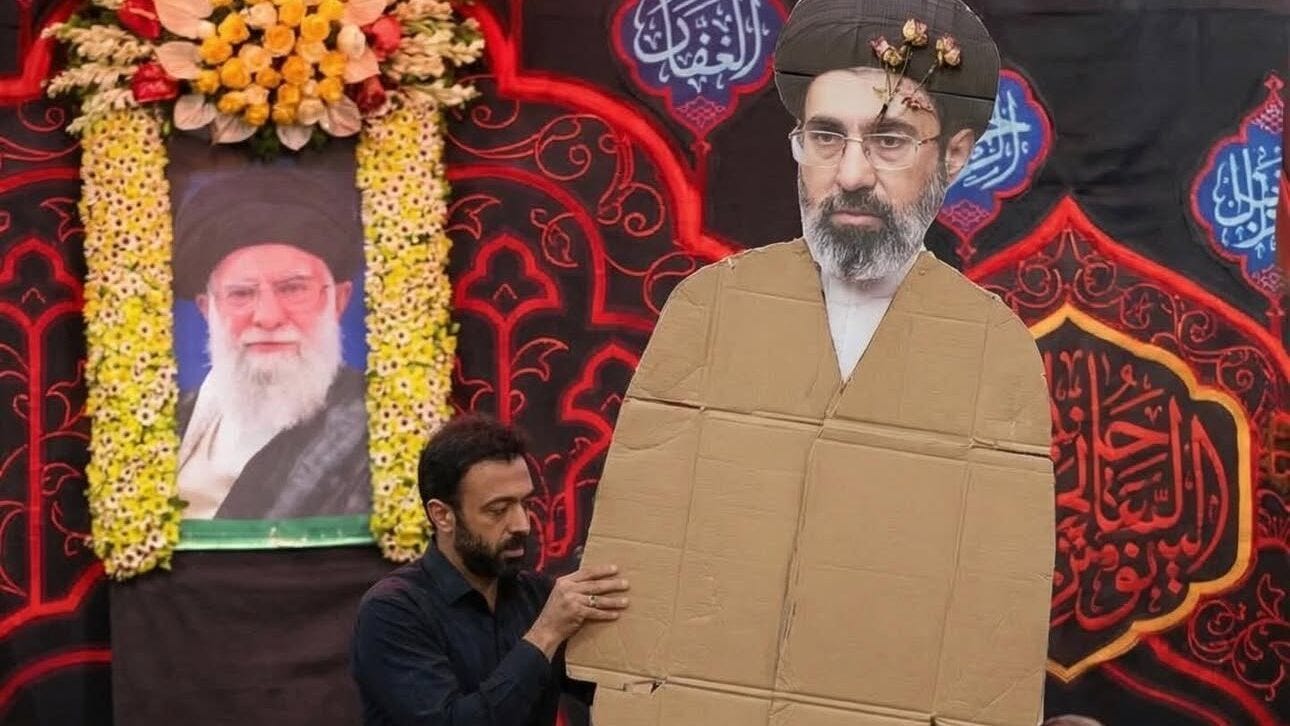
“What has taken shape in the Pakistan negotiations is fundamentally different from what was supposed to happen and from what constituted the condition for the legitimacy of the negotiations.” With those words, Iranian lawmaker Seyed Mahmoud Nabavian, an influential MP in the camp that opposes negotiations with the Great Satan, accused the government of treason against the Supreme Leader last weekend.
Reacting to the memorandum of understanding (MOU) with the United States, Nabavian called it a “total loss”. Then on Friday, Nabavian told a state TV channel that Mojataba Khamenei had made repeated objections to the conditions of the MOU while it was under negotiation. “The Supreme Leader explicitly expresses his dissatisfaction,” Nabavian claimed. “He says, ‘Why did you not observe the conditions?’”
Nabavian belongs to the Paydari Front of Saeed Jalili, which has been critical of the MOU. The broadcaster stopped the interview and vowed legal action after Nabavian claimed to be reading messages from Khamenei. According to Nabavian, Khamenei wrote that Iran was “neither in a hurry nor under any compulsion to negotiate or reach an agreement”. Furthermore, the nuclear program was not up for discussion, while “ending the war and securing compensation” were to be paramount goals.
I have no way of accounting for the veracity of these alleged messages, but they do speak to the concerns of the resistance to the MOU within Iran, and they might explain why the Iranian side wanted the MOU text embargoed for three days, as well as the ambiguity of the language on the Iranian side. When Iran denies that any sort of deal regarding uranium is taking place at all, that is because the subject remains extremely sensitive within Iran.
Nabavian clearly wants to undermine the government. He says that when Khamenei wrote his alleged messages in March, the supreme leader was keen to maintain the Strait of Hormuz as a point of leverage. He wanted complete control rather than a shared arrangement with Oman or any other country, and even came up with a detailed toll scheme.
“If the Americans want pressure taken off their throat, they must first implement preconditions, foremost among them the payment of compensation and debts”, Nabavian read, complaining that “none of these things” was in the MOU. However, these items have turned up again and again in the public negotiating position of Iran, likely to appease reactionary elements.
The problem for everyone in Tehran is that their leverage keeps evaporating.
Hormuz risk premium deflation
Over the weekend, the Islamic Revolutionary Guard Corps (IRGC) announced that the strait was once again closed. This ostensible closure was officially supposed to be a response to what Tehran called MOU violations by Israel; this was a “first step” against IDF “aggression” in Lebanon.
On Saturday, Iran’s Supreme National Security Council, in a directive seen by Iran International, instructed media outlets not to portray the renewed closure of the Strait of Hormuz and Iran’s simultaneous participation in talks as a split between the “field” and diplomacy.
The directive said Iran was pursuing a single strategy combining military pressure and diplomacy, and urged media outlets to frame action in Hormuz not as an alternative to negotiations but as support for them.
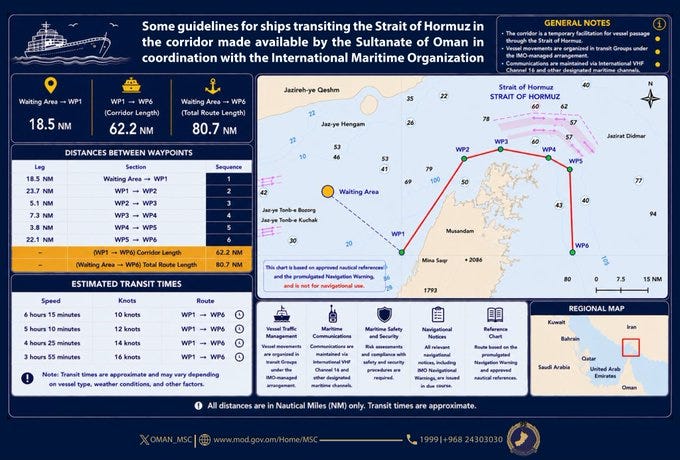
This two-track approach played out on Thursday as a cargo ship, the Ever Lovely, was reportedly struck by a “projectile” on the starboard side of her bridge while transiting the ‘Omani route’. At least one VLCC (very large crude carrier) turned around before continuing through the strait later. Traffic continues to move through the strait at this hour. At least 70 vessels transited the strait on Thursday, a new post-February high.
Indeed, ships have continued moving through the strait via the Omani route ever since Iran declared it closed. Approximately 55 vessels made it through the strait on Saturday alone, before the negotiations in Switzerland began. At the time of this writing on Thursday, 25 June, the market price for a barrel of oil has returned to its pre-28 February level. Shipping insurance rates in the strait have declined by almost half from their peak, though they remain above pre-crisis levels.
The “projectile” that struck Ever Lovely turned out to be a drone. It must have been small, as it caused no major damage or casualties. The IRGC is clearly frustrated by the overall decline in risk, so they created more risk. But they barely made a hiccup in the flow of shipping traffic.
Criticism of the MOU inside the United States has emphasized the risk of Iran learning to close the strait in order to extract concessions. In fact Iran has always known they could try to close the strait, and according to Mahmoud Nabavian this was very much what they wanted to do with the MOU.
President Trump seems to understand the struggle for control because he keeps signaling his intentions to keep the strait open. He told reporter Trey Yingst on Sunday that the Iranians “won’t have a country” and “won’t even make it back to your f**king country” if they closed the strait. The Iranian delegation walked out and demanded an apology. None was forthcoming. Discussions continued though Qatari intermediaries.
By my count, this is at least the fifth time since April that the IRGC has declared the strait to be closed. But they cannot close the strait. By contrast, President Trump speculates out loud about “tak[ing] over the strait if we have to” and collecting tolls if Iran fails to make a deal, and Trump has actual power to reimpose the blockade any time he wants, though he says it is “highly unlikely” he will have to do so. The IRGC wishes that they had the same hard power.
This puts Oman in the middle. Oman lets ships pass for free, while Iran wants to charge for passage. The market is choosing Omani waters and the IRGC is mad about it. Iran needs the fear to come back a little bit, but they also fear Uncle Sam will punish them if they go too far.