

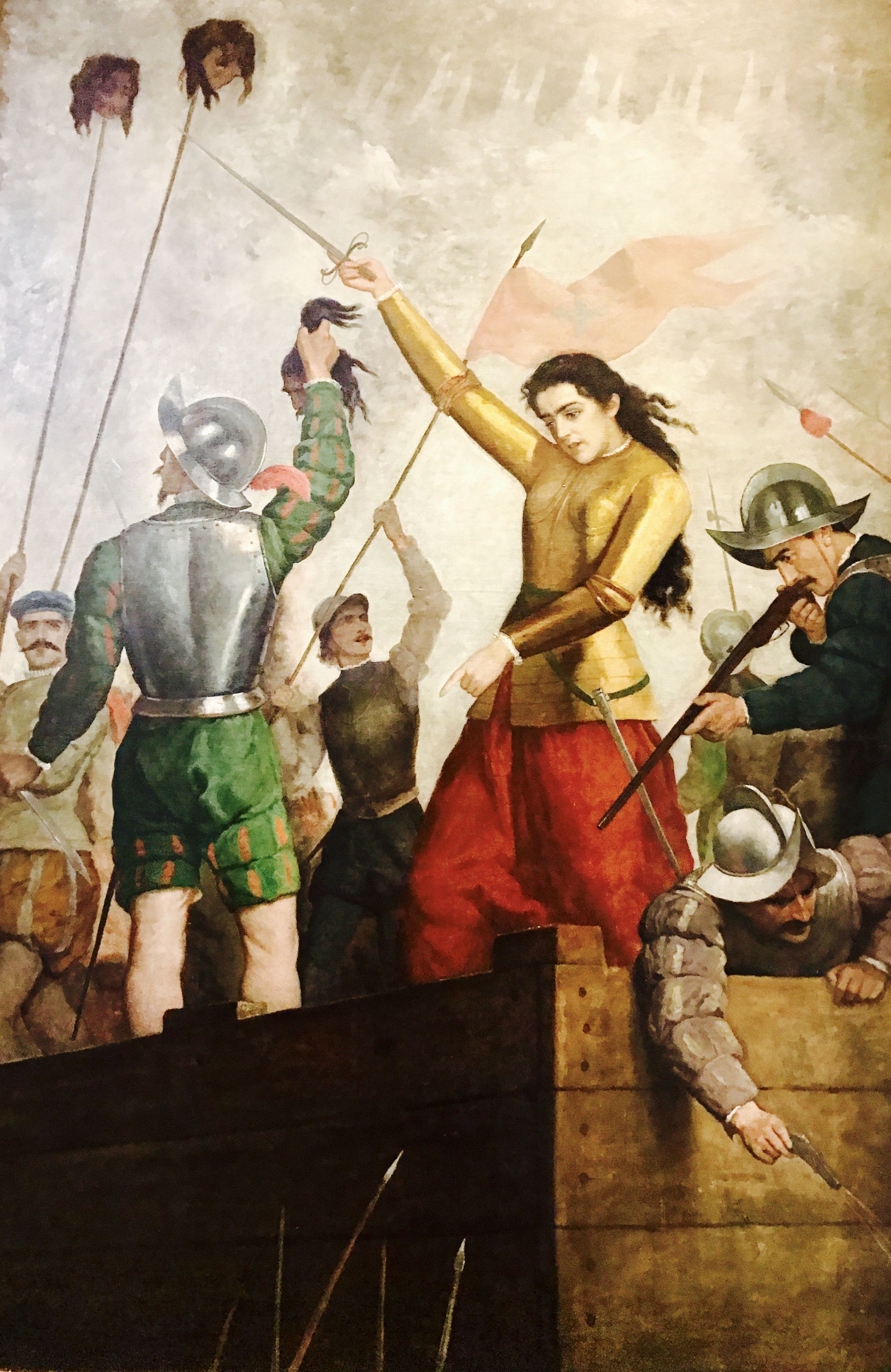
My research interest in siege art led me to discover a motif that was born in western Europe at the beginning of the modern world in which women appear as fighters atop the city wall in the face of foreign aggression. These rare episodes seem to derive from real moments of desperation in defense of communities, but then they always become propaganda once the smoke clears. A key argument I make in my research on siege art is that it has primarily served to represent power — autocratic or democratic — and to project a unifying civic identity, i.e. mass politics. These archived essays are available for premium subscribers.


Isabel Allende opens her 2006 novel Inés del alma mía, published in English as Inés of My Soul, by describing the Spanish town of Plasencia, where Inés Suárez was born in 1507, “a border city steeped in war and religion”. The book is a fictionalized romance based on the life of the real conquistadora who co-founded the Chilean capital city of Santiago. Framed as a series of letters written at the end of her life, Allende has Inés Suárez “respect and admire the Mapuche” as “worthy enemies” in the struggle for the country, both sides being “equally courageous, brutal . . . and determined to live in Chile.”
A “widow of the Americas”, Inés Suárez came to the New World following her conquistador husband, Juan de Málaga, in 1537. By the time she tracked him down in Peru, however, Juan had been killed in a battle between Spaniards. Diego de Almagro had returned from an expedition into Chile to find Hernando Pizarro scheming to seize the city of Cuzco, which the king of Spain had given to de Almagro in 1537. The two conquistadores met for battle on the salt plains outside the city and de Almagro was defeated. Allende invents a deception in which Pizarro traded clothing with Juan, so that his enemies attacked Inés’s husband in his stead. It is fair storytelling, but entirely fictional. The real story of Juan’s death is lost to time.
Nevertheless, as the real widow of a Spanish soldier, Inés was granted an encomienda, a plot of land along with native people to work it. Her new property bordered the lands of Pedro de Valdivia, which is how she met her new lover. Pedro was married to a woman back in Spain, so their love was never sanctioned by the church, but of course that mattered less in the New World. When de Valdivia set out to conquer Chile for Christ in January 1540, Inés Suárez rode by his side carrying a sword and a dowsing stick. Both would prove instrumental to the founding of the Chilean nation.
