
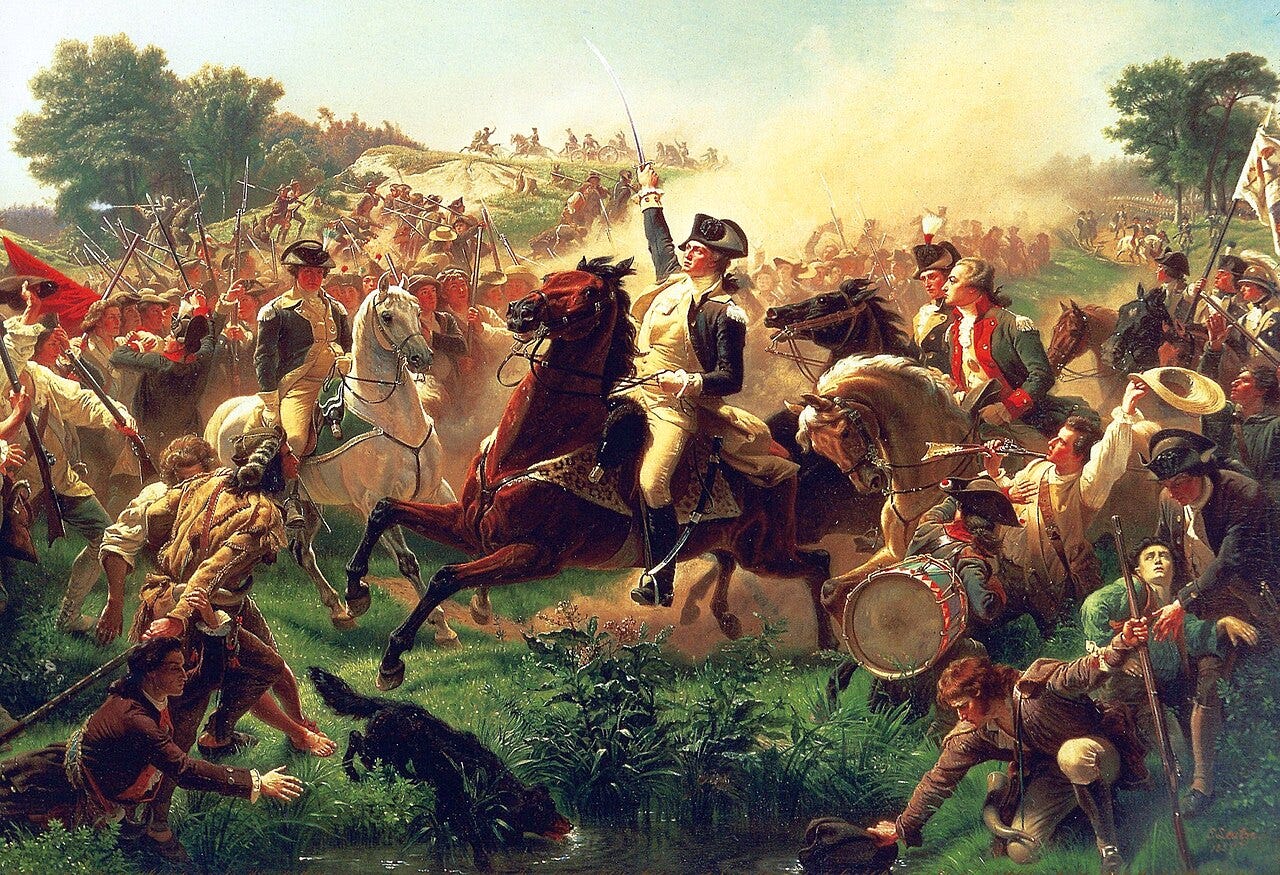
George Washington And The Guns Of Monmouth
Third in a free essay series on the American Revolution - June 28, 1778
Monmouth was not a particularly large battle. In his dispatches to Congress, Gen. George Washington reported 69 dead, 161 wounded, and 140 missing from his army, most of the latter from heat exhaustion. He also reported that 249 enemy officers and men lay dead on the field. Sir Henry Clinton, the British commander, reported just 65 killed, but the loyalist New York Gazette later published a list of 110 British troops either killed in action or by heat stroke.
While the continentals held the field after their fight with the British rearguard, it had not been a decisive encounter. “If ever a battle was a drawn struggle, Monmouth was it”, the late historian Willard Wallace said. British Brig. Gen. Sir William Erskine, on the other hand, called it “a handsome flogging” by the rebels.1 Monmouth became the battle of legend on purpose, in both the immediate aftermath as well as the early decades of America’s history of nationhood. The events at Monmouth Courthouse were magnified into importance by time, politics, and patriotism.
Washington intended as much when he began the pursuit of Clinton’s force during their withdrawal from Philadelphia to New York. He was looking for a short, sharp fight that would cement his position as commander in chief against his enemies in both the Continental Army and the Continental Congress. Washington had labored to rebuild his army into a competent force capable of just such a battle, and he got the very battle he had wanted, with the men he wanted.
The biggest loser
There were exceptions, of course. Maj. Gen. Charles Lee thought that Washington was not “fit to command a sergeant’s guard.” He first turned down the command of Washington’s vanguard at Monmouth when it was offered, only to plead for the command again when he learned that its size had grown enough to merit his magnificent presence. Washington met Lee in the early afternoon with the battle underway, the vanguard in retreat to more defensible terrain amid the muddy, morass-filled topography of Monmouth Courthouse.
“When I arrived first in [Washington’s] presence, conscious of having done nothing that could draw on the least censure, but rather flattering myself with his congratulation and applause, I confess I was disconcerted, astonished and confounded by the words and manner in which his Excellency accosted me”, Lee wrote later. “The terms, I think, were these—’I desire to know, sir, what is the reason—whence arises this disorder and confusion?’”
Lee did not understand at the time that two of his unit commanders had repositioned their units without communicating their intentions. The Continental Army lacked signal flags and troops, requiring staff officers to ride with orders. During the morning, Lee had run out of capable aides to carry orders and return with reports. Washington surely knew the miserable state of his communications, since he had arrived to the battlefield uninformed of events.
Moreover, the “disorder and confusion” Washington found as he arrived with the main body of the army was not unusual or hard to understand. Temperatures had soared to over 100 degrees Fahrenheit (38C), causing many men to drop out of the march from heat exhaustion. Both armies wore stifling wool uniforms.
Washington’s words did not bother Lee. It was his tone that rankled. “The manner in which he expressed them was much stronger and more severe than the expressions themselves”, he wrote.
When I recovered myself sufficiently, I answered, that I saw or knew of no confusion but what naturally arose from disobedience of orders, contradictory intelligence, and the impertinence and presumption of individuals, who were vested with no authority, intruding themselves in matters above them and out of their sphere. That the retreat… was contrary to my intentions, contrary to my orders, and contrary to my wishes … . To which he replied, “All may be very true, sir, but you ought not to have undertaken it unless you intended to go through with it.”
According to Lee’s aide, Capt. John Mercer, Washington then “passed him by” and continued on his way to victory. Accounts of this encounter between generals on horseback were embellished later with very un-Washington behavior: he supposedly swore “until the leaves shook on trees” and denounced Lee as a “damned poltroon”, according to the Marquis de Lafayette and Gen. Charles Scott. Neither man was present at the encounter. They were creating the legend of Washington and Lee at Monmouth.
In Fatal Sunday, the definitive modern history of the Monmouth Campaign, Mark Lender and Garry Stone write that “careful scholarship has conclusively demonstrated that Washington was angry but not profane at Monmouth, and he never ordered Lee off of the field.”2
Emanuel Leutze, the painter who gave us the famous scene of Washington crossing he Delaware, also painted the encounter at Monmouth. His Lee is a dejected failure, bent-backed, his sword lowered in symbolic shame. Even the wine bottle holder seems flaccid. No such emasculation took place at Monmouth Courthouse.
In fact, Washington put Lee back in charge of his exhausted troops until they were able to withdraw and rest. Only days later, after the battle, did Lee make his fatal mistake of writing his grievances down and sending them to Washington. Lee “solicited” a court martial in hopes of clearing his name, so Washington brought “him to tryal at his own request”, as he later put it.
Meanwhile, in the painting, Washington is absurdly galloping with his saber out. As Lee recalls, Washington did not pause to rally the troops when they ran into one another. Washington did in fact take risks to be seen by his troops during the battle, causing his officers to cringe at times, but he wasted no further time on Lee after this exchange, nor did he hang about to crush the ego of a rival for command.
The legend of their encounter at Monmouth was constructed later, through the public relations work of his men. Alexander Hamilton, John Laurens, and Marquis de Lafayette wanted Monmouth Courthouse remembered as Washington’s finest hour. They needed a big win, something that could erase the recent hard times and end the questions about the army’s leadership, so Monmouth became a greater victory in retrospect than it was in the moment. Heroes and villains emerged from this creative patriotism, but they were projections on the past.
An army in adaptation
Washington had been unable to prevent the capture of Philadelphia by a superior British force on 26 September 1777. Seizing the capital of the nascent nation did not end revolutionary resistance. The Continental Congress simply moved to York, while Washington conducted a “forage war” against the British garrison in Philadelphia.
The captured city had become a logistical trap for the British. Small detachments of patriots harassed British and Hessian troops as they scouted for food and supplies in the countryside around the city. Withdrawing to the city meant relying on overseas shipments of everything the force ate or used, raising the costs of occupation to unacceptable levels. Indeed, there were not enough ships to withdraw by sea. Clinton decided to march overland to New York instead, risking a battle with Washington, who would doubtless hear about the evacuation.
Washington did not know the exact route Clinton would take. Nevertheless, he decided to “proceed towards Jersey & govern ourselves according to circumstances” in a bid to catch the British rearguard. It was the confidence of a man waging war on friendly terrain, for Washington still lacked a cavalry corps to conduct reconnaissance or screen his movements. New Jersey was held by well-organized patriots who had the local loyalists under their heels.
Washington’s army had been transformed. During 1777, enlistments were extended to three years to enlarge the Continental Army. While it would never reach its unrealistic goal of 75,000 men under arms, the policy shift from short-term enlistments did create a larger, standing army for a longer conflict.
Recruitment improved in 1778. “In March the main army at Valley Forge counted fewer than 7,500 men of all arms fit for duty”, according to Fatal Sunday, but “by May this figure had climbed to slightly over 15,000. In June (after the Battle of Monmouth), the roster of the main army showed 15,336 men actually on duty.”

Another important change had arrived at Valley Forge in late February 1778. Friedrich Wilhelm Ludolf Gerhard Augustin von Steuben was not a real Prussian nobleman, but he had served on the staff of Frederick the Great. Ron Chernow writes that “Benjamin Franklin probably was responsible for inflating Steuben’s European record — which included a story that he had been a Prussian lieutenant general — in order to smooth his way with Congress.”3 Despite the embellishments of his CV, Steuben proved to be a very capable inspector general.
Steuben did not introduce a new drill system wholesale. He adapted the drill systems that were already in use by the Continental Army into a single, simplified system. He later complied his notes on these drills and procedures into his famous ‘Blue Book’, which remained the standard reference text until the War of 1812. At Valley Forge, he picked 100 men to learn the new drill, then had them teach the system to their home units. “He left matters of a permanent post and rank for later discussion with the understanding that if he proved himself, appropriate emoluments would follow”, Chernow writes.
Steuben’s most important reforms however lay in castrametation, the science of laying out a military camp. “Orderly streets and drill fields were established, trash and debris were removed, and the latrines were placed far from the tents, away from both the men and their water supply”, write the authors of Fatal Sunday. “This had an almost immediate effect on the health of the army.” Quartermaster services improved under Maj. Gen. Nathaniel Greene, so that men no longer wore rags or went hungry.
The guns of Monmouth
If morale had improved across the board, then “esprit among the artillerists was among the highest in the army.” Brig. Gen. Henry Knox had learned the science of cannons from reading books and then earned his technical competence the hard way, leading the exhausting relocation of artillery from Fort Ticonderoga to Boston. This maneuver had forced the British out of that city. Knox had not been idle, establishing a technically competent artillery arm with armories and repair shops and trained gunners.
It all paid off when the Americans won a counter-battery duel and then overwhelmed the British cavalry and infantry at Monmouth, forcing them to withdraw and ending the battle. The big guns carried the day. Leutze painted the limbered guns advancing in the background, behind Washington’s sword, a marginal element of the scene. On the day of the battle, however, they were the center of everyone’s attention.
When the rebels encountered the British, the Royal Artillery claimed the most casualties, about a dozen. At the moment Washington had his contretemps with Lee, the battle was still largely bloodless, with both sides maneuvering to take advantage of the terrain.
The British rearguard made one last effort. A colleague of de Lafayette, Lt. Col. Thomas Antoine, chevalier de Mauduit du Plessis, organized a battery of four guns on Combs Hill that enfiladed the advancing British lines with grapeshot. “With excellent crews, they could fire two or three aimed rounds per minute”, Fatal Sunday observes. “A 4-pounder case round using 1.5-ounce iron shot contained about forty-four shots; a canister of lead musket balls would contain many more. With all four guns firing at a rate of three rounds per minute, at any given minute over 500 pieces of hot metal were hurtling downrange.”
It was simply too much for the advancing 1st Grenadier Battalion and 33rd Regiment of Foot, which turned and ran to find cover on the reverse side of a hedgerow. Lieutenant Walter Finney of the Fourth Pennsylvania noted that “by a few well directed shot on the Head of thire Collom they ware broke in Disorder.”
At around 3:45 PM, the tempo of the guns increased as the Royal Artillery and the Continental artillery engaged in a two-hour duel. It was “the brisket Cannonade on both sides that I Ever heard,” wrote Lieutenant Colonel Henry Dearborn. “If any thing Can be Call.d Musical where their is so much Danger, I think that was the finest musick, I Ever heard.” Yet “the agreeableness of the musick was very often Lessen.d,” he observed, “by the balls Coming too near.”4
“With the exception of the sieges at Yorktown, Charleston, and Fort Mifflin, it would be the largest single day’s artillery action of the war, and although it attracted thousands of witnesses, we know surprisingly little about key aspects of it”, write the authors of Fatal Sunday. Monmouth saw the largest artillery duel of the war, the longest cannonade of the war, and the longest single day of battle in the entire war.
Lieutenant Colonel The Honorable Henry Monckton, the highest-ranking British officer to die at Monmouth, was killed by grapeshot. The patriot artillerymen paid a proportional price for the victory. “Of the total dead and wounded, 29 (or about 10 percent) were in the artillery, which also lost six horses killed and two wounded”, according to Fatal Sunday. Indeed, the action was so hot and bloody that legend says a woman stepped up to take her husband’s place at his gun.
The myths of Monmouth
According to the legend, Mary Hays McCauley, the wife of an American gunner in the 4th Continental Artillery, took up his ramrod and continued the battle when he fell. Joseph Plumb Martin, a witness to the battle, recalled a woman who “attended … the piece the whole time.” In his telling, which seems apocryphal, a British cannon shot had passed right through her petticoat, between her legs.
Yet the case for McCauley is “built on a deck of cards,” historian David Martin writes in the single most complete volume on the topic of ‘Molly Pitcher’.5 “Each piece of evidence … has a weakness or loophole, and there is no clear-cut ‘smoking gun’ to confirm her case.” The primary sources left to us “are particularly weak.” Martin concludes that Molly Pitcher is likely a composite character created from real women of the American Revolution.
In 1848, Elizabeth Schuyler Hamilton, the widow of Alexander Hamilton, who was at the Battle of Monmouth, recalled meeting “Captain Molly” a total of three or four times. In her telling, Washington made the “stout, red-haired, freckle-faced young Irish woman named Mary” a sergeant, Martin writes.
However, Mrs. Hamilton had in fact confused the purported Molly at Monmouth with “Captain” Molly Corbin, a woman who actually fought at the Battle of Fort Washington in New York during 1776 and who did accompany Washington’s headquarters for much of the war. When her husband John was mortally wounded, Corbin took his place until she was seriously wounded herself by grapeshot.
Indeed, it seems that Washington devotees invented the myth of Molly Pitcher long after his death, probably by building on this misremembered connection. “The confusion is not surprising, since both women were known as ‘Captain Molly’ and both were noted female combatants who served in the artillery”, Martin explains.
The legend of Washington’s meeting with Lee also grew over the decades. In reality, Lee was a disruptive character, vain and opinionated, who opposed the reforms of Steuben and had his own ideas about how the army should be organized. His disgrace was the elimination of Washington’s last critic within the officer corps. Afterwards, he had no rivals for power.
“The incident became part of the folklore of the Revolution, with various witnesses (or would-be witnesses) taking increasing dramatic license with their stories over the years”, Fatal Sunday says. “Thus if Monmouth revealed a newly ‘respectable’ American army, it also confirmed the advent of Washington as the unchallengeable ‘indispensable man.’”
One factor probably enhanced the mythic value of the battle more than any other: it was to be one of the last battles of Washington’s war. “Washington’s role at Monmouth stands out with special vividness because it was the last such major battle in the North during the war”, Chernow writes. Henceforth, the British would stay out of the heartland of rebellion and try operating in the south, where loyalist sentiment was higher.
“Britain never again sought a military solution to the war in the northern colonies”, Fatal Sunday says, and Washington did not get another chance to fight the British, after Monmouth. “Not until Yorktown, more than three years later, would he again be directly exposed to the hurly-burly of a full-scale battle.”
By then, his army would make more improvements, despite the many challenges Washington faced. One of these was staff communications. At Yorktown, “the army had corps moving separately but effectively over considerable distances. At Monmouth, however, the staff capabilities necessary for such results were not yet in place”, producing the “disorder and confusion” that had embarrassed Lee.
Ten days after the Battle of Monmouth, a French fleet led by Count Jean-Baptiste-Charles-Henri-Hector d’Estaing dropped anchor in Delaware Bay. France had entered the war. Spain would also declare war against Britain in 1779, the Dutch in 1780. With more wars on their hands, the British government could not prioritize North America, where most of the empire’s armies were tied down. The American Revolution succeeded when the cost of continued war became too much for London.
With relatively little fighting to do for the rest of the conflict, George Washington’s men were already looking forward to postwar nation-building and the necessity of a father figure who could unite the newly independent states. They had time and motivation to erect myths about what took place at Monmouth, New Jersey, so that he became larger than life.
Molly, Her Myth, And Her Pitcher
“There are no first-hand contemporary sources from the time of the Revolution that mention Molly Pitcher at the Battle of Monmouth,” David Martin writes in the single most comprehensive volume on the topic. Only three contemporary sources from after the American Revolution m…
Griffith, William R. A Handsome Flogging: The Battle of Monmouth, June 28, 1778. Savas Beatie, 2020.
Lender, Mark Edward and Stone, Garry Wheeler. Fatal Sunday: George Washington, the Monmouth Campaign, and the Politics of Battle. University of Oklahoma Press, 2016.
Chernow, Ron. Washington: A Life. Penguin Books, 2010.
Dearborn, Henry. Revolutionary war journals of Henry Dearborn, 1775-1783. 127.
Martin, David G. A Molly Pitcher Sourcebook. Longstreet House, 2023.


