

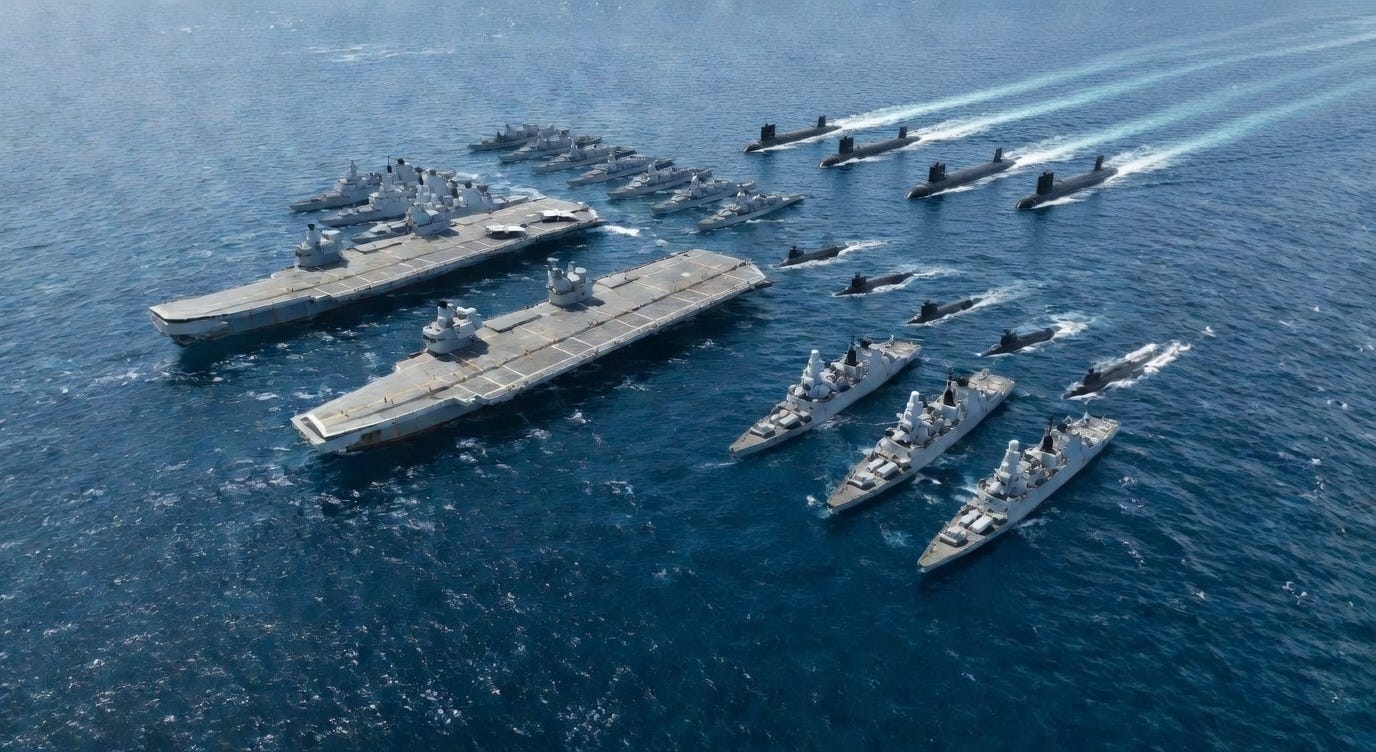
What if they had a war, and nobody could make it? The above image is a visualization of the Royal Navy. The entire Royal Navy, in effective terms.
All but five of these ships have seaworthiness issues, including the air defense destroyer HMS Dragon. Yes, the pride of the surface fleet is a mere destroyer.
Both British carriers put together have roughly the same combat power as one US Navy supercarrier — at a stretch.
The Royal Navy recently impressed the world by putting three nuclear submarines to sea at one time. In general, only one out of three of any ship is available for duty at any given peacetime.
That is, out of every three ships of one kind, one ship will normally be ready for sea, one ship will be in refit and crew training, while another will be undergoing maintenance.
Putting three nuclear subs to sea at one time is supposed to be a demonstration of naval readiness. It is a puny demonstration, though. The United States has enough nuclear submarines to keep more than 20 at sea at any given peacetime, enough for global operations and 24/7 nuclear response.
Britain has let their navy slide, and it shows.
My friends and family sometimes ask my opinion about brewing conflicts, and this one has come up a lot, in recent months.
There are two important questions about the ability of the United Kingdom to fight for the Falklands again, if Argentina should ever try once more to seize possession of las Islas Malvinas, as Argentinians refer to the tiny archipelago in the South Atlantic.
First, will the British people actually fight for them? That is not clear, especially when the Labour government is investigating elite SAS soldiers over allegations from thousands of miles away, over firefights they survived years ago.
Monica Grenfell, a former civil servant who worked at SAS headquarters, told the investigation that soldiers “swear all the time,” which would never be allowed in a civilian workplace. It seems lost on Ms. Grenfell that she was not working in a civilian workplace.

Western societies are disenchanted with their own governments. An October Ipsos poll found that half to two-thirds of Britons are unwilling to take up arms in defense of the country. This majority consists of leftists, feminists, and pacifists who oppose war, as well as members of the political right and center who oppose what Britain has become.
Before he passed away in May, Don Poole, a 102-year-old World War II veteran who served in the British Home Guard and the Royal Army Ordnance Corps in India, told journalist Steven Edginton that “if war was to break out tomorrow, it wouldn't be worth fighting for this country”.
If Argentina attacked again, it is not clear that the British state would have the popular support necessary to sustain a fight for the Falklands, let alone the naval and air power capabilities to defend them.
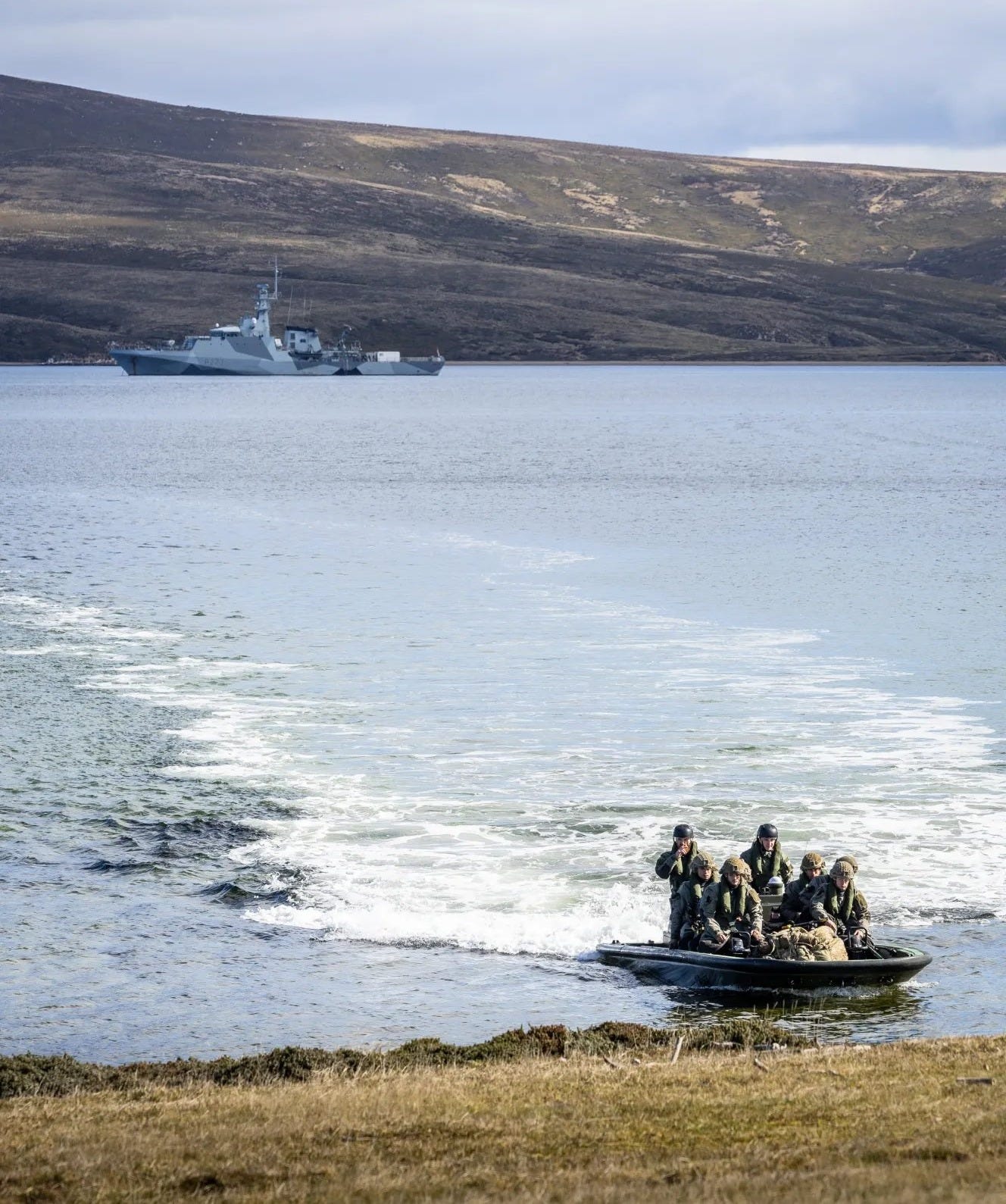
Yet it takes two to tangle, and the Argentinian Navy (AN) is smaller and older than the Royal Navy. Argentina has no active submarines, 3 destroyers built in the 1980s, a few old corvettes with light arms, and zero aircraft carriers.
The most modern surface ships in the AN are four French-built Gorwind-class patrol corvettes. Air defense is limited at best, while sensors are generally old and obsolete, adding up to a police force on the water.
From the perspective of Buenos Aires, the force balance in the air is not any better. One dozen of 24 F-16s that were scheduled for Danish sale to Argentina have been delivered. By contrast, each of the RN’s carriers can host 24 F-35Bs.
The air power gap was a deliberate creation of British policy after the 1982 Falklands War, as the UK used its crucial position in western air power supply chains to embargo the Argentine Air Force.
On or under the sea, and in the air, Argentina is simply outmatched by the relatively puny force that the RN can bring to bear against them. The imbalance makes the probability of this conflict escalating to a shooting war rather remote.
Javier Miliei, the president of Argentina, has made a number of recent statements about Las Malvinas that raised speculation of a renewed historical hostility between his country and the UK.
On Malvinas War Veterans’ Day in April 2025, Milei said that Argentina should become strong enough that the islanders will want to be Argentine instead of British. He mentioned both military and economic decline in criticizing past governments. Such a speech is inseparable from the domestic politics that elected Milei.
In December 2025, Milei clarified that the Argentine claim to the Falklands should be settled diplomatically and floated the idea of a trip to the UK. In his 2026 Malvinas War Veterans’ Day speech, Milei referred to the “legal nature” of the dispute and “diplomatic measures.”
In September 2026, Milei seemed to escalate, insisting the islands are “a national cause for us” and argued against the self-determination of the islanders. He reserved his most ardent criticism for oil development projects in the Sea Lion Field north of the islands.
Most recently, Milei said that “peaceful means” would recover the islands “in accordance with international law.” Argentina has sanctioned the companies developing the Sea Lion Field. While this has raised costs and risks, it has not stopped or even slowed the project down.
The tensions between the UK and Argentina over the Falklands are real enough. National pride and economic jealousy are real enough, but they do not translate into hard power. This war seems unlikely to happen, and it might bore me to tears if it did.
How Activist Lawyers Tried To Destroy The Fighting Spirit Of The US Army With DEI

Of all the branches and specialties in the US Army, the most important target for any ideologue bent on changing America’s armed forces is the Judge Advocate General’s Corps (JAGC). JAGs are the lawyers of the Army. Any soldier being court martialed will have a judge, prosecutor, and defense attorney from the JAGC. Every commander planning a mission or …