

USAF Doubles Down On Electronic Warfare
Asks Congress for ten additional EA-37B Compass Call aircraft
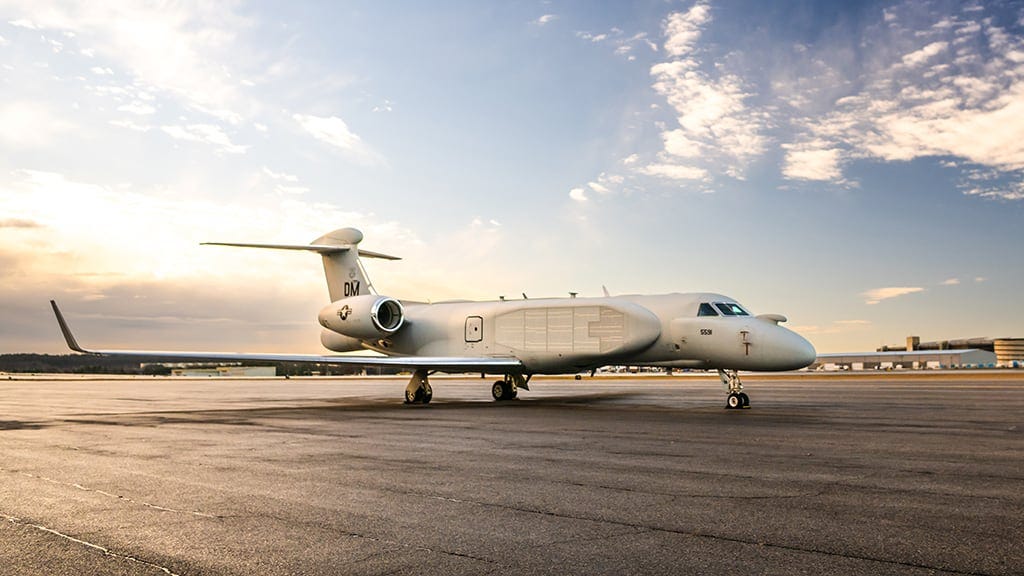
Depending on the source, there were only either 2 or 4 EC-130H Compass Call aircraft still in service on 28 February, when Operation Epic Fury began. These were venerable airplanes that entered service in 1983 and were already near the end of their service lives.
Two of the remaining fleet, possibly all the remaining fleet, were parked at Prince Sultan Air Base in Saudi Arabia at the end of March when an Iranian missile, apparently guided by a Chinese satellite, damaged both.
This marks the end of the career of the EC-130H, as it makes no sense to repair or replace the older aircraft when the successor type is already in service. Although the EA-37B has only been in service for one year, two of them were dispatched to fill in for the damaged aircraft. Apparently, they gave such good service that now the Air Force wants to nearly double their order for the plane.
In documents seen by The Aviationist, the Air Force has requested the final number of EA-37B Compass Call aircraft be increased from 12 jets to 22. “BAE Systems and L3Harris are halfway through delivery of the Air Force’s planned fleet of 10 EA-37B Compass Call planes and expect to deliver the final five in 2027 and 2028” they report.
The new planes can fly at 670 mph (1,078 km/h), much faster than the cruising speed of the EC-130H, which is around 350 mph (536 km/h). They also have nearly three times the fuel range, and they can fly 15,000 feet (4,572 m) higher, which effectively doubles the range of their electronic warfare capabilities.
Based on the more famous Cold War C-130 cargo plane, the previous iteration of Compass Call had dozens of external antenna wires strung from the tailplanes to the fuselage, giving it an ungainly, cobwebbed appearance. The bulging “cheeks” on the fuselage of the new Compass Call will not be winning any aeronautical beauty contests, but the solid-state arrays inside them are far advanced from the old system.
“Clearly, one of the biggest challenges to cross-decking Compass Call from the EC-130H to the much smaller EC-37B platform was reducing the size of the systems and its on-aircraft support requirements,” John Haystead writes in the February 2023 Journal of Electromagnetic Dominance. “Given that the current platform is itself packed full of equipment, this was a substantial undertaking.”
Automation and an improved interface reduce the workload on the aircrew. Software-defined radio technology and open source architecture have greatly reduced the size, weight, and power (SWAP) requirements of the system, helping to “squeeze” nine tons of equipment down to just four tons. The G550 also produces a lot more electrical power than the propeller-driven EC-130H did.
More than 600 civilian G550s are flying around the world, ensuring that spare parts are available to fix them. Air Force officials have estimated that availability for each aircraft will be in the high 90-percent range.
By comparison, during Operation Inherent Resolve, the campaign against the Islamic State, the aging EH-130C was mission-capable only 72 percent of the time in 2015. Altogether, one-quarter of the fleet was always down for maintenance.
Whereas the flight components of the EA-37B can be repaired anywhere as long as the electronics are not damaged, the older Compass Call could only be fixed at Davis-Monthan Air Base. It is therefore unlikely that the damaged planes in Saudi Arabia will ever return home. They will probably be scrapped on site.
Demonstrating the crucial role of electronic warfare in modern combat, the older Compass Call had been in nearly continuous service since 2002, which has worn out the airframes. Having tested its abilities against Iran, the Air Force now wants a lot more of the new Compass Calls than they had before OP Epic Fury. Seldom has any military jet entered service so fast, or proven itself so immediately.
Airborne electronic attack planes are incredibly powerful. They crush enemy communications and air defense radars. By coordinating with other planes, such as the RC-135 Rivet Joint intelligence, surveillance, and reconnaissance (ISR) aircraft, the Compass Call is so effective as a force multiplier that Iran went out of their way to target it. Ironically, they may have just made Air Force EW nearly twice as powerful as it would have been.
The IRGC Has Chosen Death By Strangulation

The cultures of the Middle East value public reputation and perceived dignity (‘face’) over material realities. To admit defeat is to ‘lose face’. In Iran, this concept is called aberu (آبرو, ‘water of the face’). To lose aberu is catastrophic to the individual, their family, and their larger…