

Islam did not experience a straightforward or unified progress. The Abbasid caliphate and its capital Baghdad had existed for over a century, surviving defeats and challenges, when the Zanj rebelled in what is today southern Iraq and southwestern Iran, devastating the imperial plantation economy.
According to al-Tabari, Ali b. Muhammad b. ‘Abd al-Rahim, “the abominable one” who led the great slave rebellion, claimed preternatural powers that rivalled the prophet. “I received surahs of the Qur’an, which I had not learned by heart, and yet I was able to recite them in a flash”, his Ali, “the enemy of God”, declares.1
Angels lent Ali b. Muhammad support. A voice from a thunderclap told Ali to advance on Basra. He had psychic insights into the minds of his companions, saw signs in dogs barking, found divine aid in barges overturning. Perhaps it was an act for an audience. He was a messianic figure to the Zanj, East Africans who were victims of a brutal slave economy in a mosquito-infested region.
The rebels and their leader
The name ‘Zanj’ appears to derive from Persian and Indian words referring to the ‘Country of the Black Man’, namely Zanzibar, the famous slave-trading island on the eastern coast of Africa. Zanzibar had been a slave trading nexus since time immemorial, with the first Arab trading missions arriving soon after the rise of Islam.
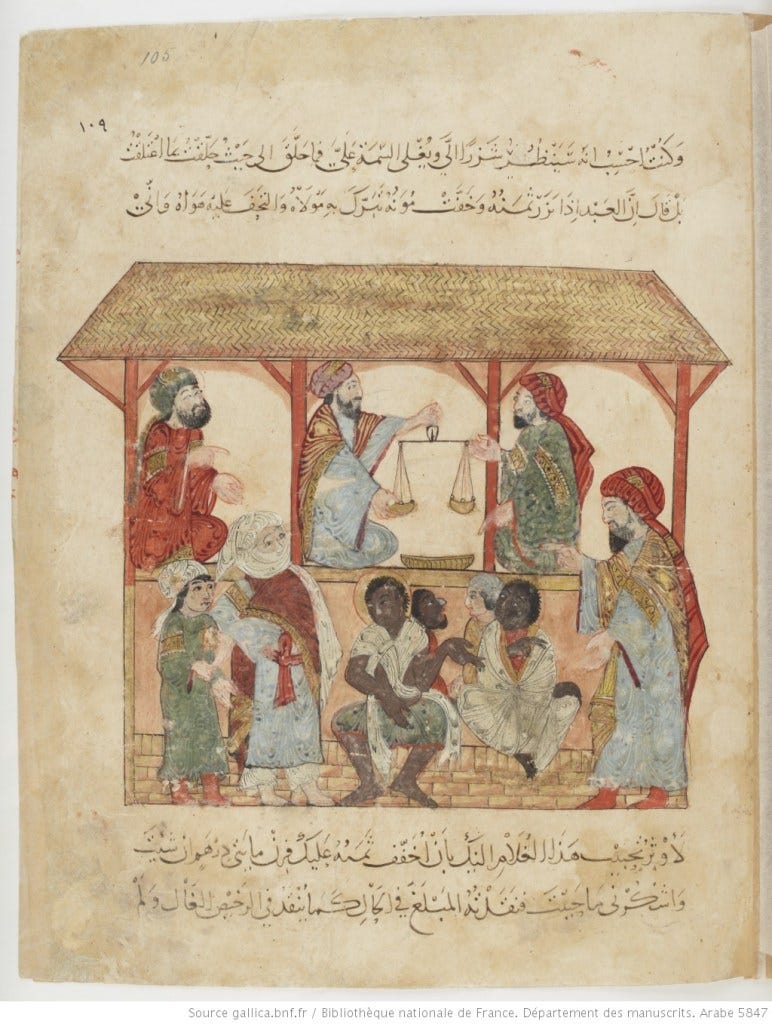
As seen in the above illustration of a market-place, black slavery was normal in the early Arab world. By 869, tens of thousands of Zanj toiled in the nitrate-rich alluvial soils of the region that became the site of rebellion. They were organized into work crews under overseers (wakil) who worked them to death. Ali b. Muhammad first mobilized a few work crews, who killed their overseers, and then set free larger camps of thousands of men at a time.
Al-Tabari writes that the people of the northwestern Persian Gulf region “regarded him as a prophet, so much so indeed that, according to report, taxes were collected in his name. He exercised judicial authority over them, and on his behalf they fought against the supporters of the central authorities.” Dissenters however “were afraid and, becoming embittered against him, caused him to withdraw into the desert.”
Now Ali b. Muhammad had an army, and he would use it to carve out a prophetic kingdom. It would last 14 years, easily defeating the ad hoc caliphal armies sent to destroy it. When the Abbasid Empire solved their other emergencies, and finally sent a competently-led force sufficient to suppress the Zanj rebellion, it ended with mass desertions by former slaves who no longer saw Ali b. Muhammad as a divinely inspired figure.
Alexandre Popovic writes that Ali b. Muhammad was “an ambitious, totally unprincipled man” and “a typical revolutionary: a person of humble descent, an educated man, and one versed in the occult sciences. Having had contact with the greats of his time, he embraced different doctrines and attempted several uprisings before kindling the great Zanj revolt.”2
Military weakness in the Caliphate
The Zanj rebellion was the largest slave rebellion in history. Claiming casualties in the tens or hundreds of thousands, it was also one of the bloodiest. A military analysis of the conflict begins with an understanding of why it took so long for the caliphate to respond effectively.
Historian Hugh Kennedy writes that “we are comparatively well-informed about both organization and personnel” in the last armies of the caliphate, which “represent the culmination of that trend towards professionalization of the military and its separation from the rest of Muslim society” that began with the Umayyads.3 In this context, however, “professional” does not imply free.
A turning point came in 870, the second year of the Zanj rebellion, when Ahmed b. al-Mutawakkil was made the Caliph. His 22-year reign “brought to an end the period of violent unrest” that preceded him, and “there is no record of mutiny or riots over pay. Instead, a moderately effective army was built up and some political credibility was restored to the Caliphate.”
Credit however belongs to his brother Abu Ahmed, known as al-Muwaffaq, and the new military elite in the caliphate, the Turks. All the previous factions within the caliphal armies disappear from the records during this period, replaced by the new dominant group. We know they were first-generation arrivals from Central Asia because they mostly have single names in the records.
The arrangement replaced payment with political power, which may go “some way to explaining how the revenues which had proved so inadequate for the military” under the previous two Caliphs “seem to have been sufficient under al-Muwaffaq.” The empire was broke and unable to afford men who demanded pay.
A second trend was the increased use of ghilman (ind. ghulam), or slave soldiers, from the Arabic word for “youths” or “servants” that is equivalent to the European concept of a knight’s page. Led by the prince al-Muwaffaq himself, the ghilman of Mu’tadad “were the élite force which bore the brunt of the fighting” when the Zanj rebellion was put down. The empire of the Abbasids could not put down a slave army until they raised their own slave army, which took time.
